

On this page
A flipped classroom swaps the order of a lesson. In the words of one large review, students study instructional material before class and apply this material during class. The lecture becomes a video at home, and class time goes to problems with the teacher.
The studies suggest the flip on its own does little. What matters is how you use the class time it frees up.
Does the flipped classroom actually work?
On average, a little. The largest review we cite is by Torstein Låg and Rannveig Grøm Sæle, published in AERA Open in 2019.
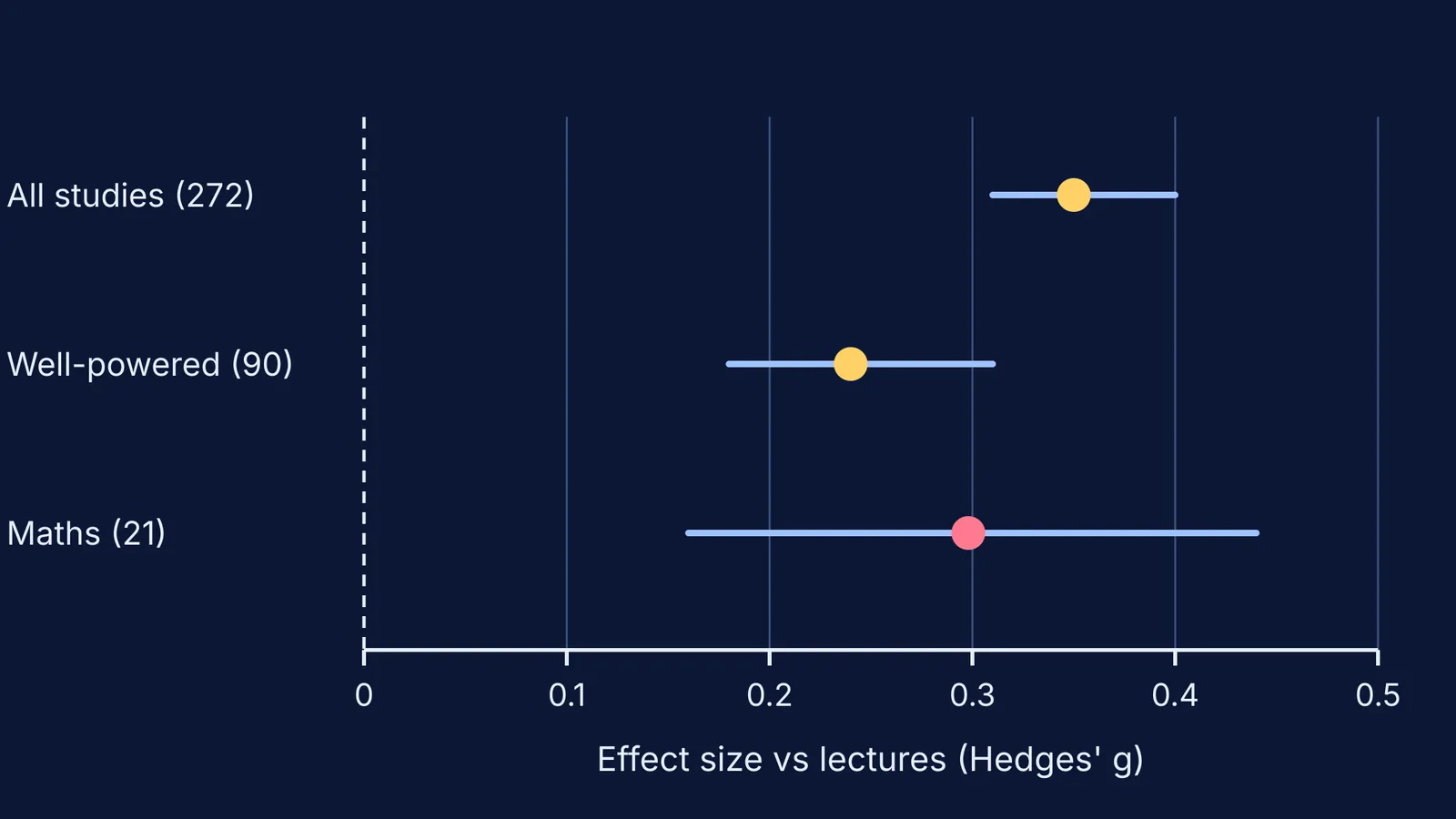
Across 272 comparisons with lecture-based teaching, flipped classes did better on learning, with a small effect of Hedges' g = 0.35 (Låg and Sæle, 2019).
When the authors kept only the 90 studies with enough statistical power, the estimate fell to g = 0.24 (same study).
Effects on pass rates and satisfaction were also small and, the authors write, likely influenced by publication bias (positive results get published more often).
Hedges' g measures the gap between two groups in standard deviations, so 0.24 means the average flipped student scored about a quarter of a standard deviation above the average lecture student. Real, but not a transformation.
A second meta-analysis, by David van Alten and colleagues, pooled 114 studies of secondary and university classes. It also found a small positive effect on learning, no effect on satisfaction, and "considerable heterogeneity between studies": some flips worked well and others did not.
What did studies in maths classrooms find?
Chung Kwan Lo, Khe Foon Hew and Gaowei Chen reviewed flipped maths classes in schools and universities where students watched videos before class (Educational Research Review, 2017).
A meta-analysis of 21 comparison studies favoured the flipped class, with g = 0.298 and no evidence of publication bias.
A wider synthesis of 61 studies found three ways flipping helped: more class time for practice, linking new ideas to what students already believed, and feedback in real time.
The two most common problems were students being unfamiliar with flipped learning and the heavy start-up effort for teachers.
A rarer kind of evidence is a randomised trial. Elizabeth Setren and colleagues ran one at the US Military Academy at West Point (Education Finance and Policy, 2021). Flipping produced short-term gains in maths and no effect in economics, and the authors found no long-term average effect on learning. It also widened the achievement gap, because the gains came mainly from white, male and higher-achieving students, and that wider gap persisted.
Why do flipped classroom results vary so much?
The moderator analyses point to a few design choices. In the van Alten review, students in flipped classes learned more when face-to-face time was not reduced, or when quizzes were added. Låg and Sæle found some support for a related idea: the benefit may increase slightly if testing student preparation is part of the implementation.
From these findings, we suggest four rules:
Class time stays the same. Flipping is not a way to save teaching hours.
Preparation is checked. A short quiz shows students the video matters and shows you who skipped it.
Class time is practice with feedback. This is the active-learning part, the same ingredient behind the 2014 Freeman meta-analysis of active learning in STEM.
Someone watches who falls behind. Students who skip the video lose the lecture and then struggle in class.
A checklist for teachers before you flip
Before class:
Make each video cover one idea, and say at the start what students should be able to do afterwards.
End with a few quiz questions that count for a small part of the grade.
Offer notes or a downloadable file for students on limited mobile data.
Teach students how to watch: pause, predict the next step, write one question. Our guide on learning from video lectures has a routine you can share.
In class:
Open with the quiz results and reteach the most-missed idea first.
Spend most of the period on problems in pairs while you walk around and listen.
Afterwards:
Talk to students who skip the quiz twice.
Give a short mixed test a few weeks later to see whether the gain lasted.
An example for Class 11 projectile motion: the video derives range and time of flight and ends with three questions. If most students missed time of flight, solve one on the board, then let pairs work graded problems. End with an exit question on a launch from a height.
What should students do if their class is flipped?
Treat the video as homework that counts. Watch it, do the quiz honestly, and bring one question you could not answer.
If a pre-class problem stops you cold, the Fermi Problem Library has worked problems with a step-by-step solver that explains the reasoning rather than printing an answer. If you don't know where to start on a topic, Fermi's AI tutor can work out what you already know and build a plan for the session, so you walk into class ready to practise.


