

On this page
Hold a wire dipped in salt water in a Bunsen flame and it flares yellow-orange. Swap in a potassium salt and the flame turns pale lilac; a copper salt turns it green. You can predict each colour from one idea: electrons can only jump between fixed energy levels.
Why do metals give different flame test colours?
The flame's heat pushes an electron into a higher orbital, and when it falls back it releases the energy difference as light of one particular wavelength; the sizes of those jumps differ from one metal to the next (Chemguide, Jim Clark), so each metal shows its own colours.
A smaller gap means a longer, redder wavelength. You can convert between the two with E (in eV) = 1240 / λ (in nm), which we work through in the quick photon-energy formula E = 1240/λ.
One detail textbooks often describe incorrectly is what actually glows. In a 2025 commentary in the Journal of Chemical Education, Michael A. Duncan of the University of Georgia explains that solvated ions such as Na⁺ and Ca²⁺ have closed-shell configurations like noble gases, with transitions only at extremely high energies (Duncan, 2025). In the hot flame the ion picks up an electron in a gas-phase collision, and the excited neutral atom usually does the glowing. If closed shells feel hazy, revise electron configurations of ions first.
Which flame colour goes with which metal?
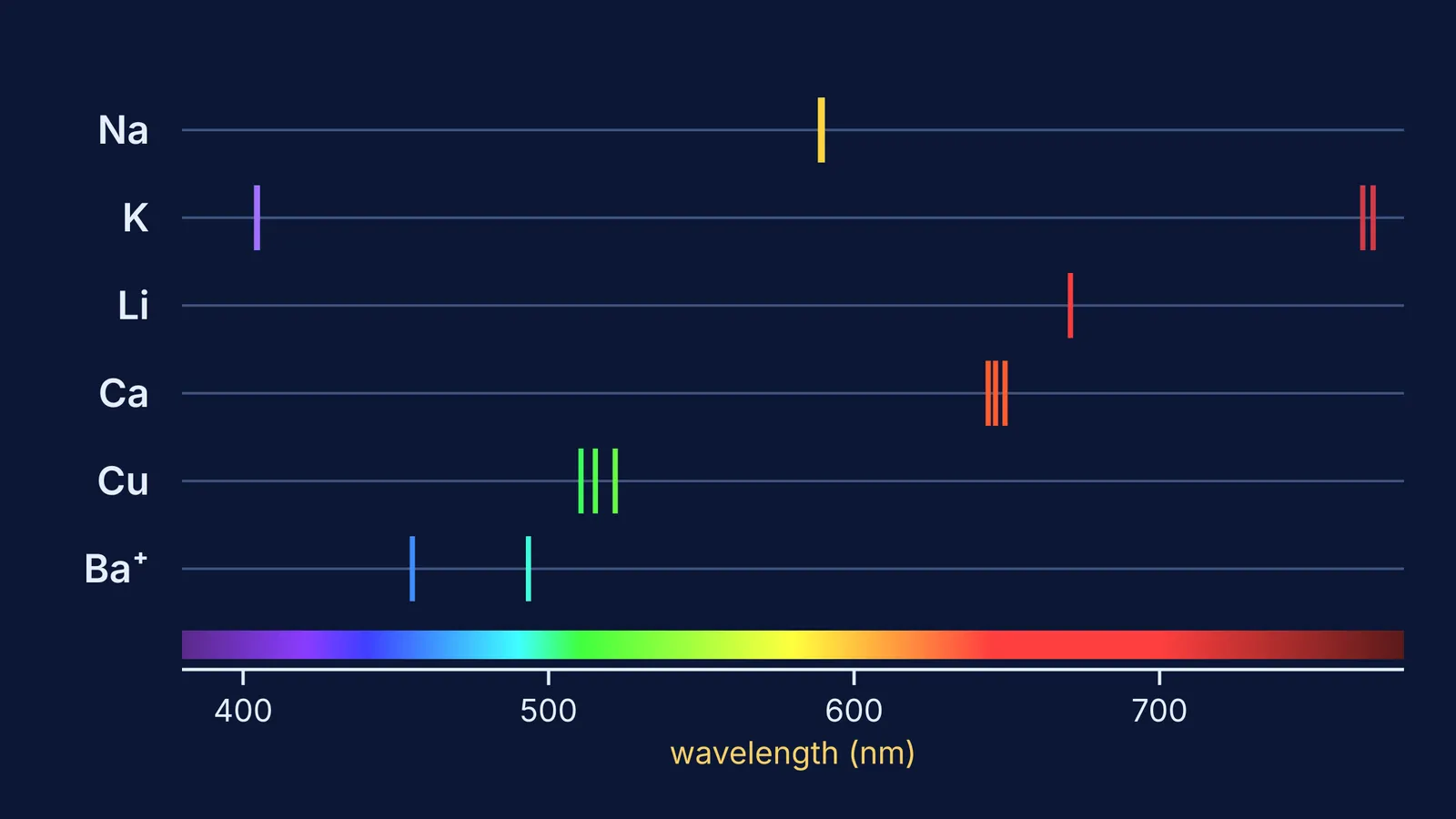
The wavelengths below come from Duncan's table of atomic emission lines and the NIST Handbook of Basic Atomic Spectroscopic Data; each gap in eV is simply 1240 divided by the wavelength. Colour names follow Clark's flame test table on LibreTexts/Descriptive_Chemistry/Elements_Organized_by_Block/1_s-Block_Elements/Group__1%3A_The_Alkali_Metals/2Reactions_of_the_Group_1_Elements/Flame_Tests).
Sodium, strong orange-yellow: lines at 589.0 and 589.6 nm from the 3p → 3s jump, a gap of about 2.10 eV.
Potassium, lilac: its strongest lines are at 766.5 and 769.9 nm (about 1.61 eV), a deep red at the edge of what you can see, and NIST also lists violet potassium lines near 404 nm. Seen together, faint deep red and violet can look lilac.
Lithium, red: one strong line at 670.8 nm, about 1.85 eV.
Calcium, orange-red: atomic lines at 643.9, 646.3 and 649.4 nm, about 1.92 eV. Molecules can join in too: a propane camping-burner spectrometer built by Bastien Néel and colleagues recorded calcium hydroxide bands at 554 and 622 nm (Néel et al., 2014).
Copper, blue-green: lines between about 510 and 522 nm, gaps of about 2.4 eV.
Barium, pale green: the exception to the neutral-atom rule. Duncan notes that barium's atomic lines at 455.4 and 493.4 nm come from the singly charged Ba⁺ ion, not the neutral atom or the Ba²⁺ in solution.
How do you predict the colour from an energy gap?
Suppose a question gives an energy gap of 2.4 eV. Then λ = 1240 / 2.4 ≈ 517 nm: green, matching copper's lines in Duncan's table, not sodium (about 2.1 eV, 589 nm) or lithium (about 1.85 eV, 671 nm). Run it backwards to check yourself: sodium's 589 nm line means a gap of 1240 / 589 ≈ 2.1 eV.
Why can flame tests mislead when metals are mixed?
The biggest trap is sodium. It is a common contaminant, so a little yellow often appears even when your original sample had none (Hope College flame test notes on LibreTexts). And it shows up at tiny amounts: the camping-burner spectrometer detected sodium down to about 3 parts per billion (Néel et al., 2014).
Potassium hides behind sodium. Its lilac is faint and its strongest lines sit at the edge of vision. Blue cobalt glass masks sodium's yellow, which is why the Hope College notes suggest it for potassium.
Three reds look alike. Lithium, strontium and calcium all give reds. Clark advises flaming known samples next to the unknown and comparing them side by side.
People name colours differently. Clark writes that almost everybody sees and describes colours differently; a qualitative analysis chapter on LibreTexts/2%3A_Experimental_techniques/2.6%3A_Flame_test) even labels the copper chloride flame plain blue.
A mixture gives a blend. The colour you see is a combination of every colour in the emission spectrum, as that chapter explains, so two metals can merge into a shade that matches neither.
A five-step checklist for your next flame test
Clean the loop until it gives the flame no colour of its own; the Hope College notes use nichrome for this reason.
Run a blank and a known sodium sample first, so you recognise contamination when you see it.
View the flame through cobalt blue glass whenever you suspect potassium.
Compare any red side by side with known lithium, strontium and calcium samples.
Write down the colour, estimate the wavelength, and convert it to an energy gap with E = 1240 / λ, so the colour and the electron jump stay linked in your notes.
If the jump from energy level to colour still feels abstract, the Fermi Simulation Lab offers interactive simulations for ideas that are easier to see than to read. The Fermi Concept Library gives every chemistry and physics concept its own lesson.


