

On this page
A bag of dice is enough to model a first-order reaction, and you can predict its half-life before the first roll. Change one rule and you get a zero-order reaction that behaves quite differently.
How does a dice simulation model a first-order reaction?
In a first-order reaction, the rate depends on how much of one reactant is left. Each die is a molecule and each round is a time step. A die that shows a six has "reacted" and leaves the game. Every die has the same 1-in-6 chance each round, so 120 dice give about 20 sixes and 60 dice about 10. The number reacting is proportional to the number left: that is first order.
Raymond Chang and John Thoman described a lecture demonstration in which standing students sit down when they flip tails, to show the half-life of a first-order reaction (The Chemical Educator, 2001). Michael Sanger's activity in the Journal of Chemical Education (2003) has students count pennies still heads-up after repeated tosses, and weigh a burning candle, then decide which process is zeroth order and which is first order.
What half-life should you predict before you roll?
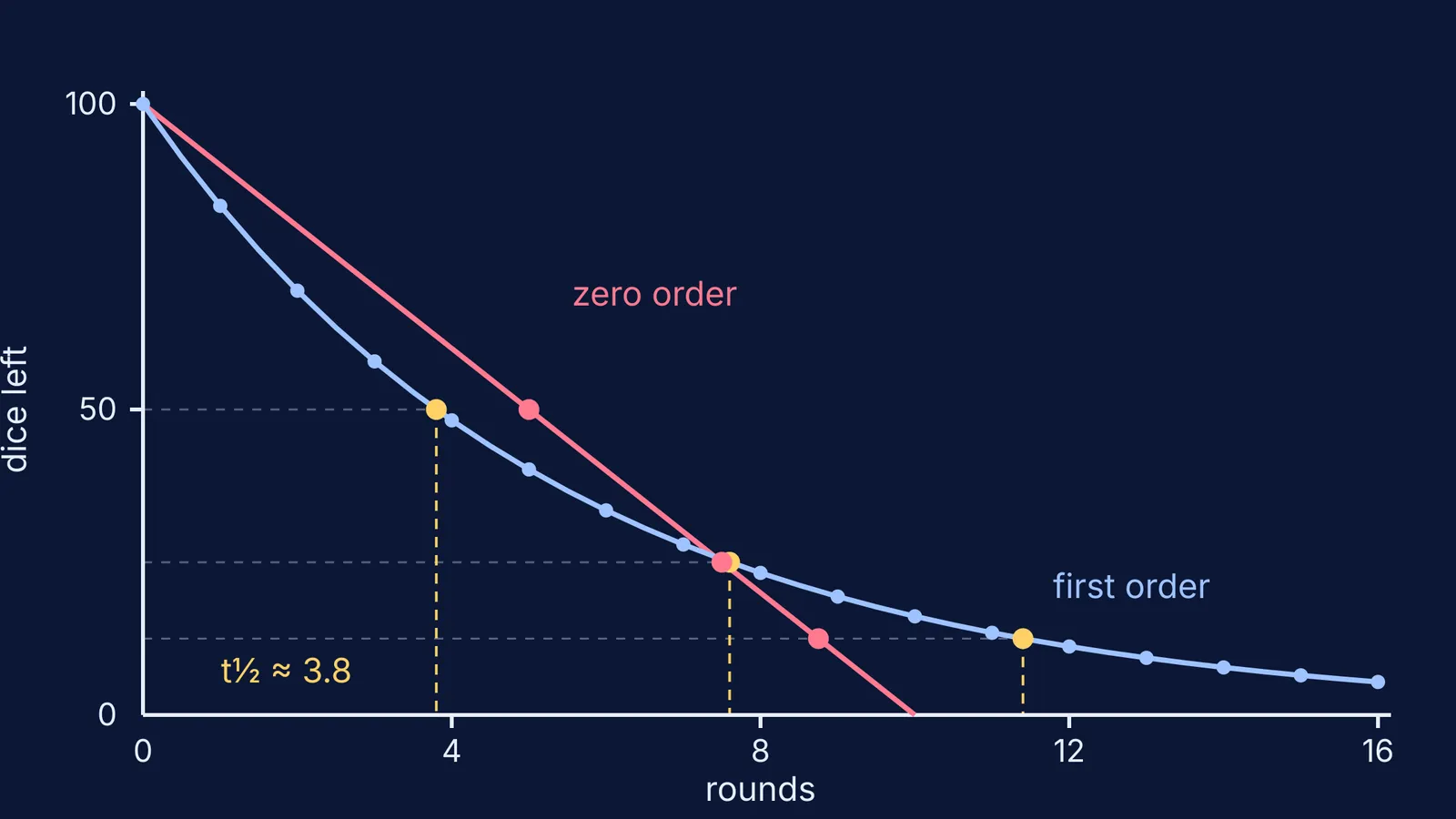
For a first-order reaction, the half-life is t½ = ln 2/k ≈ 0.693/k and does not depend on the starting concentration (LibreTexts Chemistry, Half-lives/Kinetics/02%3A_Reaction_Rates/2.04%3A_Half-lives)). Here is the worked prediction for 100 dice. A die survives a round with probability 5/6, so the expected count after n rounds is 100 × (5/6)^n.
Round 0: 100 dice
Round 1: about 83
Round 2: about 69
Round 3: about 58
Round 4: about 48
Round 8: about 23
Round 12: about 11
To find the half-life, solve (5/6)^t = 1/2. That gives t = ln 2 ÷ ln(6/5) = 0.693 ÷ 0.182, which is about 3.8 rounds. So the rate constant of your dice reaction is k = ln(6/5) ≈ 0.182 per round.
Your prediction is therefore: 100 to 50 in about 3.8 rounds, 50 to 25 in another 3.8, and 25 to about 12 in another 3.8.
A common slip is to use k = 1/6, which predicts about 4.2 rounds. That shortcut only works when the chance per step is small; for dice, use ln(6/5).
How is a zero-order reaction different?
In a zero-order reaction, the rate does not depend on how much reactant is left, and the half-life is t½ = [A]0/2k, so it depends on both the starting amount and k (LibreTexts Chemistry/Kinetics/02%3A_Reaction_Rates/2.04%3A_Half-lives)). To model it, change one rule: remove exactly 10 dice every round, whatever the count.
Now the count falls in a straight line, 100, 90, 80, and hits zero at round 10. The halvings are not equal: 100 to 50 takes 5 rounds, 50 to 25 takes 2.5, and 25 to 12.5 takes 1.25.
That matches the formula. With k = 10 dice per round and 100 dice, t½ = 100 ÷ 20 = 5 rounds.
The graphs give it away: zero order is straight when you plot count against time; first order is straight when you plot ln(count) against time. Our post on reading reaction order from integrated rate law graphs walks through all three orders.
Can you run it with random numbers instead of dice?
Yes, and with far more molecules. In a spreadsheet:
Put 1 (unreacted) in cells A2 to A1001.
In B2, type =IF(AND(A2=1,RAND()>1/6),1,0) and fill it down and across for 20 columns. Each column is one round.
Sum each column to get the count left.
Plot the sums against round number, then plot their natural log.
Change 1/6 to 1/2 and you have Chang and Thoman's coin version: the predicted half-life becomes exactly 1 round. Change it to 1/10 and the same first-order half-life rule/Kinetics/02%3A_Reaction_Rates/2.04%3A_Half-lives) predicts ln 2 ÷ ln(10/9), about 6.6 rounds.
If you would rather watch the curve form than build a sheet, the Fermi Simulation Lab has interactive simulations for ideas that are easier to see than to read.
What should you check in your results?
Use this checklist after a dice or spreadsheet run, comparing your counts with the half-life formulas for each order/Kinetics/02%3A_Reaction_Rates/2.04%3A_Half-lives):
Did you write your predicted half-life down before rolling?
Mark the rounds where the count crosses 50, 25 and 12.5. Are the gaps roughly equal?
Is ln(count) against round close to a straight line, with a slope near -0.18?
For the zero-order rule, is count against round a straight line?
Start again with 60 dice. The first-order half-life should still be about 3.8 rounds; the zero-order half-life should drop to 3 rounds.
That last test shows the key idea: a half-life that stays the same as the reaction runs is the signature of first order. The same maths appears in our guide to radioactive decay and half-life, and the full set of formulas is in our chemical kinetics rate laws walkthrough.
If the idea of order itself is the gap, the Fermi Concept Library gives each chemistry concept its own lesson. Then get the dice out and test your prediction.


