

On this page
It is easy to read a textbook chapter on rotational motion or cell division and feel confident that you understand it. The formulas look familiar, the diagrams make sense, and the summary is clear. But when you sit down to solve a numerical problem or answer an assertion-reason question in a mock exam, your mind goes blank. This is known as the illusion of explanatory depth: recognising a concept is not the same thing as understanding it.
The fastest way to test if you actually know a topic is to explain it out loud from scratch, without looking at your notes. When you have to put your thoughts into full sentences, you instantly spot the steps you skipped and the connections you have not fully grasped.
Why does explaining a concept out loud work?
Cognitive scientists have known about the power of talking through a problem for decades. In 1989, a landmark study by Michelene Chi published in *Cognitive Science* investigated how students learn from worked-out physics examples (Chi, 198990002-5)). The study found that successful learners generated spontaneous self-explanations, talking themselves through the reasoning behind each step rather than just copying formulas. This active processing helped them build a solid mental model that could handle entirely new, unseen questions.
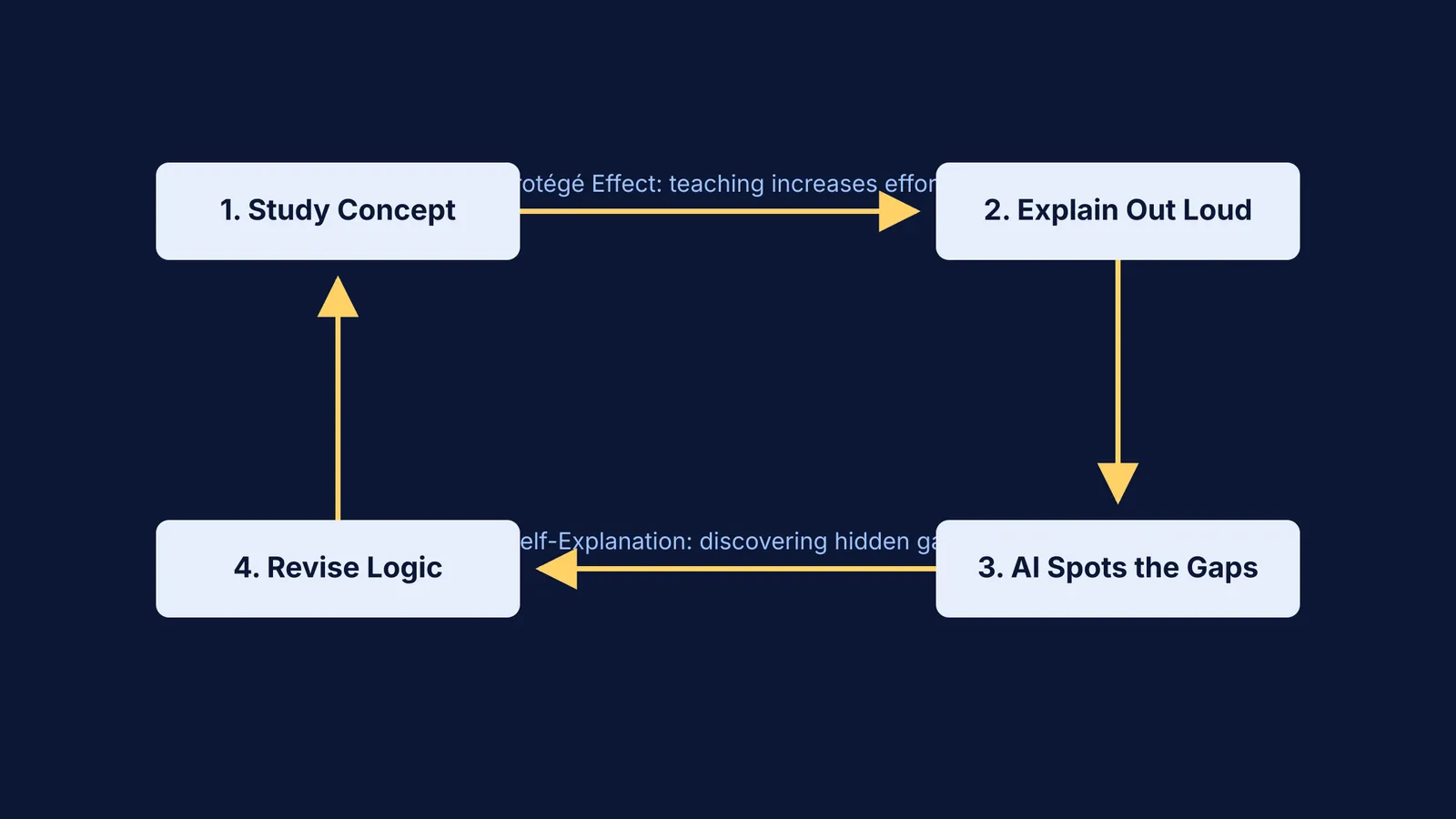
Research also shows that having an audience fundamentally changes how you approach learning. A 2009 study in the *Journal of Science Education and Technology* explored a phenomenon known as the Protégé Effect (Chase et al., 2009). The researchers found that students who were tasked with teaching a digital agent spent more time and effort revising the material than students who were simply studying for their own test. You learn better and persist longer when you feel a sense of responsibility to explain it clearly.
How to explain a concept out loud to AI and get feedback?
You do not need a dedicated study partner to get the benefits of the Protégé Effect. Today, you can use an AI tutor as your student.
When you finish studying a new topic for your JEE Main or NEET-UG preparation, take a few minutes to teach it back to the AI. Instead of typing out a long paragraph, use the voice or microphone feature on your phone or laptop. Speaking out loud forces you to connect your ideas in real-time, at a conversational pace, exactly as you would when teaching a friend at a whiteboard.
When you explain it to Fermi's AI tutor, it notices where you are stuck. The tutor teaches rather than answers: it holds a line of reasoning across a session, works out what you already know, and builds a plan for the session. If you skip a vital step in your explanation, the AI will not just correct you; it will ask a targeted question to help you discover the gap for yourself.
What happens when you make a mistake?
Imagine you are trying to explain why a projectile's horizontal velocity remains constant, but you forget to explicitly state that gravity only acts downwards. A basic search engine would just give you the definition, but there is a vast difference between AI tutors and answer chatbots. A genuine tutor will pause and ask, "What forces are acting on the object horizontally once it leaves the hand?"
This immediate, corrective feedback loop is the foundation of active learning. By reading a textbook alone, you might go weeks without realising you missed that critical detail about forces. But when the AI flags the gap in your verbal explanation, you are forced to stop, think, and fix your mental model on the spot.
What is a script for your next study session?
To get the most out of this technique, you need to establish the rules of the session before you start talking. Open your AI tutor and use a prompt like this to set up the exercise:
Set the role: "I am preparing for my exams and I have just studied the mechanism of human breathing."
Give the instruction: "I am going to explain the process out loud to you. I want you to act as a student who is trying to understand the topic."
Ask for feedback: "Do not give me the full answer. Stop me if I skip a step, use the wrong vocabulary, or if my logic does not make sense. Ask me a question to help me correct it."
Once you send that instruction, press the microphone icon and begin your explanation. If you can explain the concept clearly from start to finish without the AI needing to interrupt you, you are ready to tackle the hardest problems the exam can throw at you.
Try this technique in your next revision session to see how much you actually remember.


