

On this page
A knot with a weight below it and two strings above it is the classic three-force problem in Class 11 physics and JEE Main. The harder skill is knowing, before you calculate, which string pulls harder and what happens when you change an angle. A simulation is the quickest place to build that sense, as long as you predict first and check second.
What does Lami's theorem say?
Lami's theorem relates the sizes of three coplanar, concurrent, non-collinear forces that keep a body in equilibrium to the angles opposite each one (Wikipedia: Lami's theorem). In symbols: A/sin α = B/sin β = C/sin γ, where α is the angle between the other two forces, not next to A. The three angles go all the way round the knot, so they add up to 360°.
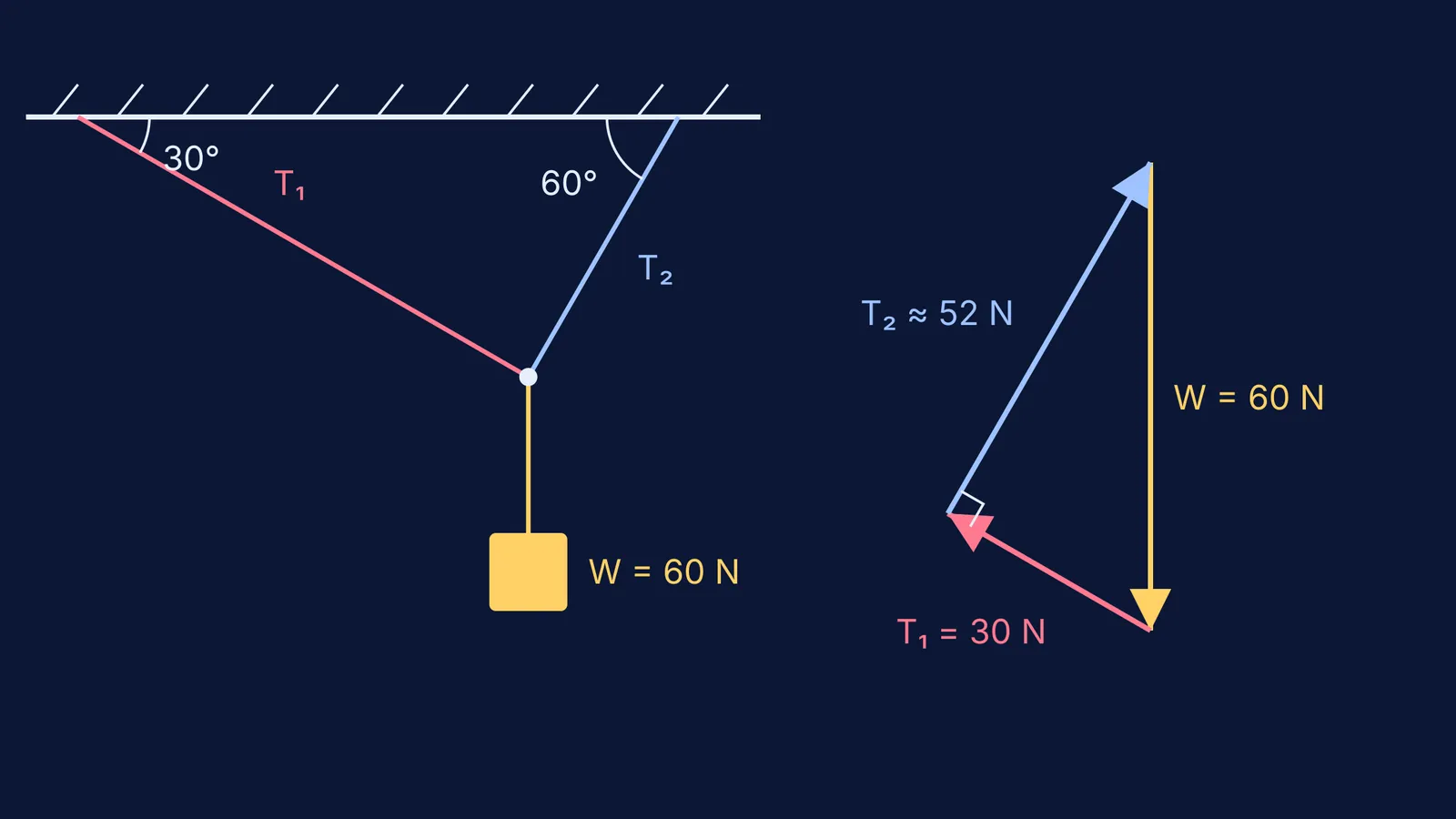
The same idea has a picture. If three forces balance, you can draw them head to tail and they close into a triangle, because their sum is zero. That vector triangle is drawn in the image at the top of this post. The sine rule on that triangle gives you Lami's theorem; you are not learning two methods, just one in two forms. For more on the theorem itself, see our explainer on Lami's theorem for strings and knots.
How do you find the tension in each string?
You can set this example up in any force-balance simulation.
A 60 N weight hangs from a knot. String 1 goes up and left at 30° to the ceiling. String 2 goes up and right at 60° to the ceiling. The third string, from knot to weight, is vertical and pulls down with 60 N.
Find the angles at the knot. Between string 1 and string 2: 90°. Between string 1 and the downward string: 120°. Between string 2 and the downward string: 150°. Check: 90 + 120 + 150 = 360.
Pair each force with the angle opposite it. W is opposite 90°. T1 is opposite 150° (the angle between T2 and W). T2 is opposite 120°.
Apply Lami: T1/sin 150° = T2/sin 120° = 60/sin 90° = 60 N.
Solve: T1 = 60 × 0.5 = 30 N. T2 = 60 × 0.866 ≈ 52 N.
Check sideways balance: T1 cos 30° ≈ 26 N to the left, T2 cos 60° ≈ 26 N to the right. They cancel, so the answer holds.
The steeper string, string 2, carries more of the load. That is the intuition worth keeping: a string close to vertical does most of the lifting.
How do the tensions change when the angle changes?
Now make it symmetric: both strings at the same angle θ from the vertical, holding the same 60 N weight. Balancing the vertical pulls gives each tension as T = W / (2 cos θ). Predict these before you move the slider:
θ = 0° (both strings vertical): 30 N each, half the weight.
θ = 30°: about 34.6 N each.
θ = 60° (strings 120° apart): 60 N each, equal to the weight.
θ = 75°: about 116 N each.
θ = 85°: about 344 N each.
The pattern surprises most people. As the strings flatten out, the tension does not level off; it climbs steeply, because only the vertical part of each pull holds the weight up. If free-body diagrams still feel shaky, start with our five-step method for free-body diagrams.
Why use a simulation for this at all?
In a 2005 study in a large introductory physics course, students who learned circuits with a computer simulation outperformed students who used real bulbs, meters and wires, both on a conceptual survey and on building a real circuit and explaining it (Finkelstein et al., Physical Review Special Topics, Physics Education Research). That study was about circuits, not strings, but the reason carries over: a simulation lets you change one thing at a time and see the result immediately. Our post on what PhET research says simulations are good for goes further into when that helps and when it does not.
A simulation only helps if you commit to a prediction first. Use this routine for each setting:
Sketch the knot and the three forces.
Say out loud which string will pull harder, and why.
Write a number using Lami's theorem.
Run it, and note the gap between your number and the simulation's.
If the gap is large, find the step where your reasoning went wrong before moving on.
You can try this predict-then-check routine with the interactive simulations in the Fermi Simulation Lab, built for ideas that are easier to see than to read. If one setting keeps catching you out, Fermi's AI tutor notices where you are stuck and decides whether to explain, ask or show, so you fix the reasoning rather than just the number.


