

On this page
Most students first meet entropy as "a measure of disorder". That phrase is easy to remember and hard to use. A better way in is to count. Take a handful of coins or a few particles in two boxes, list every way they can be arranged, and see which outcomes have the most ways. That count is the heart of entropy, and you can do it with a pencil in ten minutes.
What is a microstate, and how is it different from a macrostate?
The OpenStax College Physics textbook defines a microstate as "a detailed description of every element of a system", and a macrostate as "an overall property of a system" that does not specify those details (OpenStax College Physics 2e, section 15.7).
With coins, the macrostate is "3 heads, 1 tail". A microstate is the exact sequence, such as HHTH. Many microstates can share one macrostate.
The link to entropy is Boltzmann's equation, S = k ln W, where W is the number of microstates and k is the Boltzmann constant (OpenStax Chemistry 2e, section 16.2). The Boltzmann constant is exactly 1.380 649 × 10^-23 J/K (NIST CODATA). More ways means more entropy. For the person behind the equation, read our profile of Ludwig Boltzmann and statistical mechanics.
How do coins show what entropy measures?
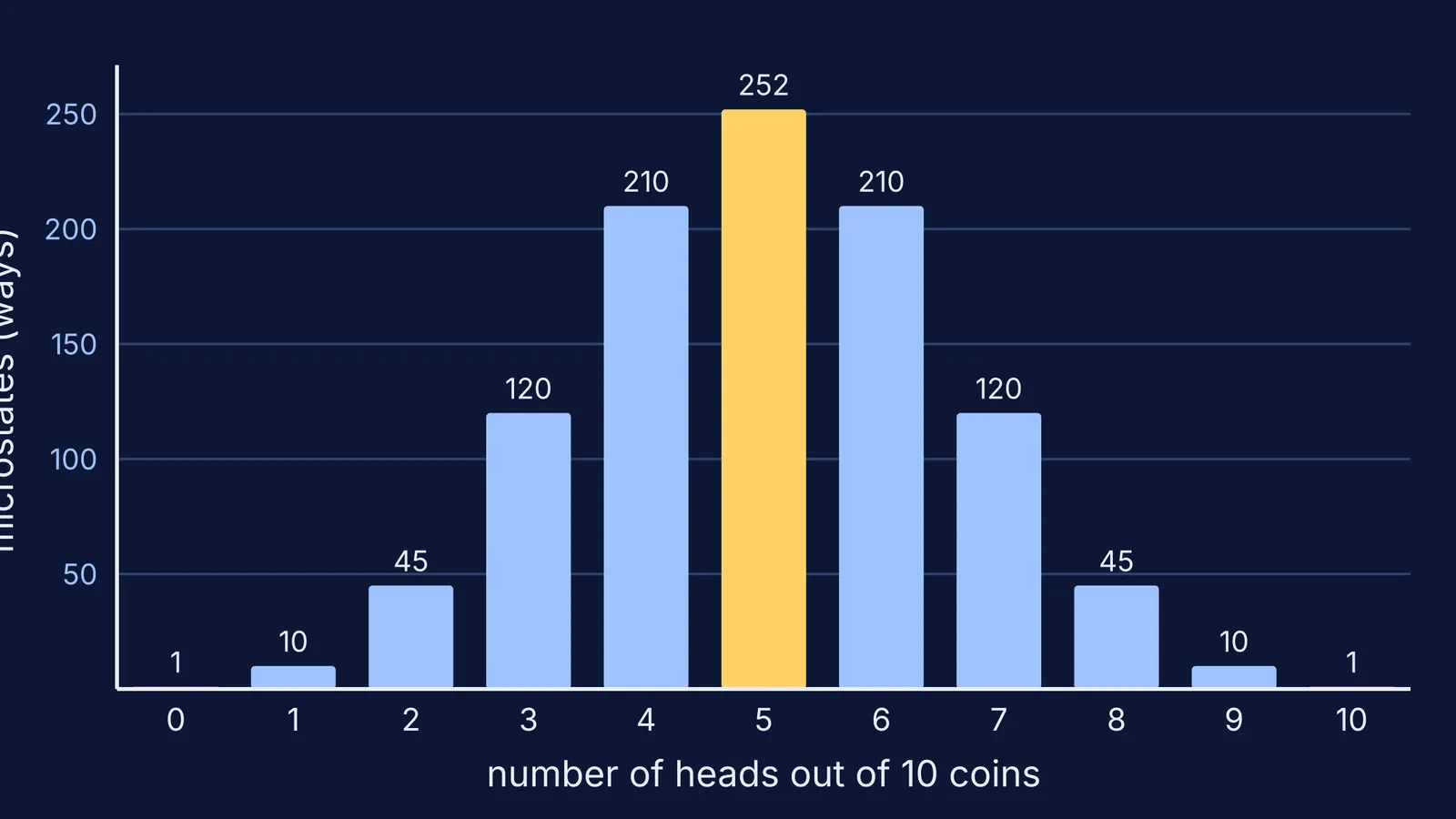
OpenStax College Physics builds its explanation of entropy on this same coin-toss model (OpenStax College Physics 2e, section 15.7). The counts below follow from basic combinations.
Four coins. Each coin has 2 outcomes, so there are 2 × 2 × 2 × 2 = 16 microstates. Group them by number of heads:
0 heads: 1 way (TTTT)
1 head: 4 ways (the head can be any of the four coins)
2 heads: 6 ways (HHTT, HTHT, HTTH, THHT, THTH, TTHH)
3 heads: 4 ways
4 heads: 1 way (HHHH)
The even split is 6 times as likely as all heads. Nothing pushes the coins towards balance; there are simply more ways to be balanced.
Ten coins. Now there are 2^10 = 1,024 microstates. The number of ways to get r heads is 10Cr, the same nCr from your permutations and combinations chapter. Five heads has 252 ways, about 25% of all outcomes. Four, five or six heads together have 672 ways, about 66%. All heads has 1 way, about 0.1%.
A hundred coins. OpenStax gives the numbers: there is 1 way to get 100 heads, 1.0×10^29 ways to get 50 heads and 50 tails, and 1.27×10^30 microstates in total (OpenStax College Physics 2e). The same section works out that, tossing once a second, you would expect all heads or all tails about once in 2×10^22 years.
Why do particles spread out into empty boxes?
Swap coins for gas particles and heads or tails for "left box" or "right box". The maths is identical. OpenStax Chemistry works through four particles in two boxes: 16 microstates, with 6 for the 2-2 split and 1 each for "all in one box", so the even spread has a probability of 6/16, or about 38% (OpenStax Chemistry 2e). The book concludes that "the most probable distribution is therefore the one of greatest entropy."
You can carry this to a real gas. If a gas expands into a vacuum and doubles its volume, each molecule now has two halves to be in, so W is multiplied by 2 for every molecule. For one mole that is 2 raised to Avogadro's number, which is exactly 6.022 140 76 × 10^23 per mole (NIST CODATA). Using S = k ln W, the entropy rises by k × N_A × ln 2, which is R ln 2, about 5.76 J/K per mole. That is the same result you get from the thermodynamic formula in our explainer on free expansion of an ideal gas.
How can you practise counting microstates?
A 20-minute plan for you, or for a parent and child at the dining table:
Toss 4 coins 32 times and tally how many heads each toss gives. Compare your tally with the 1-4-6-4-1 pattern.
Write out all 16 sequences by hand and check that your groups match.
Predict the 10-coin counts with nCr, then toss 10 coins 20 times and see how often you land between 4 and 6 heads.
Rewrite each coin as a particle in a left or right box and explain, in one sentence, why a gas fills its container.
Finish with one board problem from our guide to entropy calculations in chemistry.
Hand tosses get slow beyond a few dozen trials. Particles spreading out is one of those ideas that is easier to see than to read, and the Fermi Simulation Lab has interactive simulations for ideas like that. If the counting itself feels shaky, the Fermi Concept Library has a lesson for each concept in physics, chemistry and mathematics, so you can go back to combinations first.
Start with four coins tonight. Once you have counted the 16 ways yourself, S = k ln W stops being a formula and becomes a tally.


