

On this page
In the famous "elephant toothpaste" demonstration, a squirt of dish soap traps rapidly escaping oxygen gas to create a massive, steaming eruption of foam. The gas is produced by the decomposition of hydrogen peroxide (2H₂O₂ → 2H₂O + O₂), a process sped up by adding a catalyst like potassium iodide or yeast.
While the basic experiment is a classic visual spectacle, changing the ingredients turns it into a rigorous lesson in reaction kinetics. A 2017 study by Hernando et al. in the *Journal of Chemical Education* demonstrated that the speed of the foam eruption can be used to calculate the kinetic parameters of the reactants. They showed that measuring foam volume over time yields an accurate picture of the reaction's progress.
How does catalyst amount affect reaction speed?
A catalyst speeds up a chemical reaction by providing an alternative pathway with a lower activation energy. In the elephant toothpaste reaction, the catalyst (usually the iodide ion, I⁻) takes part in the reaction to form an intermediate, but is regenerated by the end so it is not consumed.
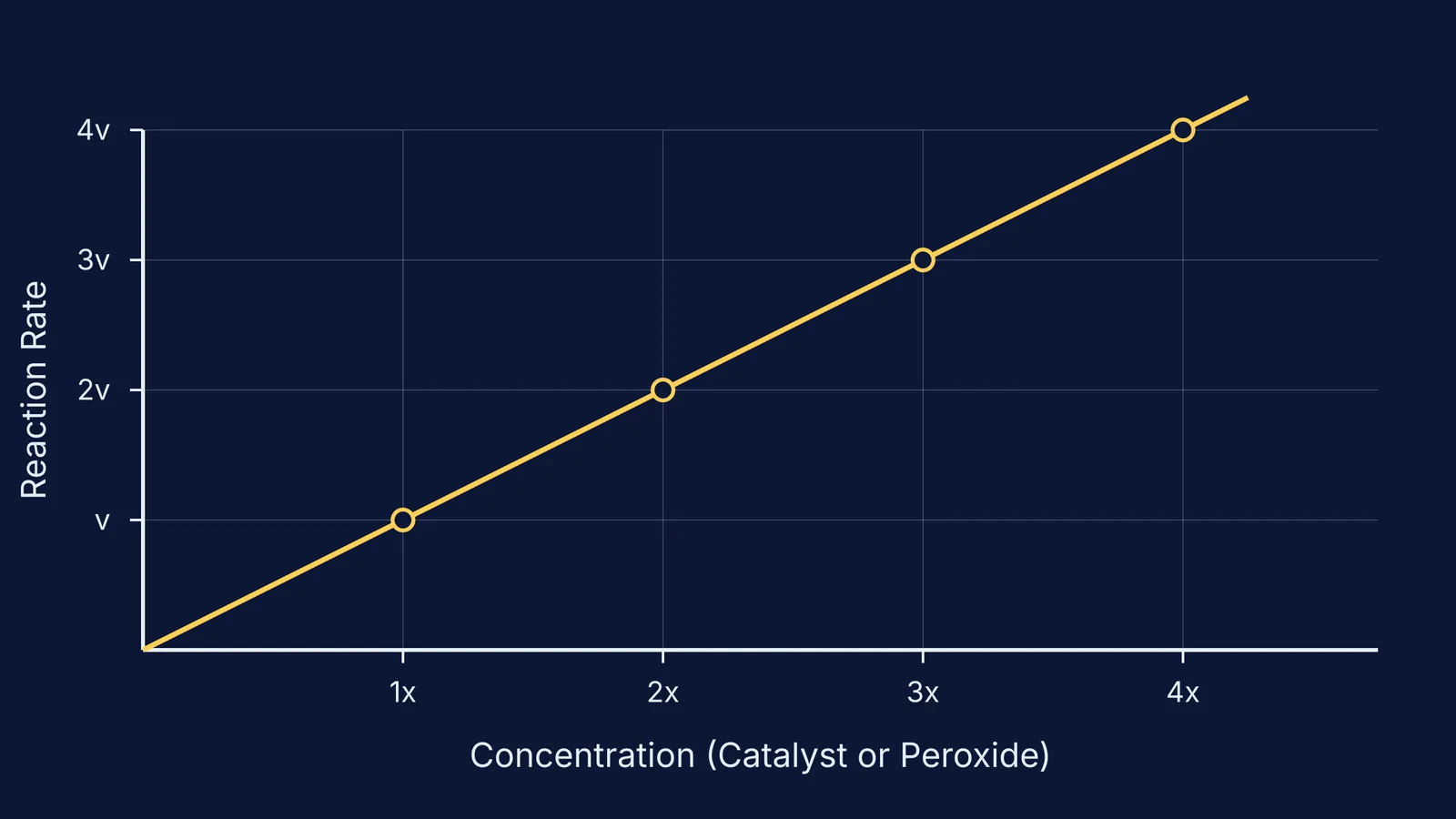
The reaction is "first-order" with respect to the catalyst. As detailed by Eldridge (2015) in the *Journal of Chemical Education*, the overall rate law for the reaction is Rate = k[H₂O₂][I⁻]. The k is the rate constant, which depends heavily on the temperature of the reacting solutions.
Because of this direct mathematical relationship, if you double the amount of potassium iodide you add to the flask, you double the concentration of the I⁻ catalyst. This provides twice as many active sites for the reaction to occur, effectively doubling the speed at which the oxygen gas is produced and the foam shoots upward. (For a deeper look at how rates depend on concentrations, you can study integrated rate law graphs).
How does hydrogen peroxide concentration change the eruption?
The reaction is also first-order with respect to hydrogen peroxide. This means the concentration of the peroxide has the exact same linear effect on the reaction speed as the catalyst does, making it an ideal system for studying kinetics in the lab.
Hernando et al. (2017) confirmed this linear relationship by measuring the rate of foam expansion in a graduated cylinder. They found a strong linear correlation between the volume percentage of hydrogen peroxide and the rate at which the foam expanded upwards.
Standard drugstore hydrogen peroxide is usually a 3% solution, which produces a gentle, slow-moving column of foam. Beauty supply stores sell 6% or 12% solutions, which contain twice or four times as many reactant molecules per unit volume. Because there are more molecules available to collide with the catalyst, these stronger solutions produce foam much faster and more violently, leading to the spectacular eruptions seen in large-scale demonstrations.
How can you test the variables safely at home?
You can test the kinetics described by Eldridge (2015) safely at home using dry active yeast (which contains the biological catalyst catalase) instead of potassium iodide. The yeast provides a safer alternative for observing how concentration changes the speed of oxygen generation.
Test the catalyst: Set up two identical bottles with 50 mL of 3% hydrogen peroxide and a squirt of dish soap. In the first bottle, add 1 teaspoon of yeast dissolved in warm water. In the second, add 2 teaspoons of dissolved yeast. You will see the second bottle erupt much faster because there is twice as much catalyst available.
Test the peroxide: Set up two identical bottles. In the first, use 50 mL of 3% peroxide. In the second, use 50 mL of 6% peroxide (often sold as "20 Volume" hair developer). Add 1 teaspoon of dissolved yeast to both. The 6% solution will erupt significantly faster and produce twice as much total foam since there is twice the starting material.
Temperature also plays a major role; like most reactions, heating the solutions will further increase the rate, a concept known as the temperature coefficient of rate. Warmer water activates the yeast more quickly and speeds up the molecular collisions.
If you want to see exactly how these variables shift the mathematical curves without the messy cleanup, the Fermi Simulation Lab has interactive simulations for the ideas that are easier to see than to read. You can explore how changing concentrations impacts reaction rates in a controlled environment.


