

On this page
You probably know the textbook answer already: more turns, more current, an iron core. The more useful question is which of those changes wins, and by how much. A simulation answers that in minutes, if you commit to a prediction first.
There is evidence that the prediction step matters. In a study of classroom demonstrations, Crouch, Fagen, Callan and Mazur (American Journal of Physics, 2004) found that students who only watched a demonstration understood the concept no better than students who did not see it at all, while students who predicted the outcome first understood it significantly better. A simulation is a demonstration you run yourself: predict, then look.
What decides how strong an electromagnet is?
The field inside a long coil (a solenoid) is B = μ0nI, where n is the number of turns per unit length and I is the current, as set out on HyperPhysics' solenoid page.
The constant μ0, the permeability of free space, is 1.25663706127 × 10⁻⁶ N A⁻² according to NIST's CODATA 2022 value.
Add an iron core and the formula becomes B = μ0knI, where k is the relative permeability of the core; HyperPhysics gives k for magnetic iron as around 200.
So turns and current each scale the field in direct proportion, and the core multiplies both.
How do you run the electromagnet experiment in a simulation?
Use any electromagnet simulation that lets you change the coil and read the field. PhET's free Magnets and Electromagnets is one to try. No iron-core option? Work that one out on paper. Then follow this prediction sheet.
Set a starting coil and note the field reading at one fixed point, ideally the centre of the coil.
Before each change, write your prediction as a multiple of the starting field (for example ×2 or ×1) and one line on why.
Change only one thing at a time.
Measure at the same point every time.
Compare with your prediction. If you were wrong, write which part of B = μ0knI you missed.
Predict these five, in order:
Double the current, same coil.
Double the number of turns, same coil length.
Double the turns by making the coil twice as long.
Swap an air core for an iron core.
With the iron core in, keep raising the current. Does the field keep rising at the same rate?
Worked example: which change matters most?
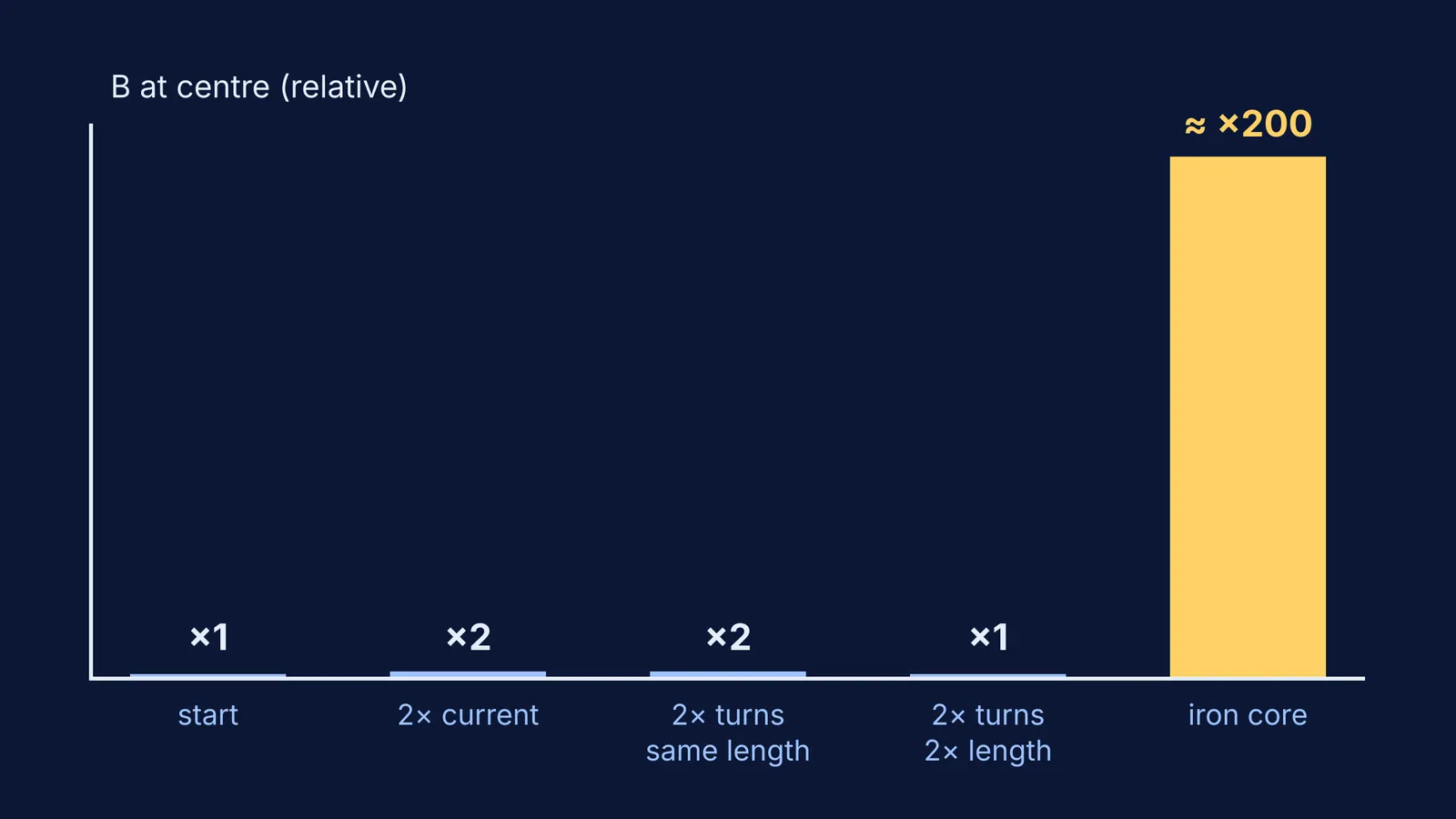
Take a coil with 100 turns wound over 10 cm, so n = 1000 turns per metre, carrying 0.5 A. Using B = μ0nI from HyperPhysics, B = 1.257 × 10⁻⁶ × 1000 × 0.5 ≈ 6.3 × 10⁻⁴ T, or about 0.63 mT.
Current to 1 A: n is unchanged and I doubles, so B ≈ 1.26 mT (×2).
200 turns on the same 10 cm: n doubles, so B ≈ 1.26 mT (×2).
200 turns over 20 cm: n is still 1000 per metre, so B stays ≈ 0.63 mT (×1).
Iron core with k ≈ 200: B ≈ 0.63 × 200 ≈ 126 mT on paper (about ×200).
The core wins by two orders of magnitude.
Why does the iron core win, and when does it stop winning?
The coil's field magnetises the iron, and the iron's own magnetisation adds to the coil's field. HyperPhysics' page on ferromagnetism gives an example where annealed iron reaches about 1 T in an external field of about 0.0002 T, a multiplication by a factor of 5000.
The same page adds the catch: the core reaches saturation magnetisation quickly. Once the iron is saturated, extra current adds little more than the coil's own small μ0nI, so the field-versus-current graph bends over. That is your fifth prediction. Our guide to dia-, para- and ferromagnetism with hysteresis loops explains where saturation sits on the curve.
If relative permeability or turns density still feels shaky, the Fermi Concept Library gives each concept its own lesson and its place in the map.
How can you make a real electromagnet stronger?
The simulation's ranking carries over to a nail-and-wire electromagnet in a school lab:
Use an iron or steel nail as the core rather than a pencil or plastic tube.
Wind the turns closer together so more fit on each centimetre.
Raise the current with care: thin wire heats up, so keep runs short and ask your teacher before adding cells.
Measure the same way each time, for example by counting paper clips lifted from the same spot.
For the history, read how William Sturgeon built an electromagnet you could switch off, and for what research says about learning this way, see what PhET research says interactive physics simulations are good for.
For other ideas that are easier to see than to read, the Fermi Simulation Lab has interactive simulations you can run the same way: predict first, then check.


