

On this page
Electrolysis questions look like memory tests, but they are prediction problems. Know which particles are present and which one takes or gives up electrons most easily, and you can name the product at each electrode; the charge passed tells you how much forms. A simulation lets you switch from molten to aqueous salt and check your guess at once.
Which product forms at each electrode in molten NaCl?
Molten sodium chloride has only two kinds of ions, so there is no contest. The NCERT Class 12 chemistry chapter on electrochemistry says Na⁺ is reduced to sodium metal at the cathode and Cl⁻ is oxidised to chlorine gas at the anode (NCERT, Electrochemistry, section 2.5.1). The same chapter notes that sodium and magnesium are produced industrially by electrolysis of their fused chlorides.
In an electrolytic cell the cathode is negative and the anode positive. Reduction always happens at the cathode, oxidation at the anode.
Why does water win at the cathode in aqueous NaCl?
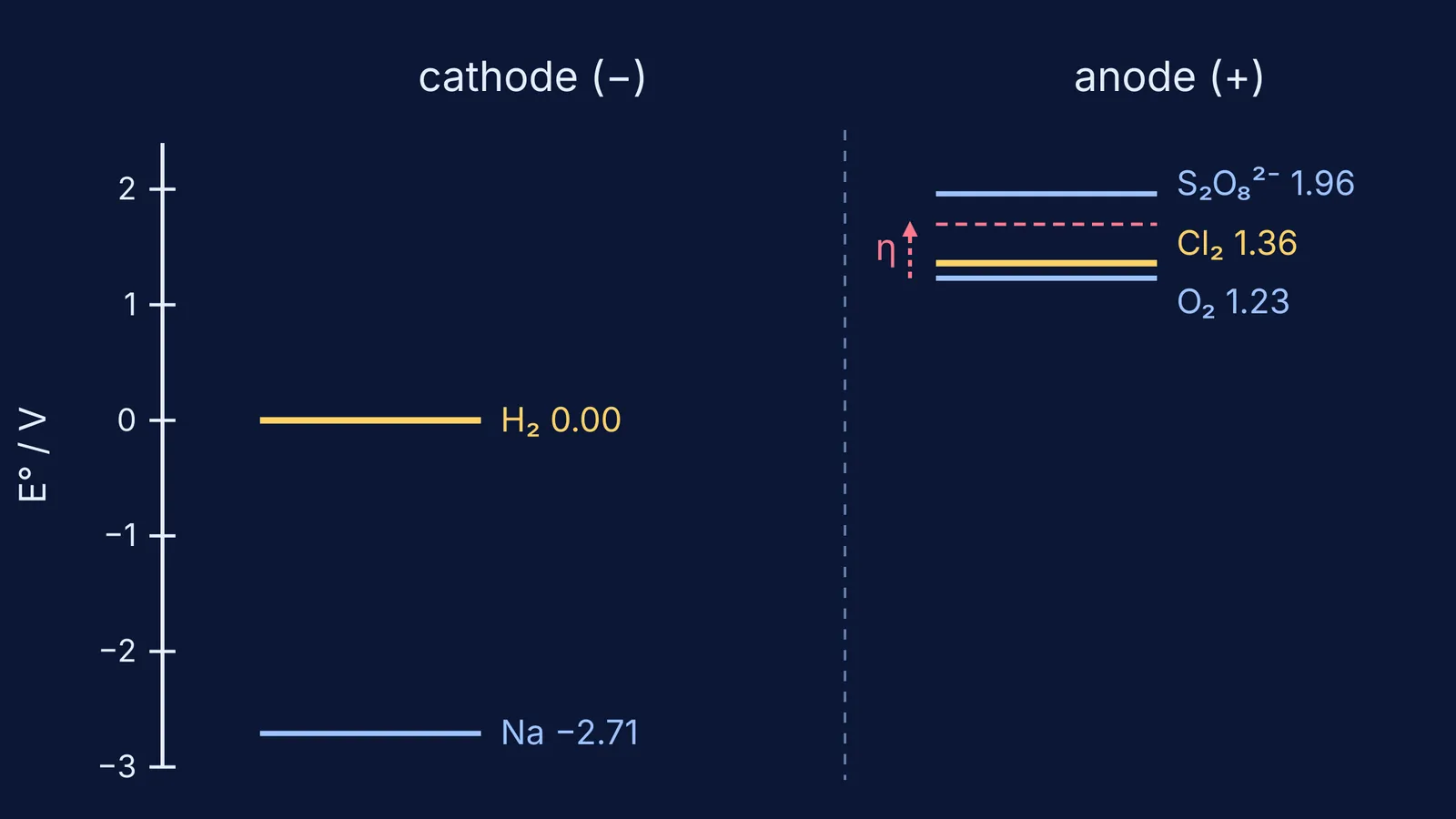
Dissolve the salt in water and a new competitor joins: water, which supplies H⁺ and OH⁻. NCERT gives the two possible cathode reactions with their standard potentials: Na⁺ + e⁻ → Na at −2.71 V, and H⁺ + e⁻ → ½H₂ at 0.00 V (NCERT).
The reduction with the higher E° is preferred, so hydrogen forms and sodium stays in solution as Na⁺. The net cathode reaction is H₂O + e⁻ → ½H₂ + OH⁻, so the overall products are NaOH, Cl₂ and H₂.
Why is chlorine released at the anode instead of oxygen?
NCERT lists the anode options as Cl⁻ → ½Cl₂ at 1.36 V and 2H₂O → O₂ + 4H⁺ + 4e⁻ at 1.23 V, and says the reaction with the lower E° should be preferred, so on paper water should be oxidised first (NCERT).
It is not, because of overpotential: some reactions are so slow that extra voltage must be applied before they go. NCERT concludes that the overpotential of oxygen makes chlorine the anode product.
Concentration matters too: NCERT says dilute sulphuric acid gives oxygen at the anode, but concentrated acid gives peroxodisulphate, S₂O₈²⁻ (1.96 V). So do electrodes: with copper electrodes in copper sulphate, the anode itself dissolves while copper deposits on the cathode, which is how copper is refined.
How do you predict electrolysis products in any simulation?
Use the same five steps every time, before you press run.
List everything present: the cation, the anion, and water if the salt is dissolved.
Check the electrodes. Inert ones (platinum, gold) only pass electrons; a reactive metal anode, such as copper, may be oxidised itself.
Cathode: among the species that can be reduced, pick the one with the higher E°.
Anode: pick the easiest oxidation, then check the known exceptions (chloride in concentrated NaCl, concentrated H₂SO₄).
Write both half-equations and count electrons per particle formed.
Steps 3 and 4 use the same logic as our post on predicting reactions from the electrochemical series.
How does the charge passed set the mass formed?
Faraday's first law says the amount of reaction at an electrode is proportional to the quantity of electricity passed (NCERT). The charge is Q = It, with current in amperes and time in seconds.
One faraday, the charge on one mole of electrons, is exactly 96,485.33212… C mol⁻¹ according to the NIST CODATA value; NCERT rounds it to 96,500 C mol⁻¹ for quick calculations.
NCERT's own worked example: 1.5 A for 10 minutes through CuSO₄ passes 900 C, and since Cu²⁺ needs 2 electrons, 0.2938 g of copper deposits.
Here is a comparison you can test in a simulation. Pass 2.00 A for 965 s, so Q = 1930 C, or 0.0200 mol of electrons (using 96,500 C mol⁻¹). Using standard atomic weights from IUPAC's CIAAW table (Na 22.99, Cl 35.45, H 1.008):
Molten NaCl: 0.0200 mol Na at the cathode, about 0.460 g; 0.0100 mol Cl₂ at the anode, about 0.709 g.
Aqueous NaCl: 0.0100 mol H₂ at the cathode, about 0.020 g; the same 0.709 g of Cl₂ at the anode; and 0.0200 mol of NaOH left in solution.
Same charge, same chlorine, but about 23 times less mass at the cathode, because water won. For more practice, see our walk-through of Faraday's laws of electrolysis.
What should you try in the simulation next?
Run the same current through molten, then aqueous NaCl, and watch the cathode. Try dilute, then concentrated H₂SO₄, and watch the anode. Swap inert electrodes for copper in CuSO₄. Each time, predict the product and the mass before you run it.
The Fermi Simulation Lab has interactive simulations for ideas that are easier to see than to read. For why moving pictures help some topics more than others, read our post on simulations versus static diagrams. If a numerical keeps going wrong, the Fermi Problem Library has a step-by-step solver that explains the reasoning, so you can see which step slipped.


