

On this page
If you use a standard AI chatbot to study, you might notice that it feels like meeting a new teacher every single day. You sit down, open a new chat, and have to explain everything from scratch: what grade you are in, which topic you are studying, and the mistakes you made yesterday.
This happens because standard AI models do not have human-like, long-term memory. Instead, they rely on what engineers call a "context window"—a strictly limited, fixed number of words the AI can process during a single conversation.
Why does a standard AI forget your past chats?
A standard chatbot's memory is tied entirely to your current browser tab. As you chat, the model reads the entire transcript of your conversation over and over again to generate its next response. However, once the conversation grows too long and exceeds the model's context window, the earliest messages drop out of sight. The AI simply stops "seeing" them. When you start a brand new session, the window is completely empty.
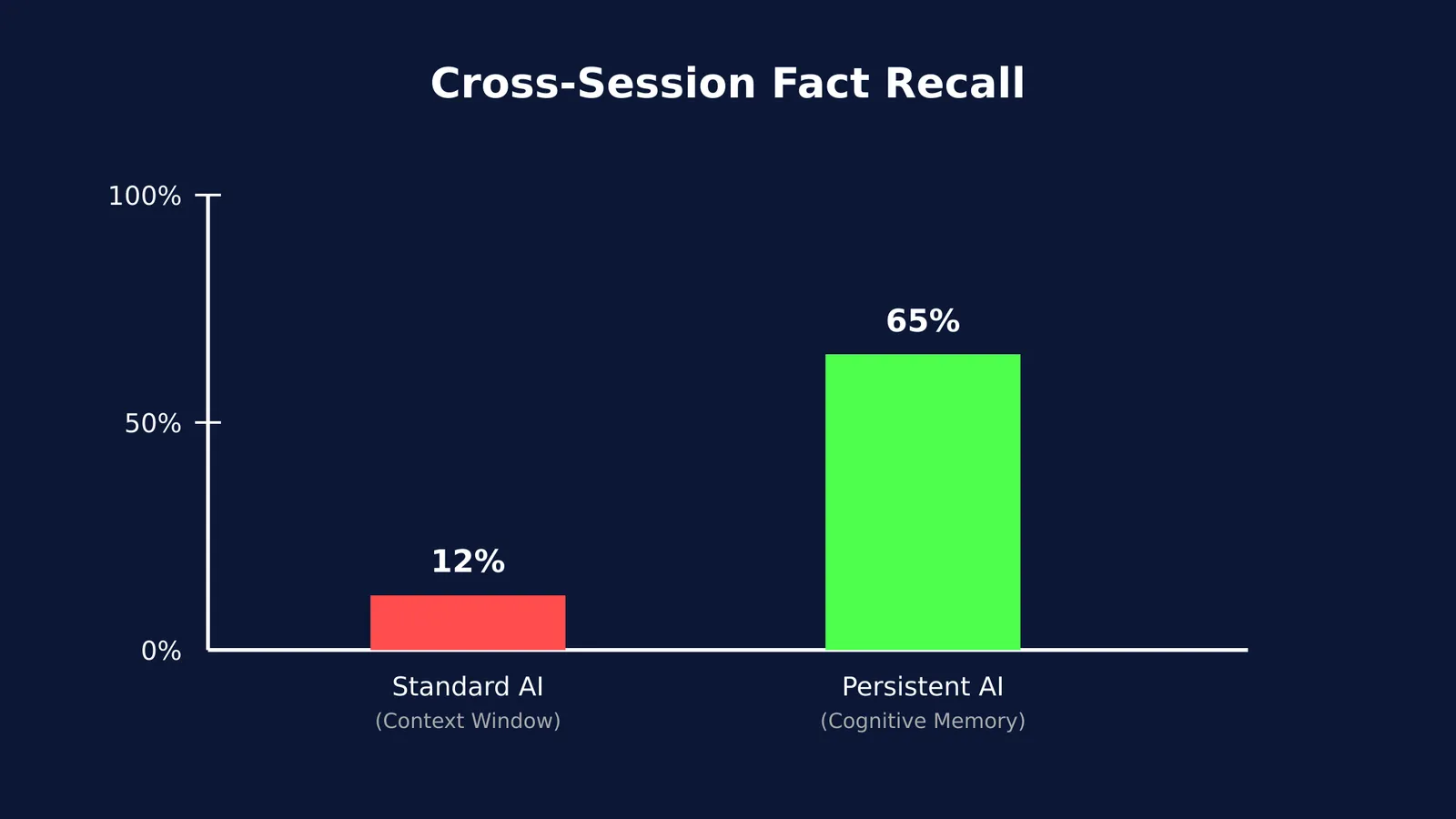
Models relying purely on standard context windows recall only 12% of taught facts across separate sessions, whereas architectures built with persistent cognitive memory reach 65% recall (Kende, 2026). Stuffing an entire chat history into a single window is highly inefficient and quickly hits technical computing limits. Because of this high processing cost, most general-purpose bots wipe the slate clean with every new chat.
How does a learning AI track your progress?
To teach effectively over weeks and months, an AI tutor cannot rely on a single, fragile chat window. Instead of trying to memorize every single word you typed, a dedicated educational AI acts more like a human teacher: it extracts the semantic facts that matter. It records which specific concepts you have mastered, where your reasoning typically breaks down, and what your current learning goal is for the syllabus.
Fermi's AI tutor works out what you already know and builds a plan for the session. When you log in, it retrieves these stored learning states in the background. Progress, notes and everything generated along the way stay in your library, so you sit down to a clear next step rather than a blank prompt.
How do you give a standard AI the right context?
If you are studying with a standard, stateless chatbot, you must manually recreate the context every time you sit down to study. This consistency is essential if you want to know how to build a study routine that lasts longer than a week.
Here is a practical framework to get the best out of each session and prevent the AI from giving generic answers:
Set the role and level: Always state your grade and the exam you are preparing for in your very first message. For example, explicitly say, "I am studying for NEET-UG physics" rather than just asking a physics question.
Remind it of your weak spots: If you know you struggle with certain concepts, state them upfront so the AI can watch out for them. If you tend to confuse sine and cosine in vector components, tell the AI to verify those steps carefully.
Bring your own syllabus: Do not rely on the AI to know the current sequence of your textbook. Paste the specific chapter sub-headings you want to cover today.
Carry over a summary: At the end of your study block, ask the AI for a three-sentence summary of what you just learned and the specific hurdle you overcame. Paste that exact summary into your first prompt the next day to bridge the gap.
Why does teaching require memory?
Most learning tools on the internet are designed to just answer questions. But true teaching requires holding a continuous line of reasoning across a whole session, noticing where a student is stuck, and deciding whether to explain, ask, or show the next step.
This persistence across time is what turns a general chatbot into a personal tutor. In the Fermi Concept Library, your place in the map is saved automatically. The tutor remembers that you finished kinematics last week before you started learning Newton's laws today, allowing it to build on that earlier foundation without needing to be reminded. When the technology handles the context, you can focus all your energy on learning the material.


