

On this page
A DNA replication animation is usually short and looks like a busy factory. It is easy to watch one, nod along, and then be unable to say why the lagging strand lags. The fix is simple: write down five predictions before you press play, then use the animation to check them.
Why predict before you watch an animation?
In a study of an introductory physics course, Crouch, Fagen, Callan and Mazur (2004) found that students who passively watched a demonstration understood the concepts no better than students who did not see it at all. Students who predicted the outcome before seeing it showed significantly greater understanding.
That study used physics demonstrations, not biology videos, but the lesson carries over. A prediction gives your eyes a job. When the animation disagrees with you, you notice, and that surprise is what you remember.
What should you predict in a DNA replication animation?
Write an answer to each of these five questions before watching. The answers below come from the open textbook OpenStax Biology 2e, section 14.4.
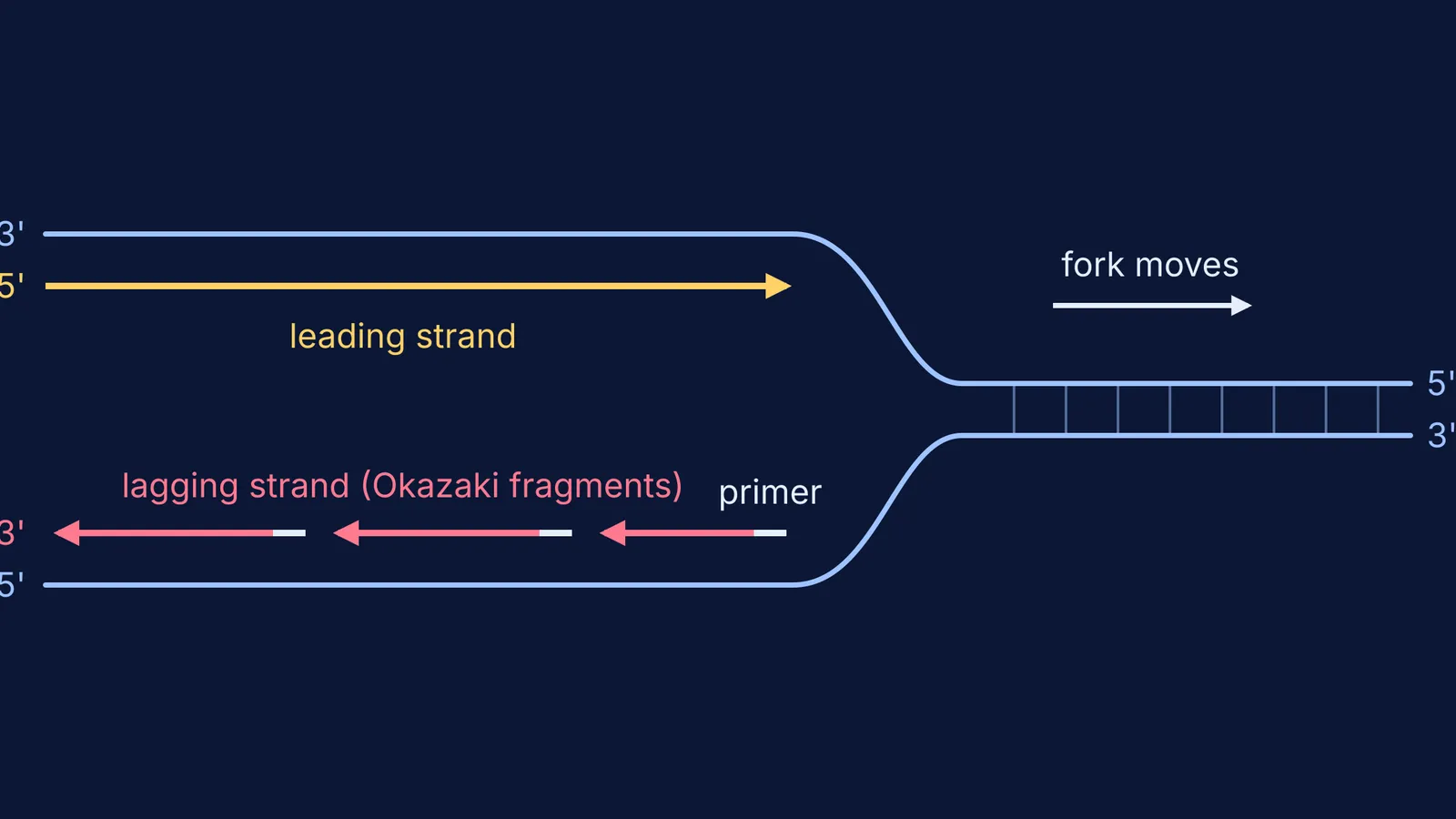
Which way does each new strand grow? DNA polymerase can add nucleotides only in the 5' to 3' direction, so every new strand grows from its 5' end towards its 3' end.
Which new strand is made in one piece? The leading strand, which is made continuously towards the replication fork.
What does the other strand look like? The lagging strand is made in short pieces called Okazaki fragments, each extended away from the fork.
Which enzyme acts where? Write a guess for each: helicase, single-strand binding proteins, topoisomerase, primase, DNA polymerase III, the sliding clamp, DNA polymerase I and DNA ligase.
Why does one strand lag? Try to explain it from answers 1 to 3 before reading on.
Give question 4 the most time: it is easy to mix up which enzyme does which job.
Which enzymes act where at the replication fork?
Use this as your answer key for prediction 4. Each line is from OpenStax Biology 2e, which describes replication in bacteria such as E. coli.
Helicase sits at the fork and unwinds DNA by breaking the hydrogen bonds between base pairs.
Single-strand binding proteins coat the exposed single strands so they do not pair up again.
Topoisomerase works ahead of the fork and stops the double helix from over-winding.
Primase makes an RNA primer about five to ten nucleotides long, because DNA polymerase cannot start a strand from nothing.
DNA polymerase III builds the new DNA, and the sliding clamp holds it on the template.
DNA polymerase I removes the RNA primers and fills the gaps with DNA.
DNA ligase seals the remaining nicks by forming phosphodiester bonds.
In eukaryotes the cast changes. OpenStax section 14.5 names polymerase epsilon on the leading strand, polymerase delta on the lagging strand, and a sliding clamp called PCNA.
Why does the lagging strand lag?
The two template strands run in opposite directions. As the fork opens, one template lets a polymerase follow the fork while building 5' to 3'. The other template is exposed in the wrong direction, so its polymerase must build away from the fork.
Each piece soon runs into the one made before it, while fresh template keeps opening up back at the fork. So the polymerase waits for a stretch to open, gets a new primer, builds back towards the previous fragment, and repeats. Those repeated restarts are why the strand lags.
The pieces are named after Reiji Okazaki and Tsuneko Okazaki, who with colleagues reported them in a classic 1968 PNAS paper. You can read their story in our post on the Okazakis and the fragments of DNA replication, and the enzyme side in Arthur Kornberg and the enzyme that copies DNA.
Fragment size is a good extra check. A 2013 review by Balakrishnan and Bambara gives prokaryotic Okazaki fragments as about 1,200 nucleotides long, with eukaryotic fragments much shorter and set by the spacing of nucleosomes.
How do you check your predictions while watching?
Run the animation three times, with a different job each time.
First pass: watch only the arrowheads on the new strands. Tick prediction 1 if every arrow points 5' to 3'.
Second pass: pause each time a new piece appears on the lagging strand. Does a primer appear first? That checks predictions 3 and 5.
Third pass: name every enzyme out loud as it appears, then compare with your list from prediction 4.
One warning: animations are slowed down so you can see anything at all. OpenStax gives a rate of about 1,000 nucleotides per second in prokaryotes such as E. coli and about 100 nucleotides per second in eukaryotes.
If a step still will not click, try controlling the motion yourself. The Fermi Simulation Lab has interactive simulations for ideas that are easier to see than to read. For the exam side, see DNA replication and transcription compared, point by point.


