

On this page
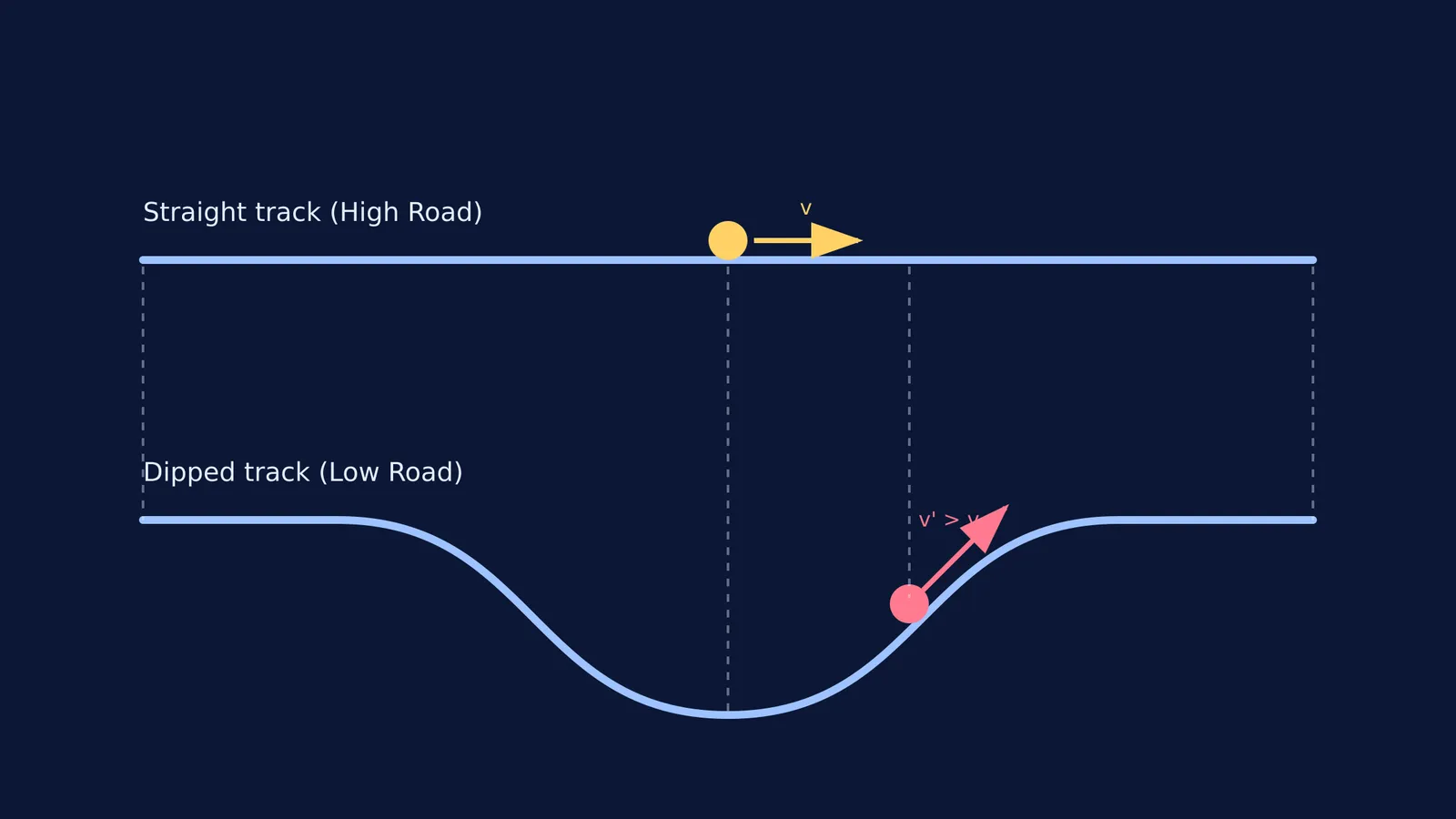
It is one of the most famous and counterintuitive demonstrations in introductory physics. Two identical balls are placed at the start of two tracks of equal horizontal length. The "High Road" is perfectly flat and straight. The "Low Road" drops into a valley and climbs back up, finishing at the same height as the first track. Both balls are released at the exact same time with the same initial push.
If you ask a classroom of students to predict the winner, most will get it wrong. A 2019 study by Dan Hosey published in The Physics Teacher noted that typically only a minority of students correctly predict that the Low Road will finish first. Our intuition tells us that the shortest distance between two points must also be the fastest path.
So, if the straight track is shorter, why does the ball on the dipped track cross the finish line first?
Ball on dipped track vs straight track which wins?
The ball on the dipped track wins the race. The reason comes down to the critical difference between total distance and average speed.
While the straight track offers the shortest physical path, the ball on it travels at a constant, steady velocity (ignoring friction). The ball on the dipped track has a longer physical distance to cover, but it does not travel at a constant speed.
As the ball rolls down into the dip, gravity converts its potential energy into kinetic energy. This causes the ball to rapidly accelerate. By the time it reaches the bottom of the valley, it is travelling significantly faster than the ball on the straight track.
Doesn't the climb slow it down?
Yes, it does. As the ball on the dipped track climbs out of the valley, it trades its kinetic energy back for potential energy. By the time it reaches the finish line—assuming the track returns to its original height—it will have slowed down to exactly the same speed as the ball on the straight track.
However, for the entire duration it spent in the dip, it was travelling much faster than its competitor. This sustained period of high velocity gives the dipped-track ball a higher average speed for the whole journey. This higher average speed more than compensates for the extra length of the track, allowing it to arrive at the finish line "ahead of schedule."
This is a classic problem in kinematics, similar to calculating acceleration given as a function of v or x. If you plot the velocity of both balls over time, the area under the dipped-track ball's curve (the distance covered) grows much faster during the middle section of the race.
Energy vs kinematics: two ways to solve it
If you were to see this problem on a physics exam, you could prove the result mathematically in two different ways:
Using kinematics: If the track is made of straight, angled segments (like a V-shape instead of a smooth U-shape), you can calculate the constant acceleration down the ramp as a = g sin θ. You can then find the velocity at the bottom and use the standard equations of motion to find the total time for the trip. This time will always be strictly less than the time taken to travel the flat horizontal distance at the original speed.
Using energy conservation: By setting up the integral for the time t = ∫ ds / v, where the speed v at any depth y is given by v = √(v₀² + 2gy), you can prove that the larger denominator (the higher speed) in the dip results in a smaller total time. This holds true even when the path length ds is significantly larger than the horizontal distance dx.
These mathematical models confirm what the physical race demonstrates: a high average velocity matters more than a short total distance.
The brachistochrone connection
The High Road vs Low Road race is a simplified version of a famous historical puzzle called the brachistochrone problem (from the Greek *brachistos* for "shortest" and *chronos* for "time"). In 1696, Johann Bernoulli challenged the mathematicians of Europe to find the exact shape of a curve that would carry a frictionless bead between two points in the shortest possible time.
The answer was not a straight line, but a cycloid—the curve traced by a point on the rim of a rolling wheel. A cycloid provides the perfect balance between a steep initial drop for maximum early acceleration and a direct path to the end.
If visualizing these changing velocities is difficult, interactive tools can help. Fermi Simulation Lab has interactive simulations for ideas easier to see than read, letting you race these tracks digitally and tweak the depth and shape of the dip to see exactly how average speed wins out over distance.
How to run the track race yourself
You do not need laboratory equipment to prove this principle. You can build your own High Road / Low Road track at home using simple materials:
Get the tracks: Buy two identical lengths of flexible plastic tubing (like the kind used for plumbing or wire management) and cut them in half lengthways to create open channels.
Set the High Road: Tape one track flat across a long table or a pair of desks.
Set the Low Road: Tape the ends of the second track exactly parallel to the ends of the first track. Let the middle section sag down into a smooth, U-shaped dip.
The race: Use two identical marbles or steel ball bearings. Place a ruler behind them at the starting line and push the ruler forward sharply to give them both the same initial speed.
You can also experiment with timing the race to find the distance in the nth second for each marble, proving that the ball in the dip covers far more ground in the middle seconds of the race.


