

On this page
When you paste an unlabelled differential equation into an AI chat, it usually outputs fifteen lines of calculus immediately. You get the final formula, but you miss the most critical skill tested in CBSE Class 12 and JEE Main: identifying which category the equation belongs to and choosing the right method.
Why does asking AI for full solutions hurt math learning?
Rushing to an AI-generated solution creates an illusion of competence that vanishes during exams. In a 2025 field experiment with nearly 1,000 high school mathematics students published in the Proceedings of the National Academy of Sciences, Hamsa Bastani and colleagues showed that unrestricted AI access led to a 17% drop in exam grades once AI access was removed. In contrast, students using an AI tutor with pedagogical guardrails avoided this penalty. Without guidance, students treat AI as an automatic answer crutch, skipping the vital phase where conceptual understanding forms.
In a 1981 study in Cognitive Science, Michelene Chi, Paul Feltovich, and Robert Glaser found that physics experts classify problems by deep structural principles before calculating, whereas novices fixate on surface details. In calculus, novices see arbitrary terms and guess at integration rules. Experts classify the equation type first.
Most learning tools answer questions. Fermi's AI tutor teaches rather than answers—it holds a line of reasoning across a whole session, notices where a student is stuck, and decides whether to explain, ask or show.
How do you test if a differential equation is separable, homogeneous, or linear?
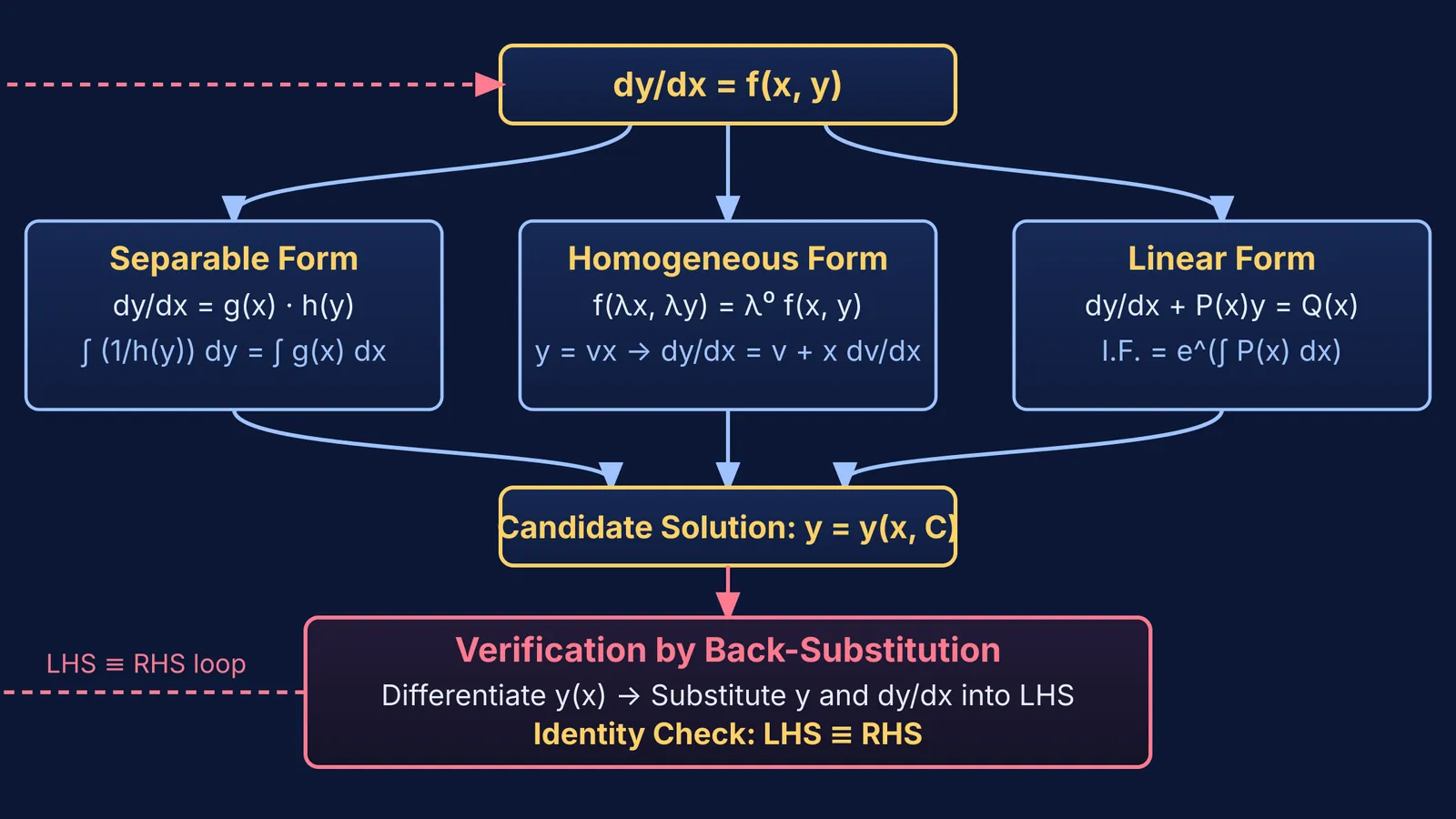
In the CBSE Class 12 mathematics curriculum, first-order ordinary differential equations fall into three primary types. Before attempting to integrate, run through this diagnostic checklist:
Separable variables: Can you rewrite the equation as dy/dx = g(x) · h(y)? If all y terms collect with dy and all x terms with dx, integrate directly: ∫ (1/h(y)) dy = ∫ g(x) dx + C. For how this models rates, see our guide on growth and decay differential equations.
Homogeneous equations: If variables cannot separate, isolate dy/dx = F(x, y). If F(λx, λy) = λ⁰ F(x, y), all terms share the same collective degree. Substitute y = vx, which turns dy/dx into v + x(dv/dx) and reduces to a separable equation. We demonstrate this in our guide to homogeneous differential equations.
Linear equations: Can you express it as dy/dx + P(x)y = Q(x), where P(x) and Q(x) depend only on x? Here y appears only to the first power. Multiply through by the integrating factor e^(∫ P(x) dx). For full derivations, see our guide to linear differential equations.
How should you prompt AI to identify the equation type?
To prevent an AI from spoiling the problem, frame your prompt as a diagnostic query rather than a request for an answer:
"I am studying first-order differential equations for JEE Main. Here is my equation: (x² + y²)dx − 2xy dy = 0. Do not solve this equation yet. First, run the diagnostic tests for separable, homogeneous, and linear forms. Confirm which category it fits, explain why the others fail, and state the substitution I should use."
When you want to see how these forms unfold without guessing, the Fermi Problem Library provides worked problems with a step-by-step solver that explains the reasoning rather than printing an answer.
Why should you make the AI verify the solution by back-substitution?
Language models frequently drop negative signs, mishandle arbitrary constants C, or make algebraic slips. Asking the AI to verify your solution by back-substitution turns error checking into an active learning exercise.
For the equation (x² + y²)dx − 2xy dy = 0, the general solution is:
x² − y² = Cx
Instead of asking if this is correct, prompt the AI:
"My solution is x² − y² = Cx. Do not re-solve the equation. Differentiate this solution implicitly with respect to x, solve for dy/dx, and substitute both y and dy/dx into (x² + y²)dx − 2xy dy = 0 to verify whether the left-hand side reduces identically to zero."
The verification unfolds in five clear steps:
Differentiate implicitly: 2x − 2y(dy/dx) = C.
Isolate the constant: C = (x² − y²)/x.
Substitute C: 2x − 2y(dy/dx) = (x² − y²)/x.
Multiply by x: 2x² − 2xy(dy/dx) = x² − y².
Rearrange: 2xy(dy/dx) = x² + y², restoring dy/dx = (x² + y²)/(2xy).
Closing the loop with back-substitution catches AI hallucinations, reinforces calculus mechanics, and ensures you master the underlying structure instead of leaning on a computational crutch.


