

On this page
If you are playing a board game and your opponent rolls three sixes in a row, you might suspect they are using a loaded die. But human intuition is terrible at judging probability. Randomness is "noisy", and short streaks happen naturally.
To prove a die is physically biased, you have to roll it enough times that the noise cancels out and the true probabilities emerge. In 1894, the biologist W. F. R. Weldon spent months rolling 12 dice 26,306 times to prove that the hollowed-out pips on cheap dice made them land on 5 and 6 more often. In 2009, Zacariah Labby automated the same experiment, rolling dice hundreds of thousands of times with a machine to confirm the exact physical bias.
You do not need to build a machine, but you do need maths. Here is how to predict how many rolls you need, and how to use a simulation to test it.
How many rolls to detect a loaded die?
A perfectly fair six-sided die has a 1 in 6 chance of landing on any face, which is a probability of about 16.7%. Suppose a die is slightly loaded so that it lands on a six 20% of the time. That is a bias of 3.3%.
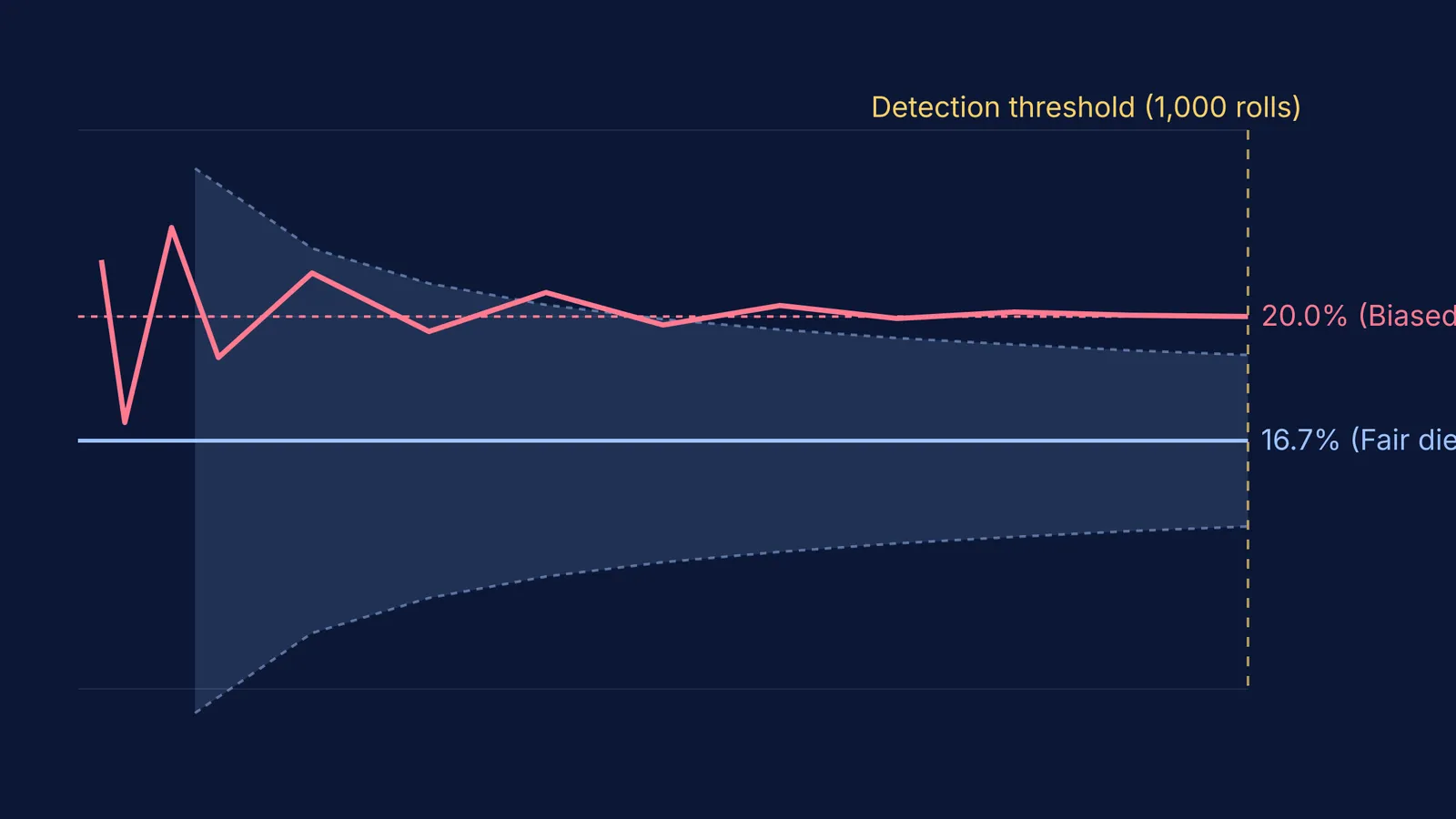
If you roll the die 30 or 50 times, the natural variation (the margin of error) is so large that a fair die could easily mimic a loaded one. The standard statistical formula for sample size determination shows that the margin of error shrinks at the rate of 1/√n. Because of this inverse-square relationship, halving the error requires four times as many rolls.
To achieve a 3% margin of error with 95% confidence, you need a sample size of approximately 1,000. If you only roll the die 100 times, your margin of error remains near 10%, meaning a die would have to be heavily weighted for you to notice. To reliably spot a subtle 3% bias, you must pass the 1,000-roll mark.
How to tell if a die is biased simulation?
Since rolling a die 1,000 times by hand takes hours, you can use a Monte Carlo simulation. A simulation lets you write a short script to mimic the rolls, count the outcomes, and graph the results in seconds.
To set up the simulation:
Define the true probabilities. Give the fair die a 1/6 chance for all faces. Give the biased die a 0.20 chance for face 6, and distribute the remaining 0.80 equally among the other five faces.
Use a random number generator to "roll" both dice thousands of times.
Keep a running tally of the proportion of sixes rolled at each step.
Plot the results on a graph.
When you run this, you will see the graph jumping wildly for the first 100 rolls. As the sample size grows, the lines smooth out. Around 400 rolls, the lines might occasionally cross, but by 1,000 rolls, the simulated loaded die's path will clearly separate from the fair die's margin of error. If you need help visualising probability distributions without writing the code from scratch, the Fermi Simulation Lab lets you run these experiments interactively.
The physical alternative: the saltwater test
If you are about to start a tournament and do not have time to run a statistical test, you can use a physical shortcut. The saltwater test exploits the same physics behind the bias in Weldon's dice: the centre of gravity.
Dissolve large amounts of salt in a glass of warm water until the die floats. Tap the die so it spins in the liquid. A perfectly balanced casino die will stop on random numbers. If the die has a hidden air bubble or missing mass from hollowed pips, the lightest side will consistently float to the top. While this does not calculate precise probabilities like converting odds in favour and odds against, it is a fast way to avoid the kind of analytical errors seen with Abraham Wald and survivorship bias—saving you from judging a die only by the rolls you happen to notice during a game.


