

On this page
Board derivations reward a chain of steps, not just the final formula. Many students revise them by rereading the textbook proof or, now, by asking a chatbot to write it out. Neither makes you produce the steps yourself, and producing them is what the exam tests. Here is a routine that uses AI as a checker rather than a ghostwriter.
Why not just ask AI for the full derivation?
Because reading a finished answer and producing one are different skills. In a field experiment with nearly a thousand high school maths students, published in PNAS in 2025, GPT-4 access during practice raised grades by 48% with a standard ChatGPT-style interface and by 127% with a tutor version designed to safeguard learning (Bastani et al., PNAS).
When access was taken away, students who had used the plain interface scored 17% lower than students who never had it, while the safeguarded tutor largely avoided that drop (Bastani et al., PNAS). The authors write that, without guardrails, students tried to use GPT-4 as a "crutch" during practice.
Memory research points the same way. A meta-analysis of 86 studies found that people remember information they generate better than information they only read, with an average effect size of 0.40 (Bertsch et al., Memory & Cognition, 2007). Writing the missing step is generating. Reading the AI's version is not.
What is a faded derivation skeleton?
A faded worked example is a solution with steps progressively removed, so you move from a complete example to more and more incomplete ones until you solve the problem alone (Renkl, Atkinson, Maier and Staley, 2002). In a field experiment and a lab experiment, fading helped students learn more than pairing a full example with a fresh problem, at least on similar problems, and they made fewer errors along the way (report version abstract). We compare the approaches in worked examples or solving from scratch.
A derivation skeleton applies that idea to one board derivation: the AI gives the starting point, the result and the structure, and leaves the mark-carrying steps blank for you.
How do you practise an NCERT derivation with AI, step by step?
Ask for the skeleton. "Give me the derivation of [result] as numbered steps. Write step 1 and the final line in full. Replace steps 2 to 4 with a blank and a one-line hint. Do not show the missing steps."
Fill the blanks on paper. Close the chat. Write each missing step and, beside it, the assumption or rule you used: uniform acceleration, small-angle approximation, point charge. Set a time limit, as in the exam.
Ask it to check each line. Type in your steps and say: "Check my steps one at a time. For each line, say correct or incorrect and why, without rewriting it. Then list every assumption the derivation needs and tell me which ones I stated and which I left out."
Fix and fade further. Correct mistakes yourself. Next time, ask for more blanks, until only the starting point and result are given.
What does this look like for a real derivation?
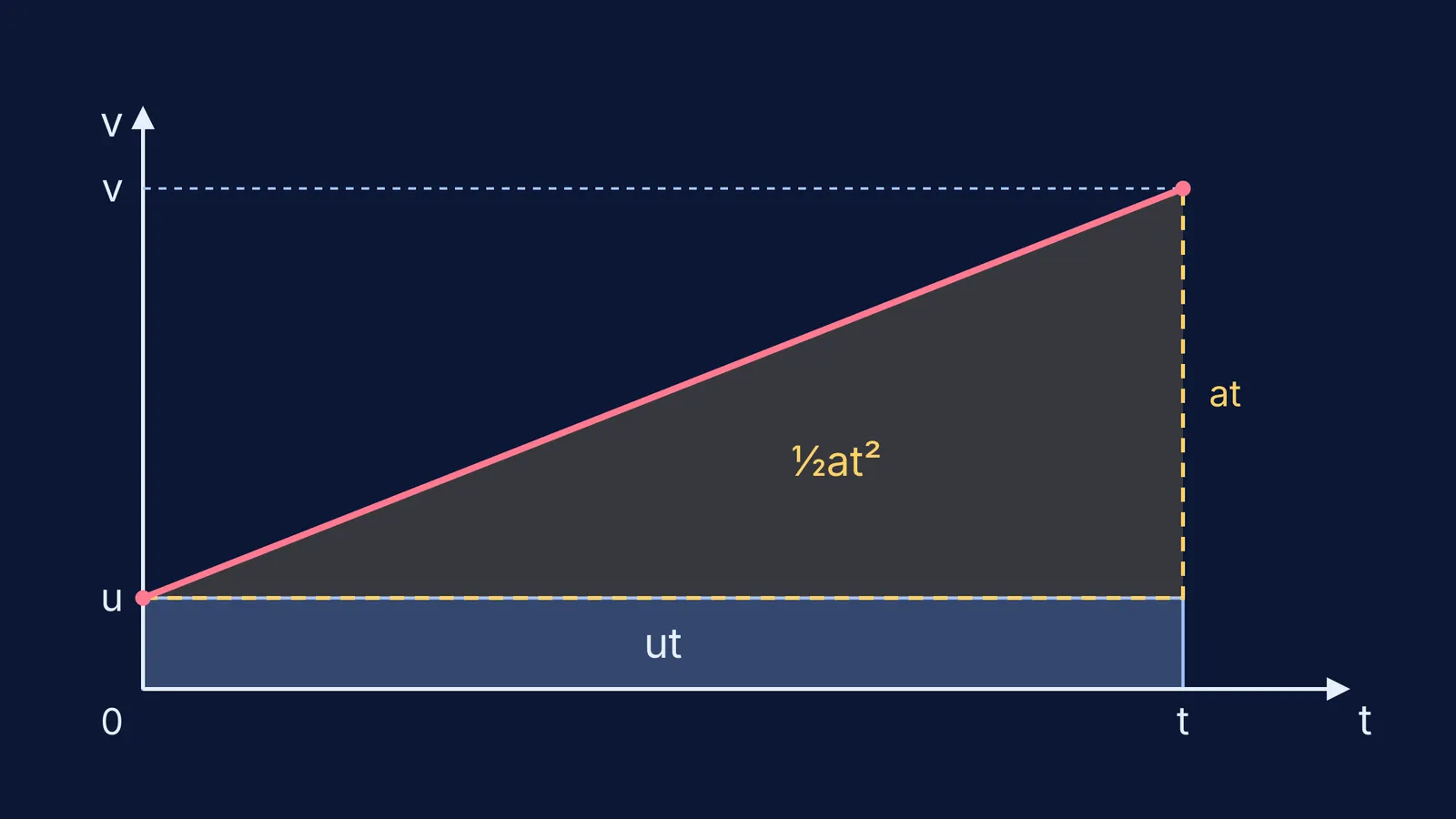
Take the second equation of motion, s = ut + ½at², from a velocity–time graph. A skeleton might read:
Step 1: For uniform acceleration, the v–t graph is a straight line from u at t = 0 to v at time t.
Step 2: blank (hint: what does the area under a v–t graph represent?)
Step 3: blank (hint: split that area into two shapes)
Step 4: blank (hint: use the first equation to replace v − u)
Result: s = ut + ½at²
A good attempt fills in: displacement equals the area under the graph; that area is a rectangle of area ut plus a triangle of area ½(v − u)t; since v − u = at, the triangle is ½at². A careful check should also flag assumptions you did not write: acceleration is constant, motion is along a straight line, and timing starts at t = 0. Leaving conditions like these unstated can cost marks.
How do you know the AI's checking is right?
You don't, automatically. Chatbots can make algebra and sign errors, so check any "incorrect" verdict against your NCERT textbook before accepting it; our guide to checking an AI's physics solution shows how. A tool built to teach rather than answer works the same way: Fermi's AI tutor holds a line of reasoning across a session, notices where you are stuck, and decides whether to explain, ask or show. For more practice, the Fermi Problem Library has worked problems with a step-by-step solver that explains the reasoning rather than printing an answer.
Once your steps are solid, lay them out so an examiner can follow them: see how to structure physics derivations for CBSE boards.


