

On this page
Picture a cube of paneer on a chopping board. One straight cut leaves a flat face where the blade went through. What shape is it? That depends on where and at what angle you cut. Predict each shape below before you check it.
What shapes can you get by slicing a cube?
The rule that decides everything: each side of the cut lies on a different face of the cube. A flat plane meets a flat face along one straight line, so the cut has as many sides as the faces it passes through. A cube has six faces, and a plane through the inside crosses at least three. So every cross-section has 3 to 6 sides. The Cut the Cube classification on the University of Luxembourg maths site works through the cases and finds these families:
Triangles, when the plane cuts off one corner and crosses three faces that meet there.
Quadrilaterals: parallelograms (including rectangles, rhombuses and squares) and trapezoids that are not parallelograms.
Pentagons, which always have two pairs of parallel sides.
Hexagons, which always have three pairs of parallel sides.
The parallel sides come from opposite faces: a plane cuts two parallel faces along two parallel lines.
Which shapes are impossible when you slice a cube?
A heptagon or anything with more sides. That would need seven faces, and a cube has six.
A right or obtuse triangle. If the plane meets the three edges at a corner at distances a, b and c, Pythagoras gives squared sides a² + b², b² + c² and c² + a². Any two add up to more than the third, so every angle is acute. The Cut the Cube triangles page proves this and shows the reverse too: every acute triangle, up to similarity, can be cut from a cube.
A regular pentagon. A five-sided cut crosses five faces, so it must include two pairs of opposite faces and therefore two pairs of parallel sides, as the classification states. A regular pentagon has no parallel sides at all.
A regular hexagon and an equilateral triangle are both possible, as the next example shows.
Worked example: slide one plane through the cube
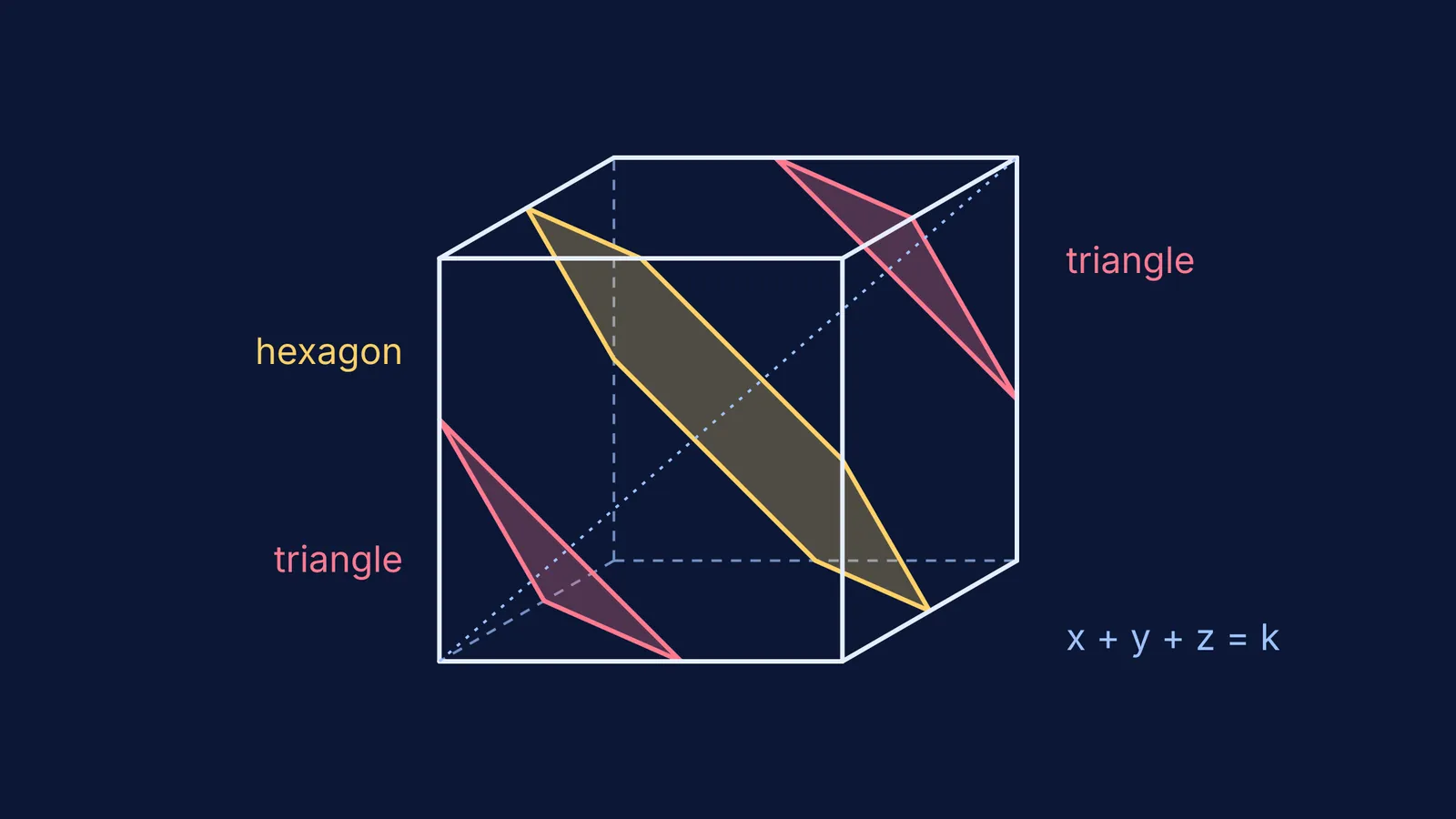
Take a cube with corners at (0, 0, 0) and (1, 1, 1), and slide the plane x + y + z = k from k = 0 to k = 3, along the long diagonal.
0 < k < 1: the plane cuts off the corner at the origin. It meets the three edges at distance k, so you get an equilateral triangle of side k√2.
k = 1: the plane passes through three corners of the cube. It is still an equilateral triangle, now with side √2.
1 < k < 2: the plane crosses all six faces, so you get a hexagon. At k = 1.5 it passes through the midpoints of six edges, and every side is √2/2, about 0.71: a regular hexagon.
2 < k < 3: the hexagon shrinks back to a triangle near the far corner.
This plane never gives a quadrilateral or pentagon. For those, change the tilt.
Square: z = 0.5 is parallel to the top face and gives a unit square.
Rectangle that is not a square: x + z = 1 passes through two opposite edges and gives a rectangle 1 by √2.
Pentagon: x + y + 2z = 2.5 crosses every face except the bottom one. It meets the edges at (0.5, 0, 1), (1, 0, 0.75), (1, 1, 0.25), (0, 1, 0.75) and (0, 0.5, 1), which gives a five-sided cut with two pairs of parallel sides.
To check any plane yourself, put each corner into its equation. The plane crosses exactly the edges that join a corner below k to a corner above k, and counting those edges, plus any corners that lie exactly on the plane, gives the number of sides.
How do you get better at seeing 3D shapes?
Seeing 3D shapes is a skill you can train. A meta-analysis of 217 spatial-training studies by David Uttal and colleagues found an average effect size of 0.47 for training over control. The gains lasted after a delay and carried over to spatial tasks that were not trained. We look at that research in more detail in our post on spatial skills training.
A 10-minute routine for this topic:
Write your prediction (sides, parallel pairs) for each plane above.
Check it by counting crossed edges.
Cut a potato cube along the same plane and compare.
Explain one impossible shape to someone at home in two sentences.
Some ideas are easier to see than to read, and the Fermi Simulation Lab has interactive simulations for them. See also our comparison of simulations and static diagrams, and our guide to 3D geometry for JEE for the plane equations.


