

On this page
Why do you inherit some traits together? When genes sit close to each other on the same chromosome, they are physically linked. If you carry the alleles for tall stems and purple flowers on one chromosome, and dwarf stems and white flowers on its homologue, these traits will usually travel together. Without crossing over, meiosis simply separates the homologous chromosomes. As explained in OpenStax Biology 2e, you end up with just two types of gametes, both identical to the original parental chromosomes (50% each).
How many gamete types does one crossover create?
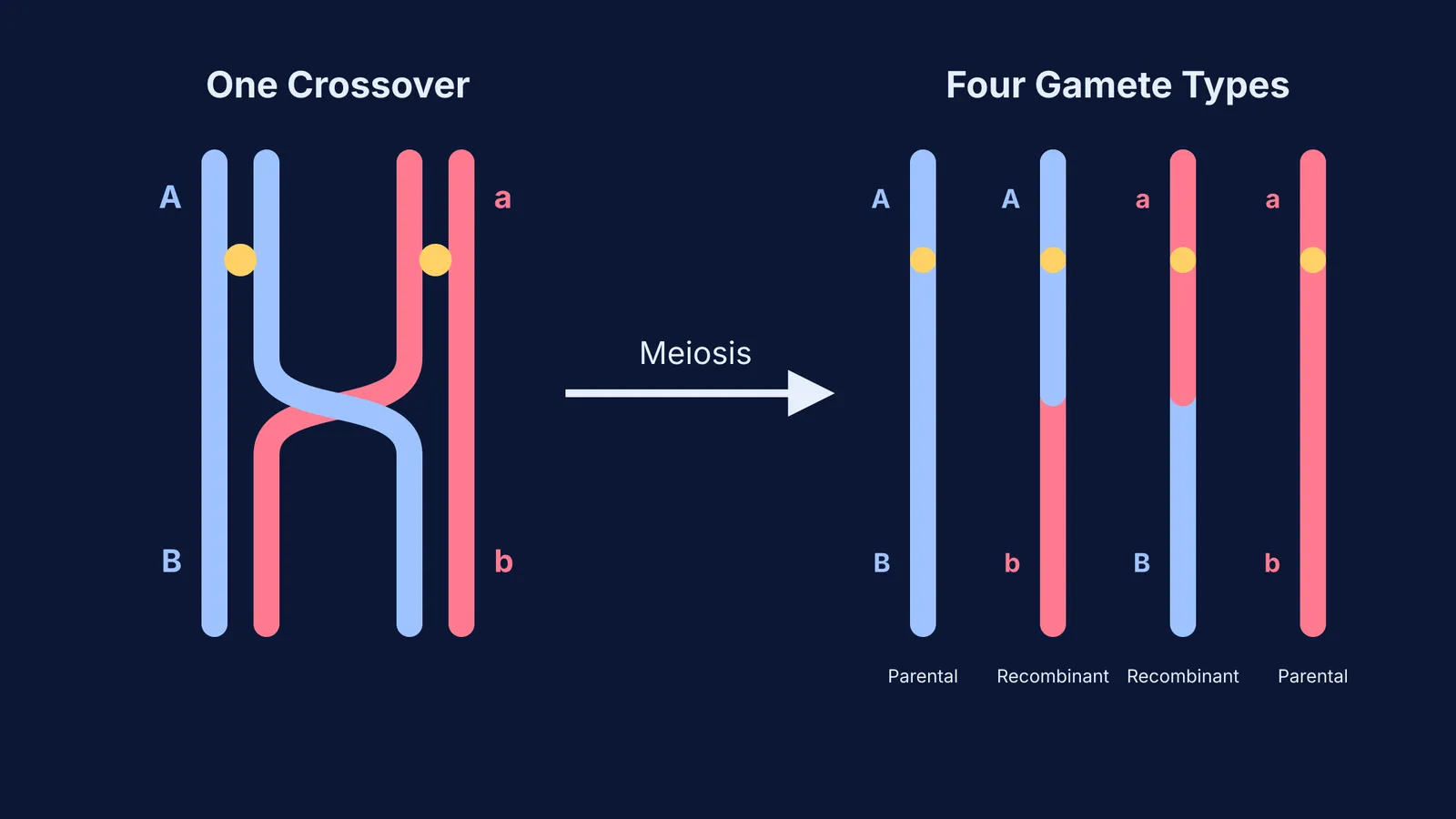
During Prophase I of meiosis, homologous chromosomes pair up to form a tetrad. Because each chromosome replicated during the preceding S phase, the tetrad contains four chromatids in total. In a single crossover event, only two of these non-sister chromatids exchange segments at a point called a chiasma. The other two chromatids remain entirely unchanged and intact on the outside of the tetrad.
Because exactly two out of the four chromatids are altered, one crossover event between two linked genes produces four distinct types of gametes in equal proportions (25% each), according to OpenStax Biology 2e. Once the cell completes its two divisions, you get:
Two parental gametes (50%): These gametes contain the chromatids that did not cross over and remain identical to the original chromosomes.
Two recombinant (nonparental) gametes (50%): These gametes contain the chromatids that swapped genetic material, creating entirely new allele combinations.
How does gene distance affect recombination?
The likelihood of a crossover occurring between two genes depends heavily on their physical distance along the chromosome. If two genes are situated right next to each other, the chances of a chiasma forming precisely between them are exceedingly small. In such cases of tight linkage, the traits remain bundled together across generations.
However, as the physical distance between the two loci increases, there is simply more room for a crossover to happen. The recombination frequency rises proportionally with distance. The maximum possible recombination frequency is 50%, according to OpenStax Biology 2e, which occurs when genes are so far apart that crossing over happens in every meiotic event. At this point, the genes assort independently, mimicking the behaviour of genes located on completely different chromosomes.
Why is crossing over a source of variation?
Breaking the physical linkage between genes is a fundamental driver of genetic variation in sexually reproducing populations. While the parental gametes pass on traits exactly as they were inherited, the recombinant gametes mix maternal and paternal alleles into novel configurations.
This reshuffling mechanism ensures that no two gametes from a single individual are likely to be identical across all chromosomes. When these uniquely shuffled gametes fuse during fertilisation, they produce offspring with new combinations of traits. This means that even siblings inherit a unique mosaic of their grandparents' DNA, providing the raw material for natural selection to act upon in changing environments.
How can you visualise variation with a simulation?
Predicting the gametes on paper is one thing, but seeing the chromatids break and rejoin makes the geometry of variation much clearer. In the Fermi Simulation Lab, you can explore interactive simulations for the ideas that are easier to see than to read.
Tracing the paths of individual alleles through the complex ballet of Prophase I, the alignment at the metaphase plate, and the final separation into four haploid cells provides an intuitive grasp of how inheritance truly works.
If you are reviewing cell division, understanding this mechanism is just the start. You might also want to revise how the 7-celled, 8-nucleate embryo sac forms in plants or look into the mechanisms of RNA processing in eukaryotes to see how genetic information is refined before it is ever translated.


