

On this page
You buy a packet of your favourite snack, and inside is a free collectible card. The packet boldly announces: "Collect all 10 cards to win a prize!" It sounds simple. You might assume that if you buy 10 or perhaps 15 packets, you will complete the set. But as your collection grows, you start getting duplicates. Soon, you have piles of the first nine cards, but that elusive tenth card is nowhere to be found.
This frustrating experience is not bad luck; it is a mathematical certainty. The question of how long it takes to complete a random set is known as the Coupon Collector's Problem, and it is a fascinating entry point into probability theory.
What is the coupon collector's problem?
The Coupon Collector's Problem is a classic puzzle that asks how many random trials you need to collect all distinct items in a set, assuming each item is equally likely to appear. It applies to cereal box toys, promotional cricket cards, and even algorithms in computer science.
According to the Brilliant Math & Science Wiki, the expected number of trials to collect all n distinct items is E[X] = nH_n, where H_n is the n-th harmonic number. The harmonic number is simply the sum of the reciprocals of the first n integers (1 + 1/2 + 1/3 + ... + 1/n).
The variance formula for the problem, Var[X] = n² ∑(1/k²) − nH_n, quantifies the massive spread in outcomes. Because the variance is high, your real-world experience could easily take far more or slightly fewer packets than the mathematical average.
How many packets to collect all cards?
To collect all 10 free cards, you need to buy 29.3 packets on average, calculated directly from the formula provided by the Brilliant Math & Science Wiki. This means you should expect to purchase about 29 to 30 packets before you see every single card in a 10-card set.
If a company increases the set size to 50 cards, the expected number jumps to 225 packets. The growth is not strictly linear; it scales at a rate of n ln(n), meaning the difficulty accelerates as the set gets larger. This is why promotional campaigns use large sets: the cost to the consumer to collect them all vastly outweighs the cost of the prize.
Why is the last card the hardest to find?
When you first start collecting, every card is new. Your probability of getting a new card from your first packet is 10/10, or 100%. Therefore, it takes exactly 1 packet on average to get your first card.
By the time you have 9 cards, there is only 1 missing card left in the pool of 10 possible cards. Your probability of finding that specific card in any given packet drops to 1/10 (or 10%). Because the probability is 1/10, the expected number of packets you must buy just to find that single final card is 10.
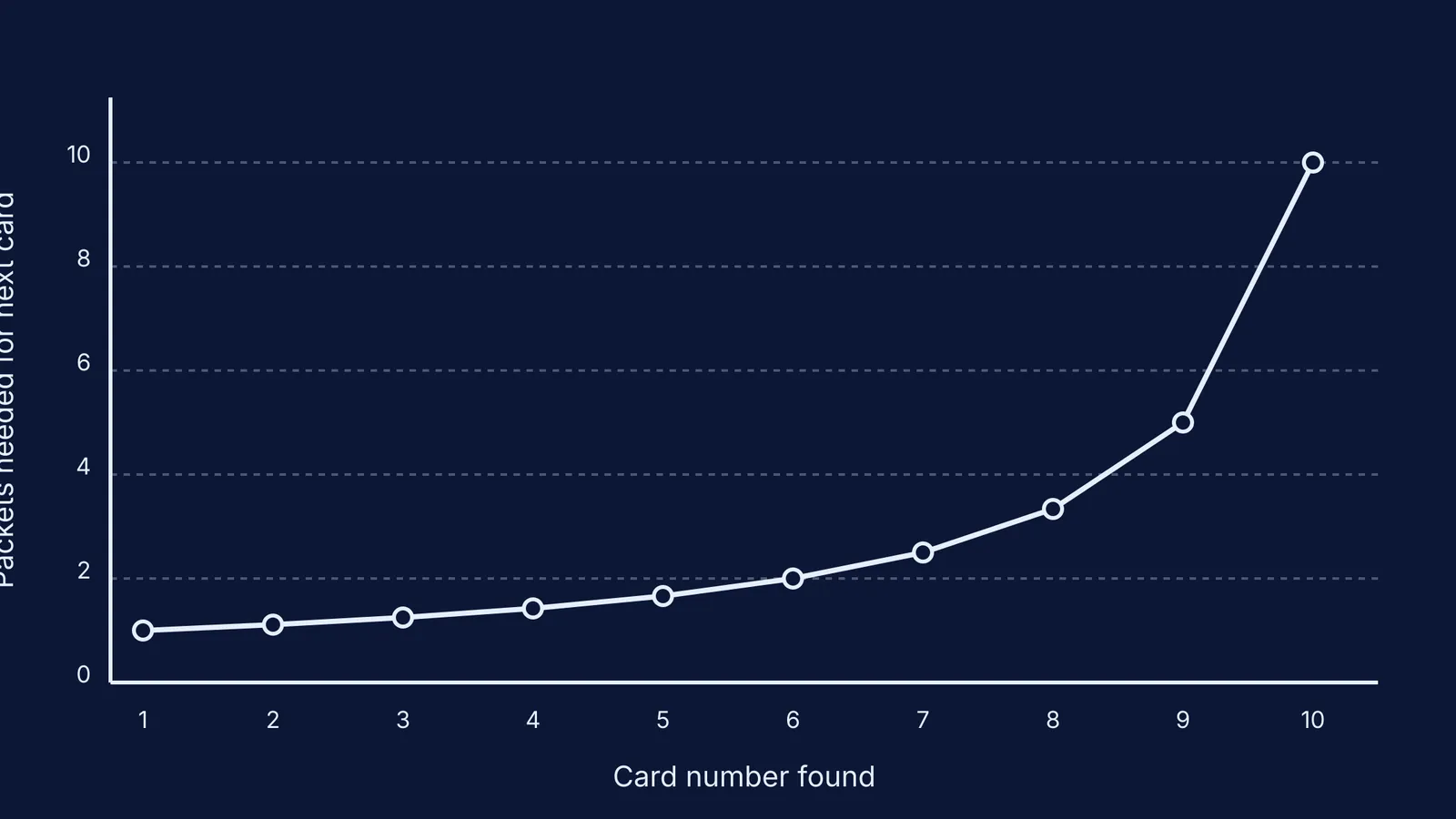
Here is the step-by-step breakdown of how many packets you need, on average, for each stage of a 10-card collection, derived from the formula on the Brilliant Math & Science Wiki:
Card 1 (10/10 probability): 1.0 packet
Card 2 (9/10 probability): 1.1 packets
Card 3 (8/10 probability): 1.25 packets
Card 4 (7/10 probability): 1.4 packets
Card 5 (6/10 probability): 1.7 packets
Card 6 (5/10 probability): 2.0 packets
Card 7 (4/10 probability): 2.5 packets
Card 8 (3/10 probability): 3.3 packets
Card 9 (2/10 probability): 5.0 packets
Card 10 (1/10 probability): 10.0 packets
If you add these numbers together, you get 29.3. Finding the final card takes 10 packets, which requires more effort than finding the first six cards combined (8.45 packets). The final two cards alone demand 15 packets, more than half of your total effort.
How do you calculate the expected value for a collection?
You can solve probability puzzles like this by breaking them into independent geometric distributions. A geometric distribution models the number of trials needed to get the first success in repeated, independent attempts.
When you are looking for the k-th new card, the probability of success is (10 − k + 1) / 10. For a geometric distribution, the expected number of trials is the reciprocal of the probability. By adding up the expected values for each of the 10 stages using the linearity of expectation, you arrive at the total expected value.
This framework is highly practical for exam preparation, especially in JEE and NEET maths segments where expected value and geometric distributions frequently appear. If you are starting out with these concepts, our guide to Probability in Class 10: cards, dice and coins worked step by step is a great foundation. For deeper study into sequences of events, you can explore Probability in repeated trials: who wins first, using a GP.
Instead of passively reading the formulas, try recreating the problem. You can build and run models of these scenarios in the Fermi Simulation Lab to see the principles in action. Writing a simple simulation to draw random numbers from 1 to 10 and count how many draws it takes to see all ten will immediately show you the "long tail" of the final card. When learning probability, simulating the maths makes abstract rules feel tangible and intuitive.


