

On this page
If you drop a piece of copper into a beaker of dilute hydrochloric acid (HCl), nothing happens. There is no fizzing, no colour change and no release of gas. However, if you drop in a piece of zinc or iron, the acid immediately starts bubbling.
Why does copper stay silent while other metals react vigorously? The answer lies in how strongly these metals hold onto their electrons compared to hydrogen.
Why does copper not react with dilute HCl?
For a metal to react with dilute hydrochloric acid, it must undergo a single displacement reaction. The metal must give away its outer electrons to the hydrogen ions (H⁺) floating in the acid. When hydrogen ions gain these electrons, they pair up to form hydrogen gas (H₂), which escapes as bubbles.
When zinc reacts with hydrochloric acid, the balanced chemical equation is: Zn(s) + 2HCl(aq) → ZnCl₂(aq) + H₂(g)
In this ionic process, solid zinc atoms lose two electrons each to become aqueous zinc ions (Zn²⁺). The two hydrogen ions (2H⁺) from the acid accept those two electrons to become a molecule of neutral hydrogen gas (H₂). This flow of electrons is the core of an oxidation-reduction (redox) reaction.
This is a competition for electrons. Copper is a noble metal that holds onto its electrons more tightly than hydrogen does. If we tried to write a similar equation for copper reacting with hydrochloric acid, the reaction would simply not proceed under standard conditions. Because copper refuses to give its electrons to the hydrogen ions, the forward reaction cannot start, and no hydrogen gas is produced.
How does standard electrode potential predict reactivity?
Chemists measure this competition for electrons using the standard electrode potential, measured in volts (V). Because we cannot measure the absolute potential of a single metal in isolation, we must compare it against a universal reference point. By definition, the standard hydrogen electrode (SHE) is set to exactly 0.00 V (Wikipedia data page)). The SHE consists of a platinum electrode immersed in an acidic solution, with hydrogen gas bubbling over it at a pressure of 1 bar.
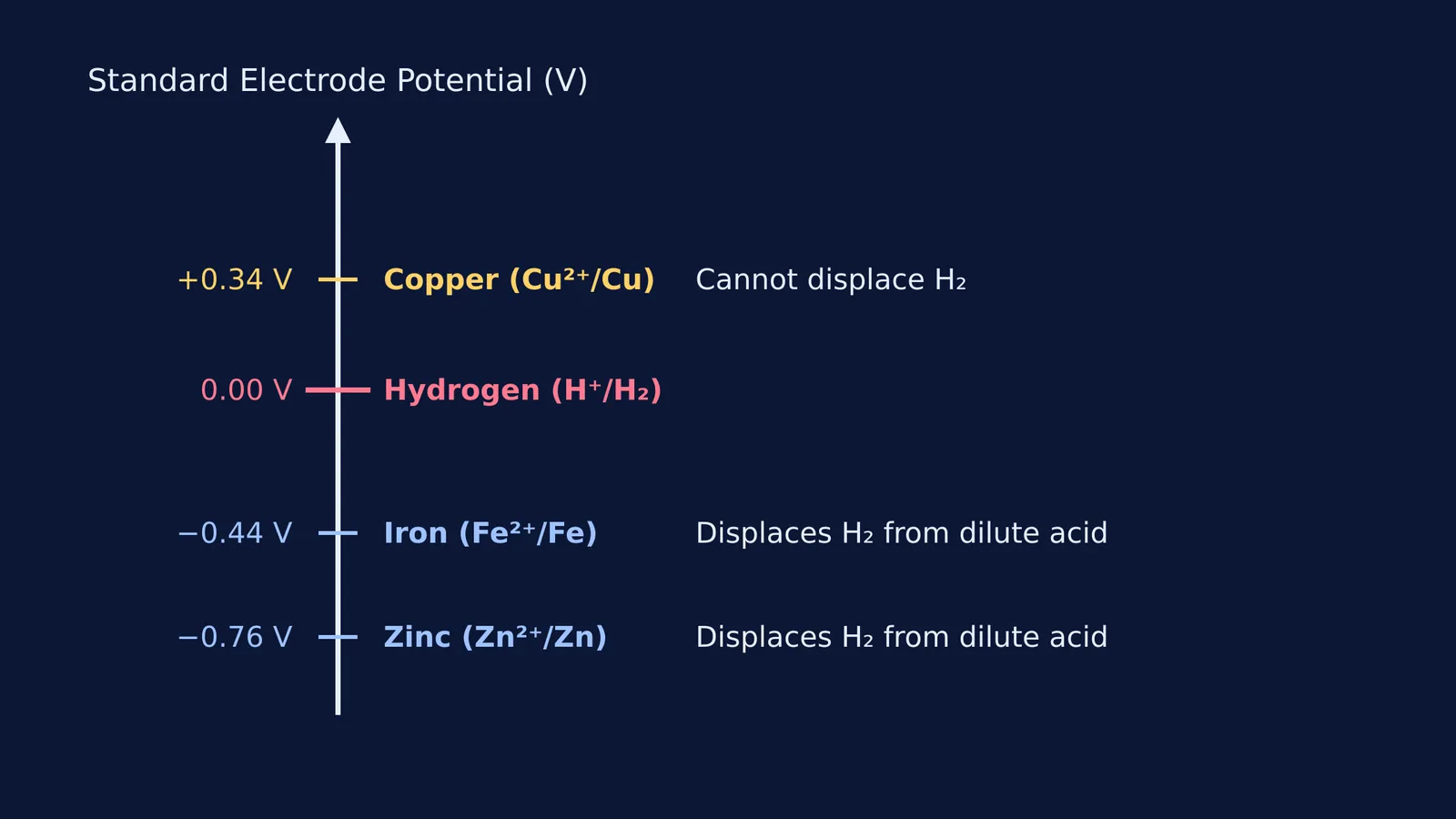
According to the IUPAC values, copper has a positive standard electrode potential of +0.34 V. A positive value means that the metal is less reactive than hydrogen and is a weaker reducing agent. It prefers to stay in its solid, uncharged metallic state rather than dissolving into ions to free hydrogen gas. This is why copper, along with other metals with positive potentials like silver and gold, will not react with dilute, non-oxidising acids like HCl.
If you are struggling to picture how these electron transfers work, the Fermi Simulation Lab has interactive simulations for the ideas that are easier to see than to read.
What about the reactivity of zinc and iron?
Unlike copper, zinc and iron are located above hydrogen in the reactivity series. This means they are more reactive and have negative standard electrode potentials.
The standard electrode potential for zinc (Zn²⁺/Zn) is −0.76 V, and for iron (Fe²⁺/Fe) it is −0.44 V (Wikipedia data page)). Because these numbers are lower than zero, both metals are stronger reducing agents than hydrogen. They readily push their electrons onto the H⁺ ions in the acid.
When zinc reacts with dilute HCl, it forms zinc chloride and releases hydrogen gas rapidly. You will see vigorous bubbling the moment the metal touches the liquid. Iron does the same, forming iron(II) chloride, though the bubbling is slightly less violent because its electrode potential is closer to zero. If you test metals even further down the negative scale, such as magnesium or sodium, the reaction with dilute acids becomes dangerously explosive. The more negative the potential, the stronger the drive to give away electrons and release hydrogen gas.
Will an unknown metal react?
When predicting if an unknown metal will react with dilute HCl or H₂SO₄, follow this three-step checklist:
Look up the standard electrode potential (E°) of the metal (Wikipedia data page)).
If E° is negative (like −0.76 V for zinc), the metal will dissolve and bubble off hydrogen gas.
If E° is positive (like +0.34 V for copper), there will be no reaction with a standard dilute acid.
If you are curious about the patterns behind these numbers, read our guide on the E° values of 3d metals, or explore why zinc is not a transition element despite sitting right next to copper on the periodic table.


