

On this page
Students often use AI to double-check their chemistry assignments, but the complex IUPAC rules for coordination compounds frequently trip the bots up. According to the ChemIQ benchmark of organic chemistry problems, standard AI models answer correctly only 3% to 7% of the time. Even the most advanced reasoning models reach just 50% to 57% accuracy. While these bots can sometimes convert simple chemical structures into names, the intricate nomenclature rules for complex inorganic ions differ significantly from standard organic compounds and simple salts like sodium chloride.
Because AI tools routinely hallucinate oxidation states and misapply prefixes, you cannot trust their answers blindly. If you are using an AI to check your homework or prepare for a chemistry exam, you need to know exactly which rules it is likely to break so you can verify its work.
Why is AI wrong at coordination compound naming?
IUPAC rules require ligands to be named in strictly alphabetical order based on the ligand name itself. You must completely ignore simple numerical prefixes like *di*, *tri*, or *tetra* when deciding this order.
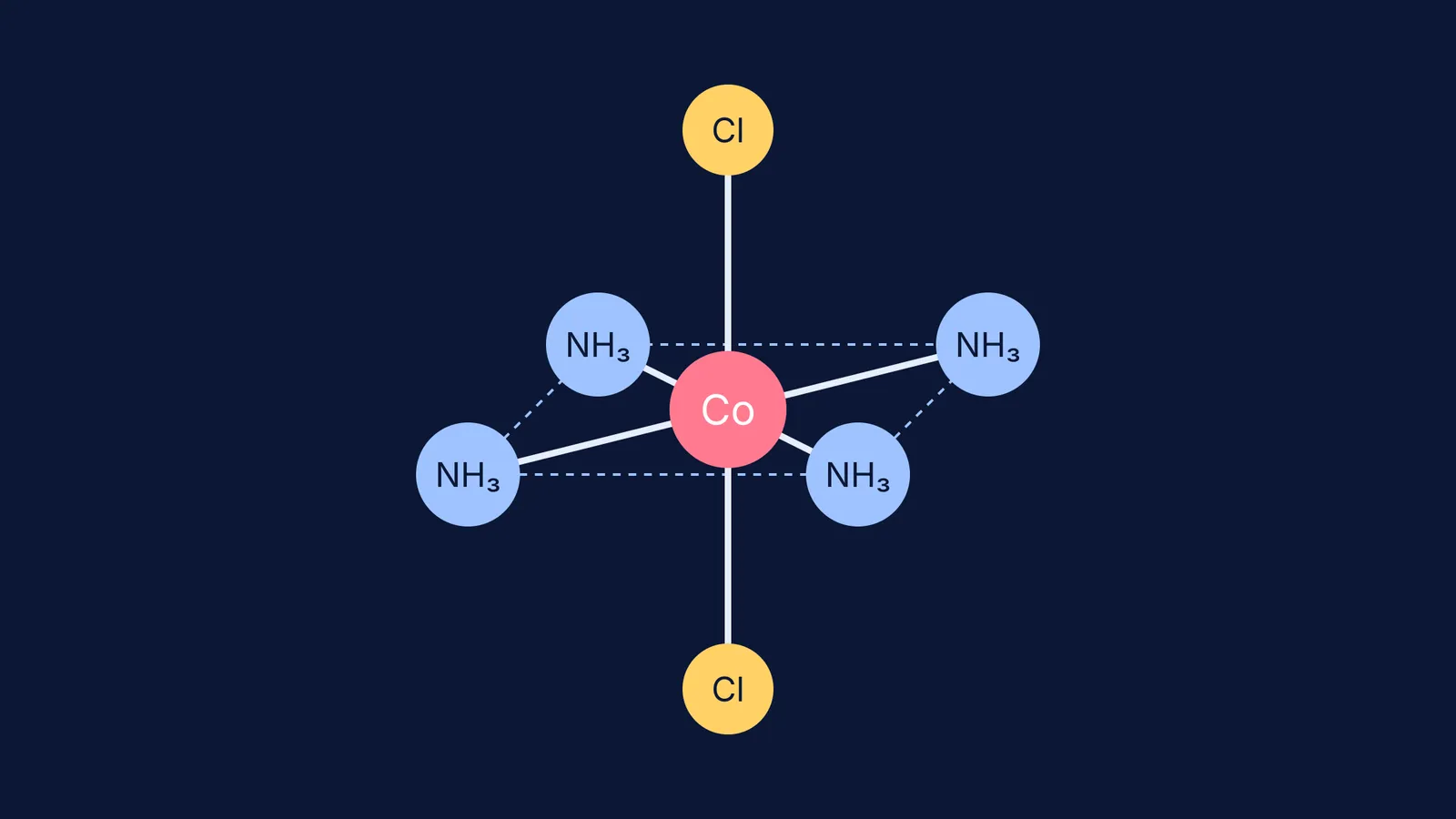
An AI often sorts by the prefix instead. For a complex with four water molecules (aqua) and two chlorides (chlorido), the AI might put *dichloro* before *tetraaqua* because 'd' comes before 't'. The correct alphabetical order is *tetraaqua* followed by *dichlorido*, because 'a' comes before 'c'.
Sometimes, the AI orders ligands by their charge—listing anionic ligands before neutral ones—or by their sequence in the chemical formula. Both of these are structural conventions used for writing the formula itself, not the IUPAC naming rules. When an AI generates a name, you should manually read through the ligands and ensure they follow the strict A-to-Z order.
Furthermore, when dealing with polydentate ligands like ethylenediamine that already contain a numerical prefix, you must use special prefixes: *bis-*, *tris-*, or *tetrakis-*. An AI might incorrectly output "diethylenediamine" instead of *bis(ethylenediamine)*. Always look out for parentheses around these complex ligands.
How to check the oxidation state and suffixes?
The oxidation state of the central metal must perfectly balance the charges of all ligands and any counter-ions outside the brackets. Neutral ligands like water (aqua), ammonia (ammine), and carbon monoxide (carbonyl) contribute a charge of zero. AI models frequently add these up incorrectly or forget to account for the counter-ions entirely, resulting in a wrong Roman numeral at the end of the name.
When an AI prints a flat answer without showing the charge math, it is hard to trust. Fermi's AI tutor teaches the reasoning instead: it writes the equation out on a board, step by step, so you can see exactly where the metal's charge comes from.
Another major trap is the anionic complex. If the coordination sphere itself has a negative charge, the central metal's name must end in "-ate". An AI will often forget this rule and output "cobalt" when it should be "cobaltate", or "iron" instead of the Latin root "ferrate". You must always check whether the complex ion sits before or after the counter-ion to spot its overall charge. If a potassium ion appears first in the formula, the complex is an anion.
What are common AI mistakes with ligands?
Look out for missing "-o" suffixes. According to IUPAC nomenclature rules for coordination complexes, anionic ligands must end in "o". A chloride ligand becomes *chlorido* and a cyanide ligand becomes *cyanido*. An AI might carelessly use the standard ion name in the middle of the complex, which will cost you marks in a chemistry exam.
You must also be careful with counter-ions. In [Co(NH₃)₆]Cl₃, the three chlorides outside the bracket are just called "chloride", not "trichloride". AI models tend to over-apply numerical prefixes where they do not belong, treating the counter-ions as if they were ligands. If you are unsure how many ions sit inside or outside the coordination sphere, reading about counting ionisable chlorides in Werner complexes helps clarify the structure before you try to name it.
A checklist for verifying AI names
If you use an AI to verify your IUPAC names, run its output through this simple checklist before accepting it as correct:
Are the ligands alphabetical by their base name, ignoring simple prefixes?
Did it use *bis-* or *tris-* for complex ligands that already contain numbers?
Do all the negative ligands end in "-o"?
Did it use the exact special names for neutral ligands (aqua, ammine, carbonyl)?
If the whole complex is negative, does the metal end in "-ate" or its Latin equivalent?
Does the oxidation state balance the charges correctly? (You can review oxidation numbers from structure to practise this step.)
Is the final name written as one continuous word, with no spaces between the ligands and the metal?
By checking these specific points, you can spot the errors that large language models make most often. If you need to revise these rules from scratch, the Fermi Concept Library holds a complete lesson on coordination nomenclature and its place in the chemistry map to refer back to.


