

On this page
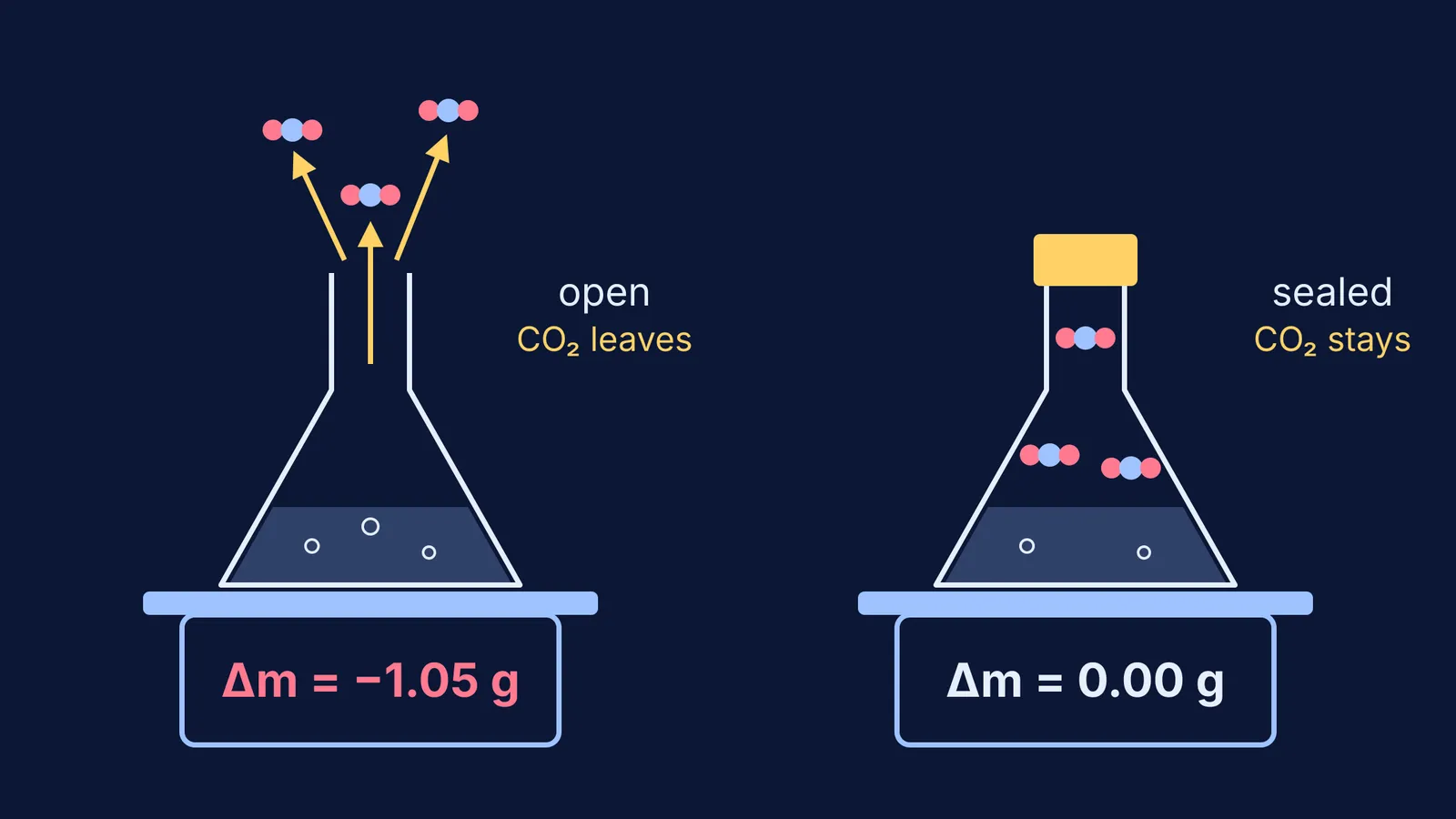
A teacher drops baking soda into vinegar on a balance, the fizzing stops, and the reading has gone down. So did the reaction destroy mass? No. The missing grams left the flask as a gas. In a simulation you can run the same reaction open and sealed, and count every atom on both sides.
Is mass conserved when a gas escapes from a reaction?
Always. A reaction rearranges atoms without creating or destroying them, so reactants and products have the same total mass. What changes is what your balance can see. The Royal Society of Chemistry's guide to teaching conservation of mass warns that in open systems, gases produced or consumed in a reaction can give the false impression that mass has been lost or gained.
Haluk Özmen and Alipasha Ayas gave a four-item test to 150 grade 10 students, aged 15-16, after they had studied a unit on chemical analysis (Chemistry Education Research and Practice, 2003). One of the most common misconceptions was that total mass increases in a precipitation reaction because the solid precipitate is 'heavier than a liquid'. Another was that total mass decreases when something burns in a closed system. For the history, read how Antoine Lavoisier used careful weighing to end the phlogiston theory and about Mikhail Lomonosov's sealed-flask test.
What happens to the balance reading in an open and a sealed flask?
Predict before reading on. For each of these three reactions from the RSC guide, will the reading rise, fall or stay the same in an open flask, and then in a sealed one?
Baking soda (sodium hydrogencarbonate) with vinegar (acetic acid).
Magnesium ribbon burning in air.
Lead nitrate solution mixed with potassium iodide solution, which forms a yellow solid.
Where does the missing mass go when you track every atom?
Baking soda and vinegar. NaHCO₃ + CH₃COOH → CH₃COONa + H₂O + CO₂. Count the atoms: the left side has 1 Na, 5 H, 3 C and 5 O, and so does the right. Sodium hydrogencarbonate has a molar mass of 84.007 g/mol (PubChem) and carbon dioxide 44.009 g/mol (PubChem). So 2.00 g of baking soda is 0.0238 mol, and with vinegar in excess it releases 0.0238 × 44.009 = 1.05 g of CO₂. In an open flask the reading drops by up to 1.05 g, a little less in practice because some CO₂ stays dissolved. In a sealed flask the gas stays inside and the reading does not change.
Burning magnesium. 2Mg + O₂ → 2MgO, with 2 Mg and 2 O on each side. Magnesium is 24.305 g/mol (PubChem) and magnesium oxide is 40.305 g/mol (PubChem). So 0.240 g of ribbon, if it all turns into oxide, becomes 0.398 g of magnesium oxide. In an open crucible the reading goes up by 0.158 g, which is the oxygen taken from the air. In a sealed flask that oxygen was already inside, so the reading stays the same.
The precipitate. Pb(NO₃)₂ + 2KI → PbI₂ + 2KNO₃. There is 1 Pb, 2 N, 6 O, 2 K and 2 I on each side, and no gas. The reading stays the same whether the flask is open or sealed. The same atoms have simply moved into a solid. If balancing is still slow for you, practise a step-by-step method for balancing equations first.
Why does a balloon over the flask still show a loss?
Stretch a balloon over the neck to trap the gas, and the reading still falls. Michael Jansen explains in ChemEdX that the expanding balloon pushes air out of the way, and the mass of that displaced air, not the CO₂, causes the drop. Using his figure of 1.2 g per litre for the density of air, a balloon that swells by half a litre pushes aside about 0.6 g of air. That is more than half of the 1.05 g in our example. A rigid, sealed flask avoids this. In a real lab a stoppered gas-producing flask builds pressure, so leave that to your teacher; a simulation seals it safely.
How do you run this as a simulation experiment?
Choose one reaction and set the starting masses.
Write down your predicted reading change for each flask, with one reason.
Run it open, then sealed, and note both readings.
List every atom on each side of the equation and check that the counts match.
Explain any change in one sentence that names what crossed the boundary.
Change one thing, such as doubling the baking soda, and predict the new loss before running it again (2.10 g from the PubChem molar masses, if vinegar is still in excess).
The same predict, run and explain loop works with the interactive simulations in the Fermi Simulation Lab, which are built for ideas that are easier to see than to read. If you get stuck on step 5, Fermi's AI tutor notices where you are stuck and decides whether to explain, ask or show.
Start with the open flask: write your prediction down, then count the atoms.


