

On this page
Picture an ice-cream cone with a second one balanced tip to tip below it, and slice through both with a flat knife. Depending on the tilt, the cut edge is a circle, an ellipse, a parabola or a hyperbola. One angle decides which. Here is the rule, a worked example you can check with a calculator, and a way to practise predicting the curve.
What do you get when you slice a double cone at different angles?
NCERT's Class 11 chapter on conic sections builds a double-napped cone by spinning a line (the generator) around a fixed axis at a constant angle α, the semi-vertical angle. Cut it with a plane at angle β to the axis, not through the vertex, and the NCERT rule is:
β = 90° (plane perpendicular to the axis): a circle.
α < β < 90°: an ellipse.
β = α (plane parallel to a generator): a parabola.
0 ≤ β < α: the plane cuts both nappes, and the curve is a hyperbola, with one branch on each.
If the plane does pass through the vertex, the same chapter lists the degenerate cases: a single point, a single straight line, or a pair of intersecting lines.
How is the cutting angle linked to eccentricity?
Eccentricity, written e, measures how far a conic is from being a circle. MathWorld's entry on conic sections gives the values: e = 0 for a circle, 0 < e < 1 for an ellipse, e = 1 for a parabola and e > 1 for a hyperbola.
The slicing angle gives e directly: with β and α as above, e = cos β ÷ cos α, a result stated in Wikipedia's article on conic sections, which uses the two letters the other way round. It matches the NCERT rule: β = 90° makes e = 0, β = α makes e = 1, and β < α makes e > 1.
Notice what is missing from the formula: where the plane cuts. Slide the knife along the cone without changing its tilt and the curve grows or shrinks but keeps its shape. Position sets the size; the angle alone sets the shape.
What do four cuts through one cone look like?
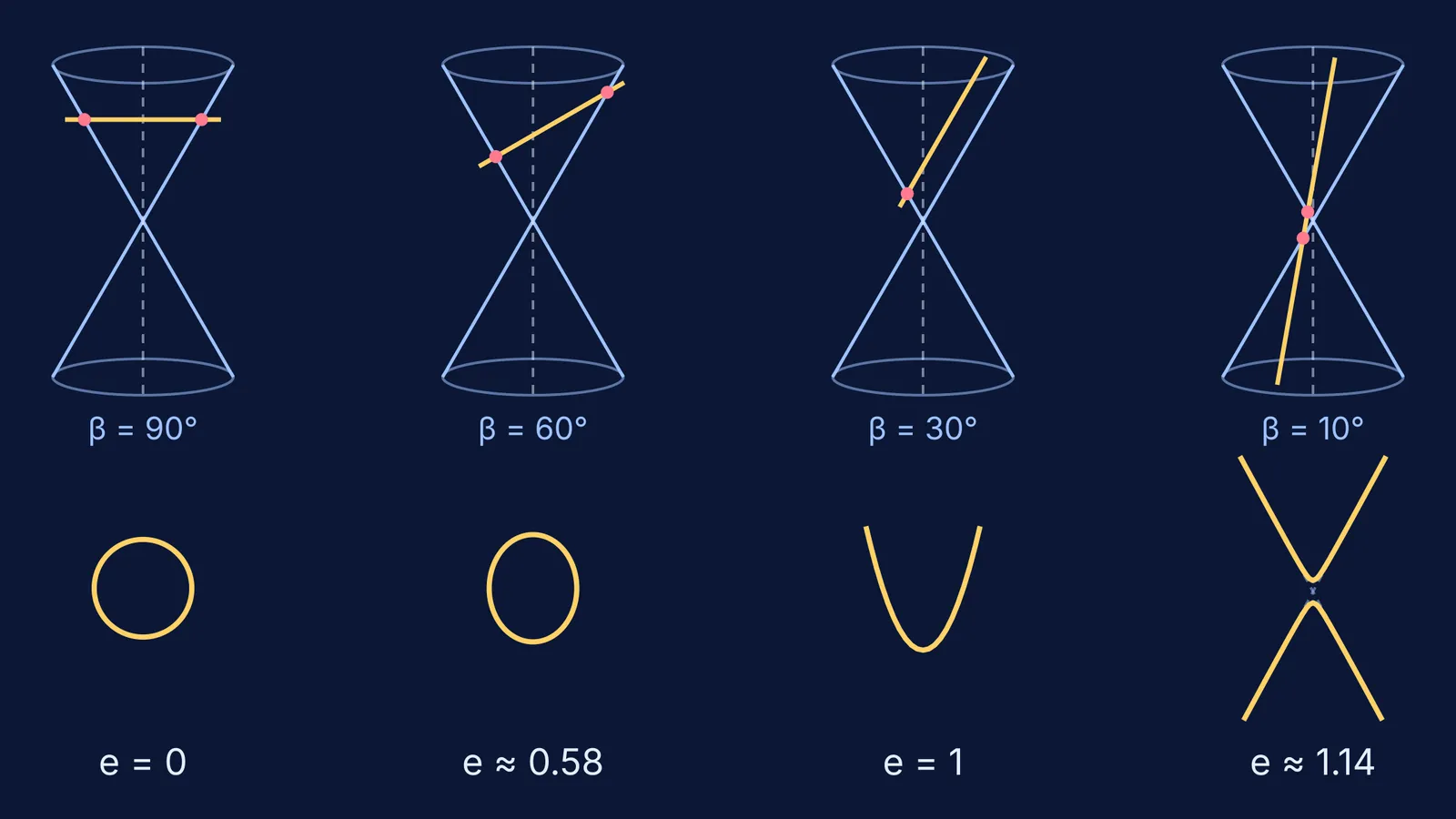
Take a cone with α = 30°, so cos α ≈ 0.866. These are the four cuts in the diagram at the top of this post.
β = 90°: e = 0 ÷ 0.866 = 0. A circle.
β = 60°: e = 0.5 ÷ 0.866 ≈ 0.577. An ellipse.
β = 30°: e = 0.866 ÷ 0.866 = 1. A parabola.
β = 10°: e = 0.985 ÷ 0.866 ≈ 1.14. A hyperbola.
Check case 2 the long way with NCERT's ellipse definition, e = c/a, where c = √(a² − b²). If the plane crosses the axis 1.1 units above the vertex, solving the cone and plane equations together gives semi-axes a = 0.825 and b ≈ 0.674. Then c ≈ 0.476 and c/a ≈ 0.577, the same as cos 60° ÷ cos 30°.
Why do the same curves turn up in orbits?
The same shapes describe paths under gravity. NASA's Earth fact sheet lists Earth's orbital eccentricity as 0.0167, an ellipse so close to a circle that you could not tell by eye. At the other end, NASA JPL's small-body database gives the interstellar object 'Oumuamua an eccentricity of about 1.2: a hyperbola, an open curve that does not come back. The Fermi Simulation Lab has interactive simulations for ideas that are easier to see than to read, and orbits are among them. For the history, read our post on Apollonius of Perga and how the conic sections got their names.
How can you practise predicting the curve?
You already own a 3D model: a torch. Its beam is a cone of light and the wall is the cutting plane. In a dark room, predict each shape before you look.
Point the torch straight at the wall: β = 90°, so expect a circle.
Tilt it a little: expect an ellipse that stretches as you tilt.
Tilt until the upper edge of the beam runs parallel to the wall. That edge is a generator, so β = α: a parabola that never closes.
Tilt further: one branch of a hyperbola. The other branch would need a second cone of light pointing backwards.
Hold the tilt and walk towards the wall. The patch shrinks but keeps its shape, as the formula says.
Step 3 is where the idea sticks: the parabola is the tipping point between closed curves and open ones.
For the equations, our five-step method for conic sections problems in JEE picks up where this post stops, and the Fermi Concept Library gives every mathematics concept its own lesson and its place in the map.


