

On this page
When you hit a wall in physics or maths, your first instinct might be to ask for the answer. But taking a moment to classify the block saves hours of frustration.
A concept doubt sounds like: "I don't get this." It happens when you read a paragraph about Gauss's law or rotational inertia, and the words make no sense together. You cannot picture the physical system.
A question doubt (or procedural doubt) sounds like: "I can't do this problem." Here, you understand the theory—you know a cylinder rolling down a hill has kinetic energy—but you are stuck on setting up the equation, resolving the forces, or finding the next mathematical step.
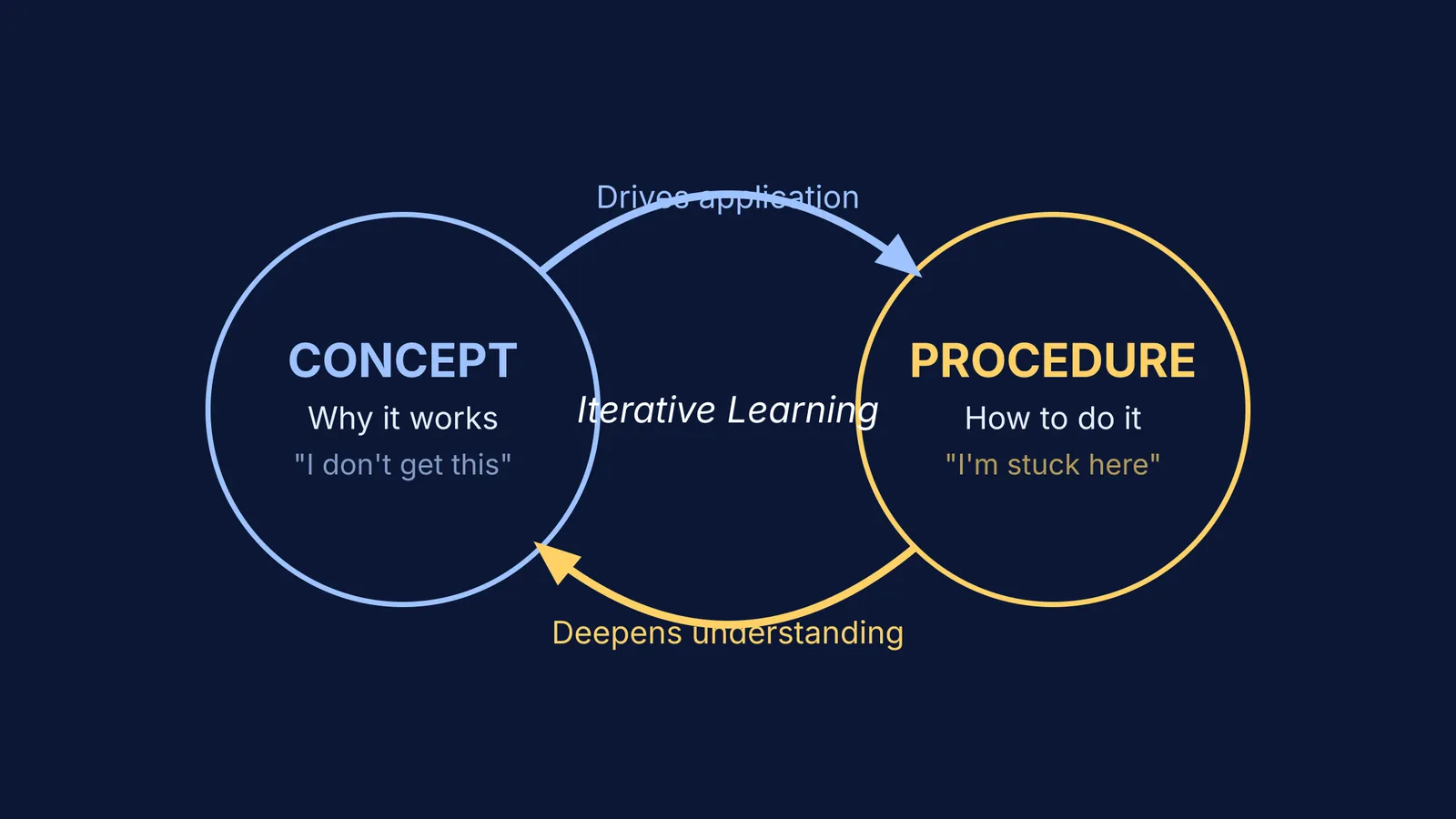
This distinction maps directly to how the brain learns mathematics. A foundational 2001 study of 133 students (Journal of Educational Psychology) found that conceptual knowledge and procedural skill develop iteratively. When you grasp a concept, you can learn the procedure; when you practice the procedure, you discover patterns that deepen your conceptual understanding. Treating them as the same thing breaks this cycle.
How to know if my doubt is concept or question?
To find out which type of help you need, try the diagram test. Close your book and try to sketch a rough picture of the system in the problem.
If you cannot draw it—if you do not know which way the forces point, or what the graph of the function should look like—you have a concept doubt. The underlying idea is still foggy.
If you can draw a perfectly good diagram but are staring blankly at the page when it is time to write the first equation, you have a question doubt. Your conceptual understanding is intact, but your procedural skill needs practice.
How should I ask an AI tutor for a concept?
If the idea itself is unclear, asking an AI to solve a related problem will only give you an algorithm to memorise. Instead, prompt the AI to teach the idea from the ground up.
Ask for analogies: "Explain electric potential like I am 15, using water pipes as an analogy."
Focus on the limits: "When does the ideal gas equation fail?"
Make it visual: If you cannot picture it, you will struggle to apply it. The Fermi Simulation Lab provides interactive simulations for the ideas that are easier to see than to read.
When you ask for conceptual help, tell the AI to hold back on the maths until you can explain the core idea back to it in plain English.
How should I ask an AI tutor for a procedure?
If you know the theory but are stuck on the execution, you need procedural help. The worst thing you can do here is ask an AI to write out the full solution, because reading a solution does not build the procedural memory you need for an exam. (See: AI tutors vs answer chatbots).
Ask for the first step only: "I know this involves conservation of momentum, but I don't know how to set up the first equation. Give me a hint."
Check your working: Upload a photo of your rough work and ask, "Where did I drop a minus sign?"
Use a dedicated solver: For worked problems with a step-by-step solver that explains the reasoning rather than printing an answer, use the Fermi Problem Library.
How do these loops build active learning?
The goal is to keep the iterative learning loop going. Why some JEE aspirants plateau often comes down to trying to memorise procedures without the concept, or reading concepts without ever testing them on hard problems.
Fermi teaches rather than answers. It holds a line of reasoning across a session, notices where a student is stuck, and decides whether to explain, ask, or show. It works out what you already know, builds a plan for the session, and teaches through it—drawing the figure, running the simulation, and checking understanding as it goes. By knowing whether your block is conceptual or procedural, you can guide the session exactly where it needs to go.


