

On this page
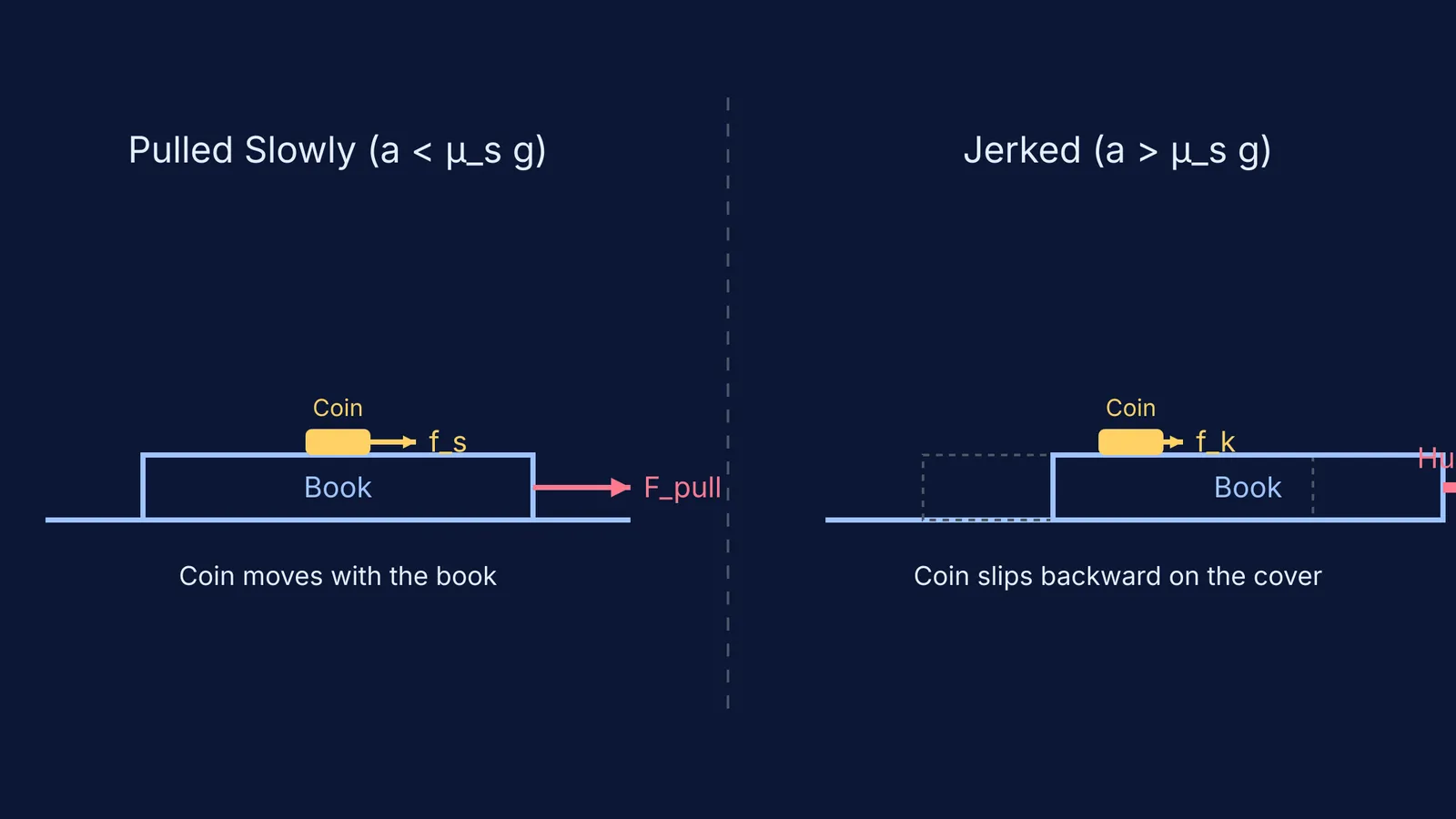
Place a coin on the cover of a closed book. If you pull the book across the table slowly, the coin rides along as if glued to the cover. But if you jerk the book quickly, the book shoots out, leaving the coin behind to drop straight down.
This simple demonstration is a classic test of Newton's laws. It shows exactly when the grip of friction is defeated by the stubbornness of mass, known as inertia.
Why does a coin ride along when pulled slowly?
For the coin to move, something must push or pull it. Since your hand is only touching the book, the only horizontal force acting on the coin is the static friction between the metal and the book's cover.
According to OpenStax University Physics, static friction responds to what you do: it "increases to be equal to and in the opposite direction of your push". When you pull the book slowly, you give it a low acceleration. The friction easily provides the small force (F = ma) needed to accelerate the coin at that same low rate. Because the required force is below the maximum limit, the coin sticks to the book and moves with it.
Why does the coin stay behind when the book is jerked?
When you jerk the book, you give it a massive, sudden acceleration. To keep the coin moving with the book at that high rate, the friction would have to pull the coin with a huge force.
However, friction has a strict upper limit. When the required force exceeds the maximum static friction, the coin's inertia wins. The coin resists the sudden change in motion. It slips backward relative to the book, and because the jerk is over in a fraction of a second, the kinetic friction does not have enough time to drag the coin very far.
If you want to visualise how these forces shift the moment the book is jerked, the Fermi Simulation Lab provides interactive simulations for the ideas that are easier to see than to read. You can adjust the acceleration and watch the exact frame where friction gives way.
What is the exact friction limit?
The physics behind the slip gives us a precise threshold. The maximum static friction is μ_s mg, where μ_s is the coefficient of static friction, m is the coin's mass, and g is gravity. For the coin to stay on the book, the required force ma must be less than μ_s mg.
Cancel out the mass, and you find that the coin slips when the book's acceleration a exceeds μ_s g. This tells us a fascinating fact: the limit is independent of the coin's mass. Whether you use a heavy brass coin or a light aluminium one, it will slip at exactly the same acceleration as long as the surfaces are the same.
According to data from The Physics Factbook, a standard penny on paper has a static coefficient of friction of approximately 0.29. Multiplying this by gravity (9.8 m/s²) gives an acceleration limit of 2.84 m/s². If you pull the book with an acceleration greater than 2.84 m/s², the penny will slip.
This limit applies to many scenarios in mechanics. For more examples, see how it determines the Angle of repose and angle of friction: the tan θ = μ result, or how it dictates the Minimum force to drag a block on a rough floor: the best angle.
How can you test this limit at home?
You can find the friction limit for your own specific coin and book without needing to measure acceleration.
Place your coin near the edge of a closed book.
Slowly lift that edge, tilting the book to create a ramp.
Stop the moment the coin begins to slide down the cover.
Measure the vertical height of the lifted edge and the horizontal distance from the raised edge to the table.
Divide the height by the horizontal distance.
This ratio is tan θ, which exactly equals your coefficient of static friction, μ_s. Multiply that number by 9.8, and you will have found the exact acceleration in m/s² required to jerk the book out from under your coin.


