

On this page
You are studying a solved example in your physics or mathematics module. Step 1 sets up the initial equations perfectly. Step 2 begins to substitute the variables. Then you hit the dreaded word: "Therefore." The book skips three algebraic steps and presents a final formula that looks nothing like the previous lines.
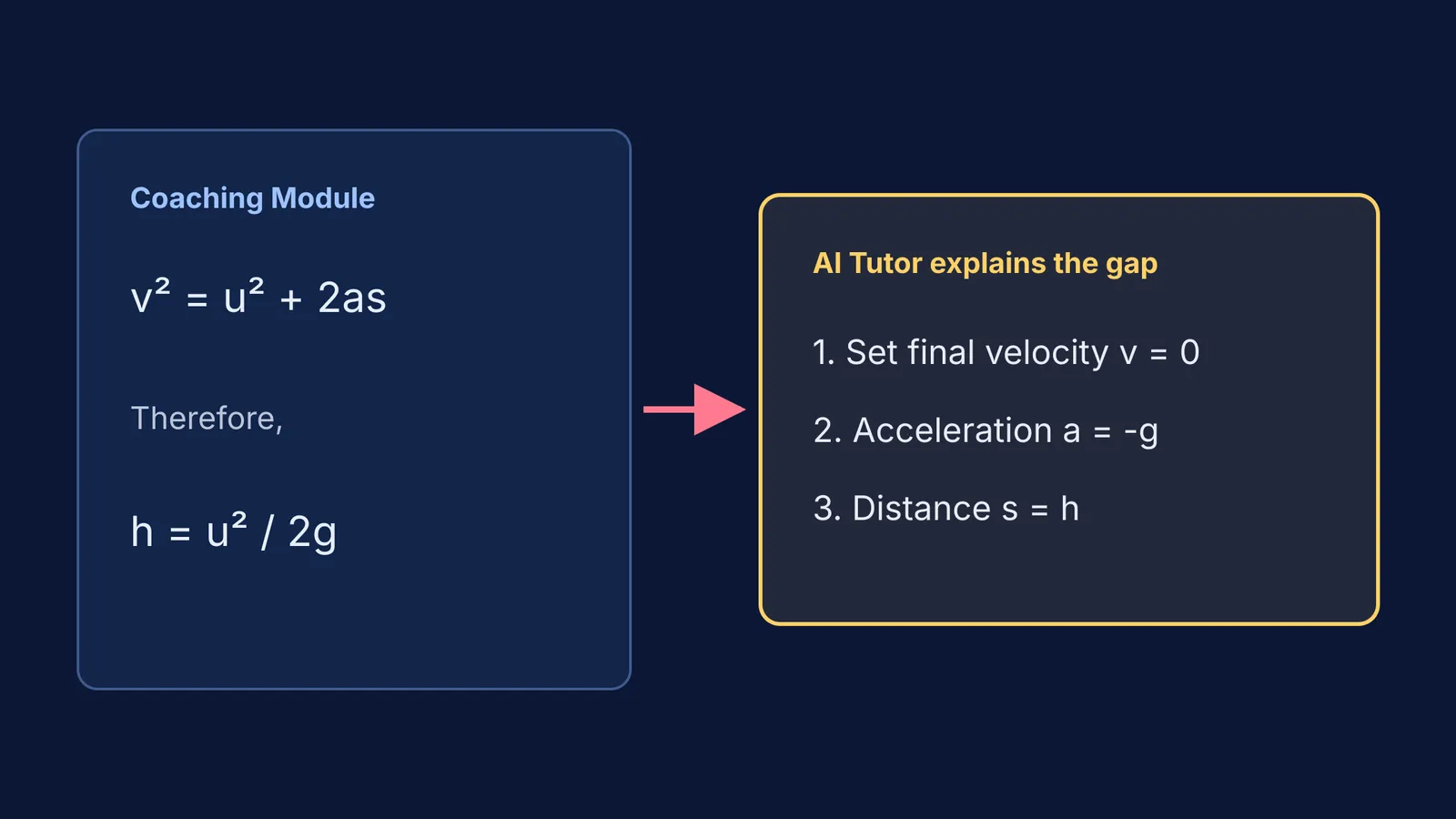
For students preparing for JEE or NEET, these missing steps are a major source of friction. Coaching modules and textbooks often skip steps to save space and reduce printing costs, assuming the intermediate algebra is obvious. When a textbook jumps from v² = u² + 2as straight to h = u² / 2g, it assumes you know that the final velocity at the peak is zero and the acceleration is negative gravity. If you do not spot that physical assumption, the rest of the solution makes no sense, and you are left staring at a blank page.
Why do good students learn more from worked examples?
Skipped steps are annoying, but they also expose how different students approach learning. The way you handle a gap in a worked example is a strong predictor of how well you understand the subject.
In 1989, cognitive scientist Michelene Chi studied how students used worked examples to learn physics. She found a stark difference between successful learners and those who struggled. The best students did not just read the text passively; they naturally paused to justify every step to themselves, generating about 15 self-explanations per example90002-5). If a step was missing, they worked it out in the margins. Poor learners, by contrast, generated only about 3 explanations90002-5) and tended to simply read past the gaps without questioning why one line led to the next.
This phenomenon—the self-explanation effect—shows that understanding does not come from reading a complete solution. It comes from the cognitive effort of figuring out why the author chose a specific substitution or applied a certain rule.
How to ask AI to explain a solved example from a coaching module?
When you cannot work out the hidden steps yourself, an AI tutor is the ideal bridge. Instead of searching the internet for a similar problem—which might use a different method—you can give the AI the exact example that has you stuck.
Using Fermi's AI tutor, the process is straightforward:
Upload the problem: Take a clear photo of the worked example and upload it.
Point out the gap: Do not just ask for the whole solution. Highlight the exact point of confusion. Ask, "I understand up to line 3, but I do not see how they got to line 4. What algebraic steps or physical assumptions are missing?"
Review the reasoning: Let the tutor explain the specific substitution that the author omitted.
Because Fermi holds a line of reasoning across a whole session, you can ask follow-up questions. If the tutor's algebra is still unclear, you can ask it to break down the calculation even further.
Why should you redo the example alone?
Once the missing steps are clear, you have one more job: you must solve the problem yourself. Reading a solution feels like learning, but it is often just an illusion of competence.
Cognitive load theory shows that studying worked examples is highly effective for novices because it reduces the burden on your working memory. When you are not struggling to find the right formula, you can focus on the underlying structure of the problem. However, this worked-example effect fades quickly if you only ever read the solutions passively.
To ensure the method sticks, follow a three-step cycle:
Study and explain: Read the solution and use the AI to fill in any gaps until you can justify every line.
Cover and solve: Close the module, take a blank sheet of paper, and solve the problem from scratch.
Compare and correct: If you get stuck, look back at the module. If your final answer is wrong, use the AI tutor to compare your new attempt against the correct path.
This routine builds the habit of self-explanation. It trains you to spot implicit assumptions so that the next time a textbook says "Therefore," you will not need the AI at all.
Read more about how to evaluate an AI tutor or whether AI tutors can teach better than chatbots that give answers.


