

On this page
Many chemistry students get stuck on chemical kinetics when confronted with a table of concentrations and initial rates. The key to solving these problems lies in isolating one variable at a time. The method of initial rates, as defined in Chemistry 2e (OpenStax), is the standard approach to determine the rate law and the overall reaction order.
What is the method of initial rates?
The method of initial rates compares how the reaction speed changes when you alter the starting concentration of one reactant while keeping the others constant. As OpenStax explains, this involves measuring reaction rates across multiple trials with different initial reactant concentrations to determine the reaction orders.
When you divide the rate of one trial by the rate of another, the rate constant (k) and the constant reactant concentrations cancel out. This leaves a simple algebraic ratio that reveals the order (exponent) for the reactant that changed.
How do you find the order from a rate table?
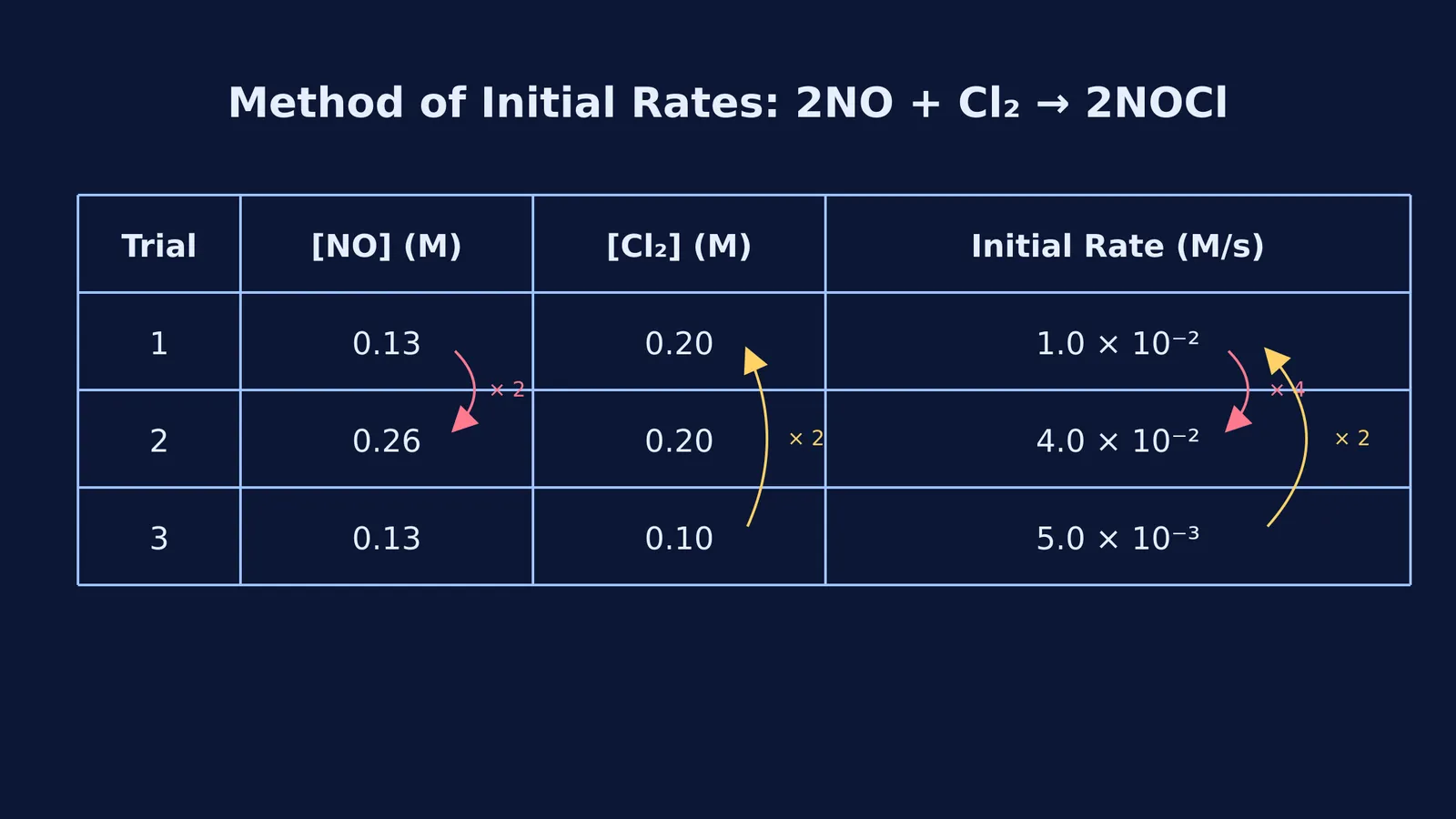
Let's look at the classic reaction between nitric oxide and chlorine: 2NO + Cl₂ → 2NOCl. Imagine an exam question gives you this data table:
Trial 1: [NO] = 0.13 M, [Cl₂] = 0.20 M, Rate = 1.0 × 10⁻² M/s
Trial 2: [NO] = 0.26 M, [Cl₂] = 0.20 M, Rate = 4.0 × 10⁻² M/s
Trial 3: [NO] = 0.13 M, [Cl₂] = 0.10 M, Rate = 5.0 × 10⁻³ M/s
To find the order with respect to NO, compare Trials 1 and 2. The [Cl₂] stays at 0.20 M, but the [NO] doubles from 0.13 to 0.26. The rate jumps from 1.0 × 10⁻² to 4.0 × 10⁻² — it quadruples. Because 2² = 4, the reaction is second order with respect to NO.
To find the order with respect to Cl₂, compare Trials 1 and 3. The [NO] stays at 0.13 M, but the [Cl₂] doubles from 0.10 to 0.20 (when moving from Trial 3 to Trial 1). The rate doubles from 5.0 × 10⁻³ to 1.0 × 10⁻². Because 2¹ = 2, the reaction is first order with respect to Cl₂.
The final rate law is Rate = k[NO]²[Cl₂]. Once you have the complete rate law, finding the rate constant (k) is straightforward. You can pick any of the three trials, plug in the concentrations and the measured rate, and solve for k. In this case, substituting the values from Trial 1 gives a rate constant of 2.96 M⁻²s⁻¹. This confirms that the relationships hold across the entire dataset.
How can an AI tutor help check the ratios yourself?
When you paste a rate table into an AI tutor, ask it to solve the problem step by step rather than just giving you the final rate law.
This is where the Fermi Problem Library excels, as it has worked problems with a step-by-step solver that explains the reasoning rather than printing an answer. You can feed your own textbook data in, and Fermi's AI tutor works out what you already know, builds a plan for the session, and teaches through it — writing on a board and checking your understanding as it goes.
Here is a simple script to use:
Paste your data table.
Add: "Here is an initial rates data table for the reaction. Please determine the reaction order with respect to each reactant. Show the mathematical ratio for two trials where only one reactant changes, so I can verify the algebra myself."
Once the tutor provides the algebraic breakdown, verifying it manually builds your confidence. You can quickly cross-reference the multipliers on a scratchpad and master the logic.
If you are struggling with the underlying rate concepts, you might also want to review Finding the order of a reaction from initial rates data or learn about Average and instantaneous rate of reaction from concentration data. For graphical methods, checking out Integrated rate law graphs: reading reaction order from straight lines is a great next step.


