

On this page
Writing a chemical equation is translating a physical event into a mathematical sentence. When magnesium burns in air, it emits a blinding white light and leaves behind a crumbling white powder. On paper, that violent change becomes a neat line of letters and numbers: 2Mg(s) + O₂(g) → 2MgO(s). But the translation from physical reality to symbolic notation is a known stumbling block for chemistry students.
Why do students struggle with chemical equations?
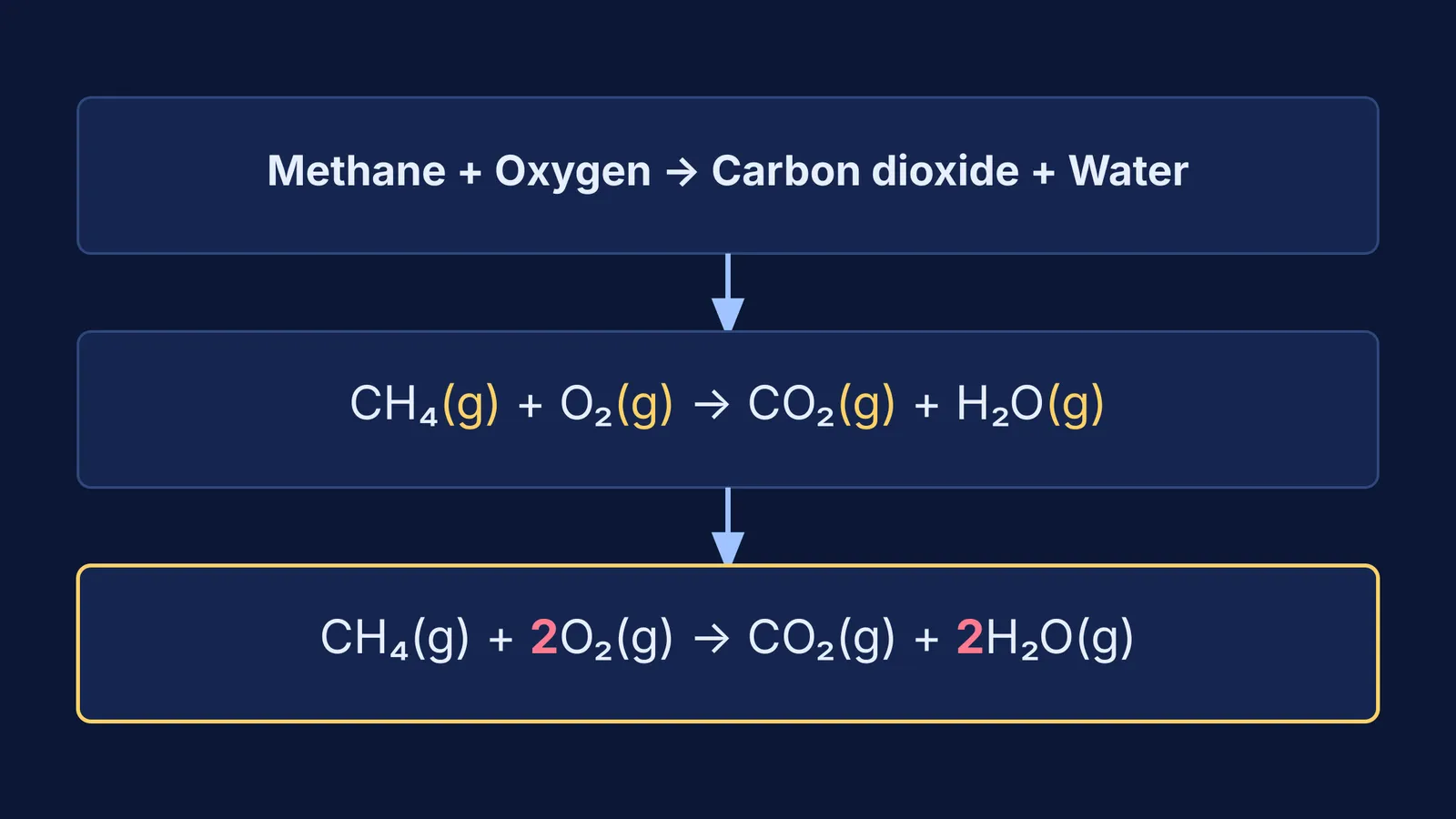
Balancing an equation is a procedural task. You count the atoms on the left, you count the atoms on the right, and you adjust the coefficients until they match. Because it feels like algebra, students often treat it as a pure math problem and ignore the chemistry.
Research highlights this disconnect between the numbers and the physical reality they represent. A 2005 study in the Journal of Chemical Education tested 156 college students on their ability to translate drawings of atoms into equations. The study found that only 15% of students could correctly write a balanced equation from a particulate drawing **(Sanger, 2005)**. Students frequently confuse subscripts, which define the molecule, with coefficients, which define how many molecules react.
State symbols are another common casualty. When a reaction produces an aqueous solution (aq) or a solid precipitate (s), the state symbols tell you what actually happened in the beaker. Yet students frequently omit them, treating them as optional decorations rather than essential facts.
How do I practice writing chemical equations with AI?
Instead of reading a textbook or watching a video of someone else balancing equations, you learn faster by doing the translation yourself.
Here is a practical framework for your study sessions:
Start with words: Give your AI tutor a prompt like, "Give me five word equations for combustion and precipitation reactions. Do not give me the chemical formulas."
Translate to symbols: Write the skeletal equation. You must know the valencies to form correct compounds, such as knowing that sodium sulphate is Na₂SO₄, not NaSO₄.
Add state symbols and conditions: Is the reactant a solid? Is the product a gas? Does the reaction need heat (Δ) or a catalyst?
Balance the atoms: Only after the formulas and states are correct should you add the coefficients.
If you struggle with the rules, Fermi's AI tutor teaches rather than answers: it holds a line of reasoning across a whole session, notices where you are stuck, and decides whether to explain, ask, or show. It checks your understanding as it goes, correcting you if you change a subscript instead of a coefficient.
What are the common mistakes in chemical equations?
When you practice, watch out for the three errors that cost students the most marks in exams.
Altering subscripts to balance the equation: You can never change a subscript to make the math work. Changing H₂O to H₂O₂ to balance oxygen turns water into hydrogen peroxide. You can only change the coefficients in front of the molecules.
Confusing liquid (l) with aqueous (aq): A pure liquid, like water or melted sodium chloride, gets an (l). A substance dissolved in water, like salt water, gets an (aq).
Forgetting diatomic elements: When a word equation says "oxygen" or "chlorine" or "nitrogen", it means O₂, Cl₂, and N₂. Students often write them as single atoms (O, Cl, N), which makes the rest of the equation impossible to balance.
To build a strong foundation before writing complex reactions, you can review the rules for naming carbon compounds in Class 10. If you are struggling to picture why some elements are diatomic, drawing the electron dot structures of covalent molecules can help you see how the atoms share electrons to become stable.
How do I prompt an AI for active practice?
To get the most out of an AI tutor, you must stop it from doing the work for you. Use this script to set up a practice drill:
"I want to practice writing and balancing chemical equations. Give me one word equation at a time, such as 'Solid calcium reacts with water to form aqueous calcium hydroxide and hydrogen gas.' Wait for me to write the balanced chemical equation with state symbols. If I make a mistake, do not give me the right answer. Tell me where I went wrong and ask me to try again."
This approach forces you to recall the formulas, assign the states, and balance the atoms independently, turning a passive reading task into active retrieval.


