

On this page
If you ask an AI tutor to solve a physics problem, it will usually give you a confident, well-formatted response. But while text-based models excel at explaining theory, they frequently stumble when a problem requires spatial reasoning or visual intuition.
When you are adding forces, finding a magnetic field direction, or checking velocity and acceleration vectors from r(t), you should never trust a pure text calculation blindly. The fastest way to verify it is to pick up a pen and draw a quick physical sketch.
Why do language models struggle with vectors?
Large language models predict the next word based on patterns in their training data. They do not maintain a mental, three-dimensional model of the physical world. This means they can easily reverse a sign, mix up left and right, or misapply the right-hand rule when finding torque about a point with vectors.
The accuracy drop is measurable. In a 2024 study published in *Frontiers in Education*, GPT-4 successfully solved 62.5% of well-specified engineering physics problems, but its accuracy fell to 8.3% for under-specified real-world scenarios (Wang et al., 2024). The researchers noted that a primary reason for these failures was the AI's inability to construct accurate physical models.
How much do diagrams actually help?
Sketching a diagram is not just a beginner's crutch; it is a core verification tool used by experts. Drawing forces or displacements forces you to translate abstract mathematics into a physical reality, instantly exposing calculation errors.
A study in *Physical Review Special Topics - Physics Education Research* found that 58% of students in representation-rich courses spontaneously drew free-body diagrams, and those who drew a correct diagram had an 85% probability of reaching the correct final answer (Rosengrant et al., 2009). Whether you are checking your own work or an AI's output, the diagram acts as an independent test.
How can you check an AI vector answer with a sketch?
You do not need graph paper or a protractor to catch an AI hallucination. A rough proportional sketch takes ten seconds and uses three simple steps to map out the vectors:
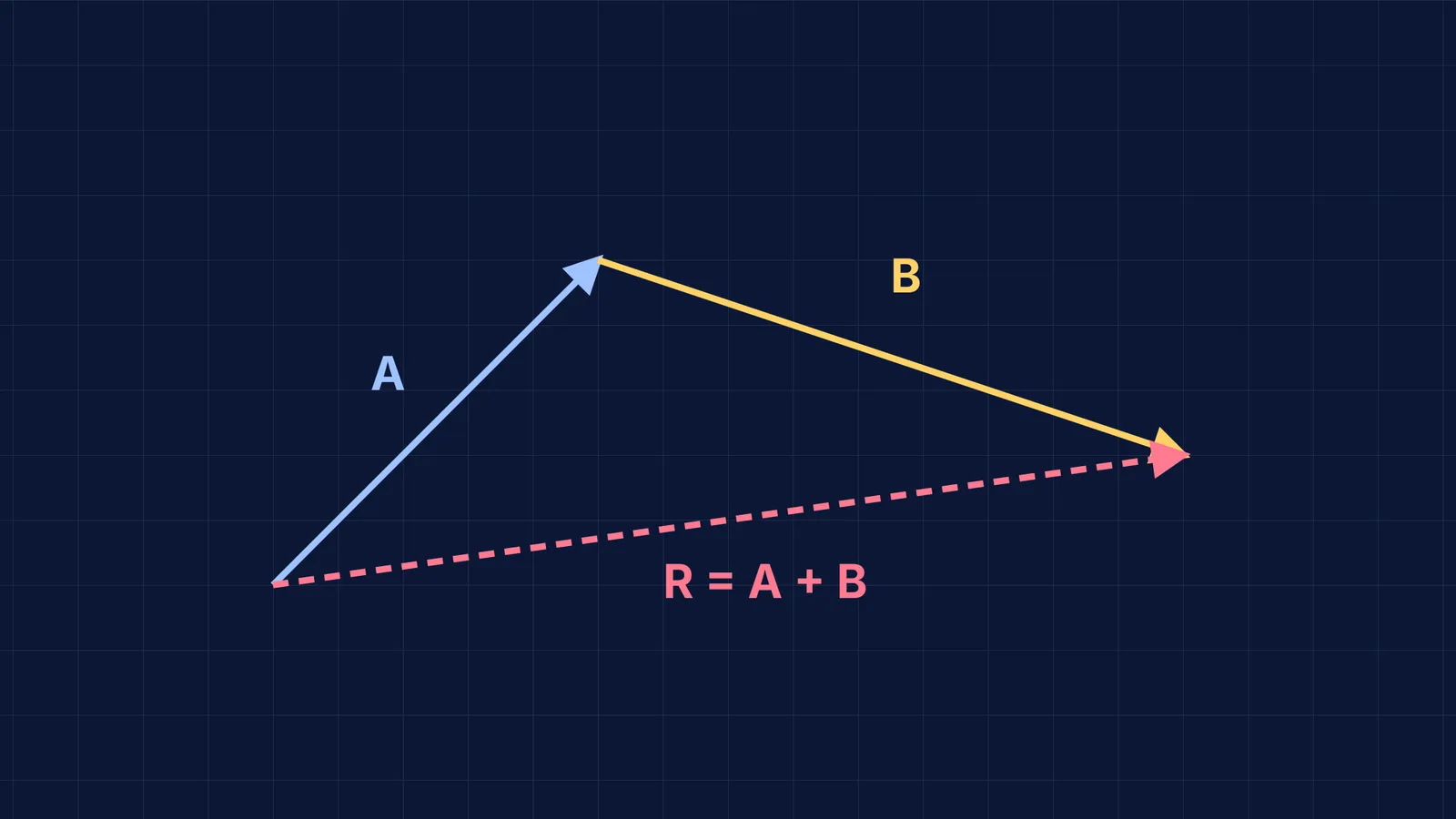
Draw head-to-tail: Pick a starting point. Draw the first vector, roughly to scale, pointing in the right direction. From the tip of that arrow, draw the second vector.
Close the triangle: Draw a new line from your very first starting point to the tip of the final arrow. This is the geometric resultant.
Compare bounds and quadrants: Look at your resultant. If it points into the upper-right (first quadrant), both its x and y components must be positive. If the AI calculated a negative x component, its math is wrong.
You can apply the same geometric logic to coordinate geometry, like the position vector test for collinear points. If an AI claims three points lie on a straight line, plotting them roughly on a set of axes will immediately confirm if the claim is plausible.
When to trust your AI tutor
Because pure text models can stumble on geometry, Fermi's AI tutor teaches by writing on a board, drawing the figure, and running the simulation to check understanding as it goes. By treating the diagram as a first-class citizen alongside the algebra, it maintains a true physical model of the problem.
Until all AI tutors can draw, keep your pen handy. Every time a model hands you a vector result, spend ten seconds sketching it out. If the geometry disagrees with the algebra, trust the geometry.


