

On this page
In short
Are AI maths shortcut tricks always correct? No; a 2024 study in PLOS One found that ChatGPT-generated math hints failed quality checks 32% of the time. You must test any AI-supplied formula against edge cases before trusting it in an exam.
When you ask a general-purpose AI for help with a physics or maths problem, it often replies with a neat, time-saving formula. For competitive exams like JEE Main or NEET, where every second counts, a shortcut feels like a gift. You are racing against a clock, and a one-line formula that bypasses a page of algebra seems like the perfect solution.
But chatbots are pattern-matching engines, not mathematicians. They reliably retrieve popular shortcuts but frequently ignore the strict mathematical conditions required to use them. The PLOS One study evaluated ChatGPT as a math tutor and found it often failed due to flawed logic or missed edge cases. If you memorise these tricks without verifying them, you risk losing crucial marks.
Here are two classic examples of AI shortcuts breaking down for special inputs, and how you can spot the trap before exam day.
Why does the average speed shortcut fail?
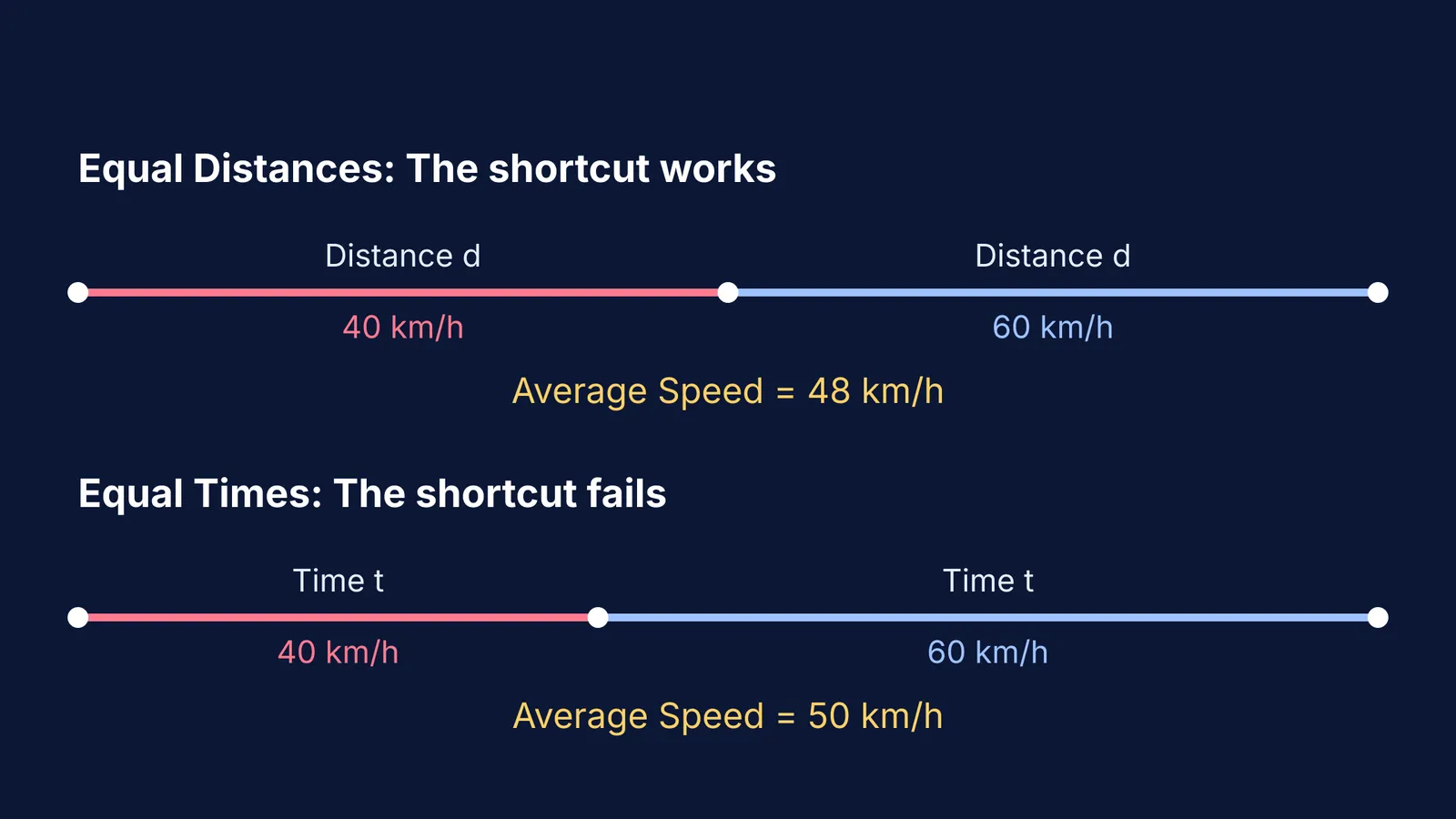
If you give an AI a kinematics problem involving two different speeds — for example, a car travelling at 40 km/h and then 60 km/h — it will almost certainly hand you the harmonic mean shortcut formula: 2 × v₁ × v₂ / (v₁ + v₂). Plugging your numbers into this neat equation gives a satisfyingly precise 48 km/h.
The math is perfectly executed, but the physics is often completely wrong. This specific shortcut only works if the distances covered at each speed are exactly equal, such as a car travelling from point A to point B and then returning from point B to point A.
If the problem instead states that the car drove at 40 km/h for the first hour and 60 km/h for the second hour, the distances are no longer equal. The times are equal. When times are equal, the correct average speed is the simple arithmetic mean: (40 + 60) / 2 = 50 km/h. If the AI blindly applies the harmonic mean shortcut, your answer will be incorrect.
You can avoid this trap by ignoring the shortcut and relying on foundational physics: average speed is always total distance divided by total time. Setting up the basic equation takes only a few seconds more, but it never fails. If you want a tool that guides you through the actual physics instead of guessing a formula, the Fermi Problem Library has worked problems with a step-by-step solver that explains the reasoning rather than printing an answer.
When does L'Hôpital's rule break down?
In calculus, L'Hôpital's rule is the ultimate shortcut for limits that evaluate to indeterminate forms like 0/0 or ∞/∞. You simply take the derivative of the numerator and the derivative of the denominator. AI chatbots love this rule and apply it relentlessly to almost any complex limit problem.
But try asking a standard chatbot to find the limit as x approaches infinity of the function (x + sin x) / x.
Both the top expression and the bottom expression approach infinity, creating an ∞/∞ indeterminate form. An AI will eagerly apply L'Hôpital's rule, taking the derivative of the top to get (1 + cos x) and the derivative of the bottom to get 1. The new expression is simply 1 + cos x. The AI will then correctly state that as x approaches infinity, cos x oscillates forever between -1 and 1. Therefore, the AI concludes, the limit of (1 + cos x) does not exist, which means the original limit must not exist.
This is a mathematical error. L'Hôpital's rule only works if the limit of the quotient of the derivatives actually settles on a specific value or goes to infinity. If the derivative oscillates, the rule is simply inconclusive — it tells you absolutely nothing about the original problem.
By dividing the original fraction yourself without the shortcut, you get 1 + (sin x) / x. As x gets infinitely large, the (sin x) / x term shrinks to zero, meaning the true, verifiable limit is exactly 1.
How can you test a new math shortcut?
Before memorising any AI-generated trick for your next mock test, you must force it through a manual reality check. Building this habit takes only a minute per formula, but it protects you from the invisible constraints of AI pattern matching.
Find the boundary condition. If the formula relies on a variable like time, distance, or an angle, what happens if you set it to zero, one, or infinity? Does the equation break down or produce a nonsensical physics result?
Read the small print. Do not accept a formula on its own. Ask the AI directly, "What are the exact mathematical and physical conditions required for this formula to be valid? When does it fail?"
Compare it against a known method. Solve a simple version of the problem using first principles. If your manual, step-by-step answer and the AI's quick shortcut disagree, the shortcut has hidden rules you have not been told about.
If you want to read more about checking AI logic and spotting errors, we have a detailed guide on why AI chatbots get maths wrong, and a five-step way to check.
And if you need to understand the structural bounds of a method rather than just extracting the final number, Fermi's AI tutor teaches — it holds a line of reasoning across a whole session, notices where a student is stuck, and decides whether to explain, ask, or show.
For another practical look at finding errors in AI outputs, see our post on when AI gets physics wrong: how to check an AI's solution. Testing the limits of your tools is a fundamental part of active learning, and it ensures that when exam day arrives, the methods you rely on are entirely your own.


