

On this page
You fill a plastic bottle with water, drop in a small eyedropper, and screw the cap on tight. When you squeeze the bottle, the diver plunges to the bottom. Let go, and it floats back to the top. This classic physics experiment looks like magic, but it is actually a perfect demonstration of three fundamental laws of fluids and gases working together.
So, how does squeezing the outside of the bottle change what happens to the diver inside?
Why does a Cartesian diver sink when squeezed?
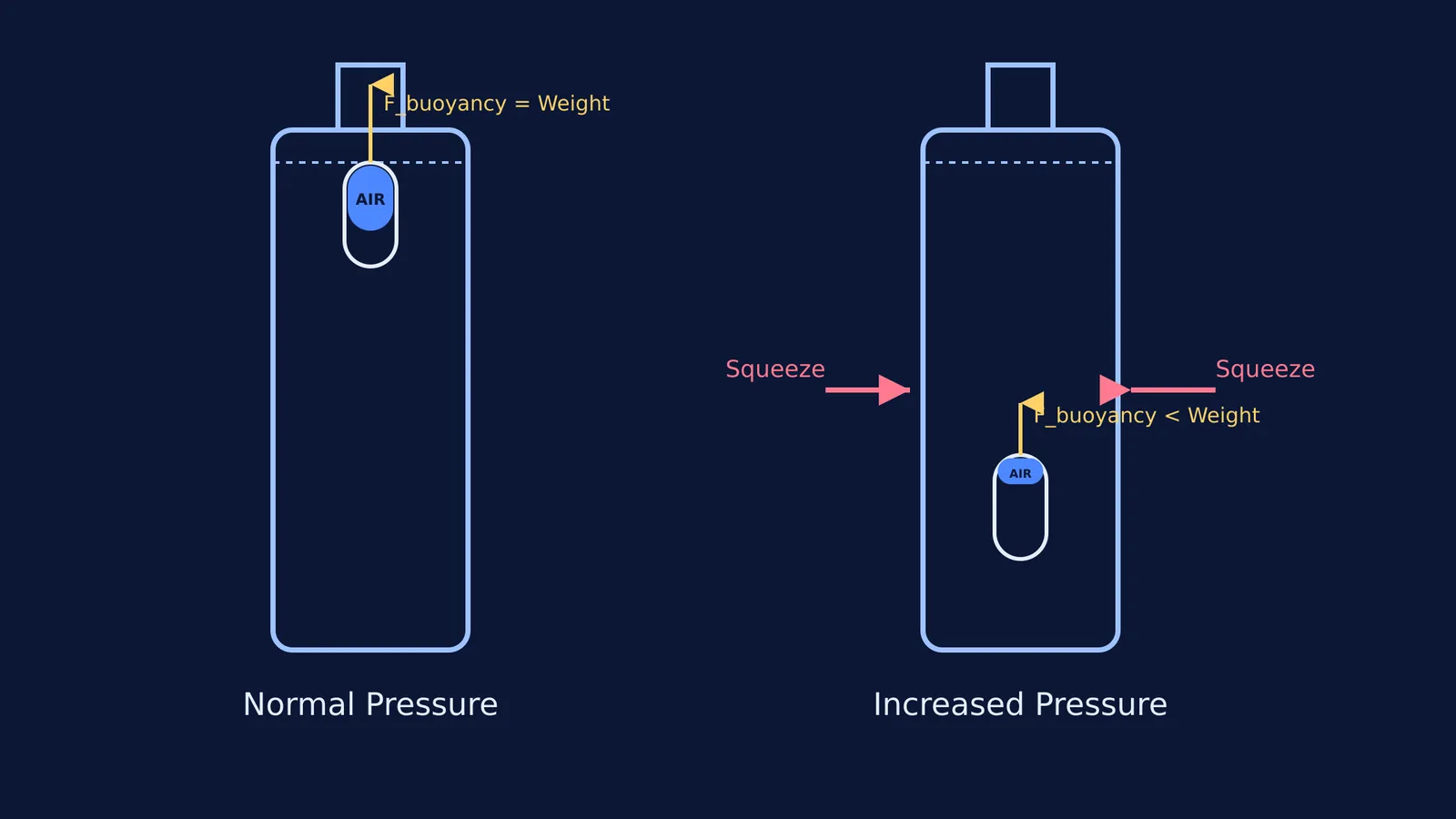
The secret lies in the tiny bubble of air trapped inside your diver. Water is an incompressible fluid, but air is highly compressible. When you squeeze the sides of the bottle, you apply pressure to the water. This is an everyday example of Pascal's law in hydraulic machines: lifting a car with a small push, which states that pressure applied to a confined fluid is transmitted undiminished in all directions.
Pascal's law explains how the force from your hand, applied to the outside of the flexible plastic bottle, reaches the diver floating deep inside. Because the water cannot be compressed, it acts almost like a solid, transferring the squeezing pressure instantly to the only thing in the bottle that can give way: the air bubble.
The water presses against the trapped air bubble. As we learn from the history of Robert Boyle: the air pump and the law of gases, Boyle's law dictates that as the pressure on a gas increases, its volume decreases. The higher pressure forces the air bubble inside the diver to shrink, allowing more water to enter the dropper.
Because the air bubble is now smaller, the diver displaces less water. Thanks to Archimedes on buoyancy and levers: what he wrote and what is legend, we know that an object is buoyed up by a force equal to the weight of the fluid it displaces. According to the Exploratorium, this compressed bubble reduces the diver's overall buoyancy. Once the upward buoyant force is less than the downward weight of the diver, gravity takes over and it sinks to the bottom.
What happens when you release the bottle?
When you let go of the bottle, the pressure inside instantly drops back to normal. The compressed air bubble springs back to its original size, pushing the extra water out of the diver. As its volume expands, it displaces more water, the upward buoyant force increases, and the diver rises back to the surface. It is a continuous cycle of sinking and floating, entirely controlled by the pressure you apply.
How do you make a Cartesian diver at home?
Building your own diver is the best way to test these principles. Here is a practical checklist to get it working perfectly:
The Bottle: Fill a clear, flexible plastic bottle with water to the very top. Leaving too much air at the top wastes your squeeze on compressing that air instead of the bubble in the diver.
The Diver: Use a glass eyedropper or a small plastic pipette. Draw up just enough water so that it barely floats—the top of the dropper should rest just at the water's surface. (Alternatively, test unopened soy sauce or ketchup packets in a bowl of water until you find one that barely floats).
The Test: Screw the cap on tightly to seal the system. Squeeze the wide sides of the bottle.
Troubleshooting: If the diver sinks immediately without squeezing, it is too heavy; squeeze a few drops of water out of it. If you squeeze as hard as you can and it still refuses to sink, it is too light; let a tiny bit more water into the dropper.
Watching the physics unfold
It is one thing to read about Boyle's law and buoyancy; it is another to see the bubble shrink in real time. If you want to look inside the bottle and measure the shifting forces, head to the Simulation Lab, which offers interactive simulations for the ideas that are easier to see than to read. You can predict what happens to the diver, change the pressure, and watch the trapped air bubble shrink.
As you experiment, Fermi's AI tutor can teach through the topic—writing on a board, drawing the figure, running the simulation, and checking understanding as it goes. By turning a fun kitchen experiment into a measurable physics problem, you bridge the gap between playing and understanding. Try the experiment in your kitchen, or explore more fluid dynamics in the Simulation Lab.


