

On this page
Biology tells us that human parents have an equal chance of having a boy or a girl. Yet, when you look at families around you, you might see parents with three girls or two boys, which does not look like a neat split. Why does this happen, and how does nature ensure the numbers balance out in the end?
In short The natural human sex ratio at birth is 1.056 boys for every girl, according to the UN Population Division's 2022 data, though chromosome biology predicts a strict 50:50 split. A simulation of 1,000 births shows that while small families often have unequal numbers, the overall population ratio always converges to an equal balance.
How do X and Y chromosomes decide a child's sex?
Human cells typically have 23 pairs of chromosomes, with the final pair determining sex. A mother carries two X chromosomes (XX), and a father carries one X and one Y chromosome (XY).
When parents have a child, the mother always passes on an X chromosome. The father has a 50% chance of passing on an X chromosome (resulting in an XX girl) and a 50% chance of passing on a Y chromosome (resulting in an XY boy). This process happens during meiosis when the father's body produces sperm cells. Because the father's sperm cells are split evenly between X and Y, the biological odds predict exactly half of all babies will be boys, and half will be girls. There is no biological memory of previous births; a family with five boys still has exactly the same chance of having a girl on their sixth attempt.
The process of fertilisation acts as a natural lottery. Millions of sperm cells, each carrying either an X or a Y chromosome, swim towards the egg. The first one to reach and fertilise the egg determines the genetic sex of the embryo. Because the swimming speed and viability of X-bearing and Y-bearing sperm are nearly identical, the outcome remains incredibly close to a fair draw every single time.
Why do some families have only boys or only girls?
If the odds are equal, why are families with three girls so common? It comes down to the mathematics of small samples.
Every birth is an independent event. The outcome of the first birth does not change the odds for the second. If you toss a coin three times, you have a 12.5% chance (one in eight) of getting three heads in a row. Similarly, a family having three children has a 12.5% chance of having three girls, and a 12.5% chance of having three boys. In small groups, extreme variation is completely normal and expected.
When we observe small sets of data, our brains often search for patterns where none exist. We might assume that a family with four girls is somehow biologically predisposed to having daughters. However, in the vast majority of cases, this is simply the expected statistical clustering that happens when you run a random process just a few times. If you flip a coin enough times, you will eventually see streaks of five or six heads in a row, purely by chance.
Why are boys and girls born in equal numbers?
While individual families vary wildly, a large population smooths out these extremes. This is known in mathematics as the law of large numbers.
As the number of births grows, the random streaks of boys or girls cancel each other out. Out of 100 births, you might see 54 boys and 46 girls. But out of one million births, the ratio will sit tightly against the underlying probability.
However, the reality is not exactly equal. The global sex ratio at birth in 2022 was 1.056 male births for every female birth, according to the World Bank. Evolutionary biologists, tracing back to Fisher's principle, suggest that this slight male bias at birth evolved because males have slightly higher mortality rates in early life. If a population produced exactly equal numbers of males at birth, the higher mortality would leave fewer males than females by adulthood. Natural selection fixes this by favouring a slight overproduction of males, ensuring that the total parental investment in both sexes is equalised and the population ratio balances out to a perfect even split by the time the individuals reach reproductive age.
This evolutionary balancing act ensures that when a generation reaches the age where they begin forming their own families, there is roughly one male for every female. This maximises the reproductive success of the population as a whole.
What does a simulation of one thousand births show?
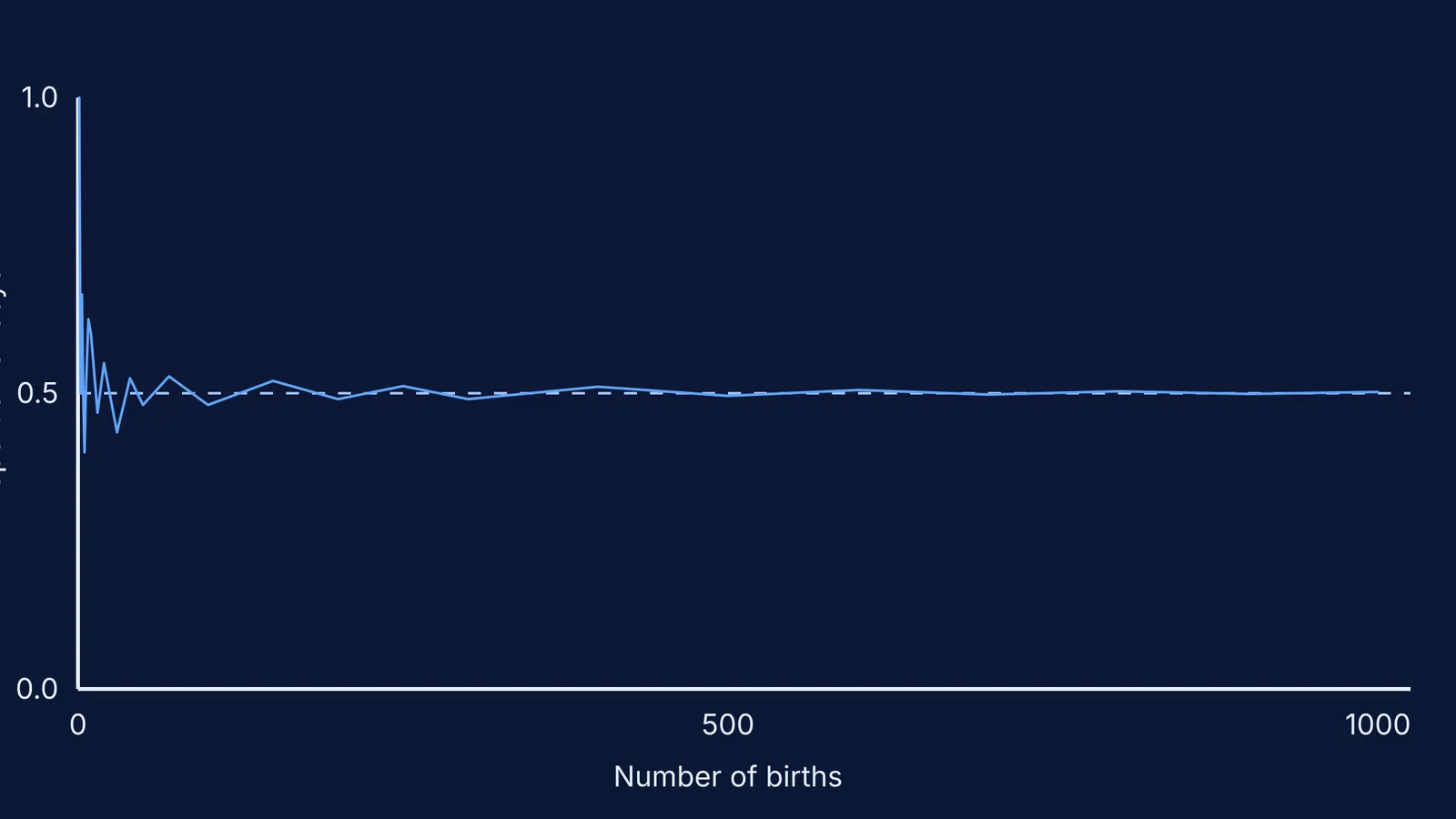
To see the law of large numbers in action, we can simulate one thousand births where each baby has an equal probability of being a boy.
The first ten births: The ratio swings violently. After two births, you might have all boys. After five, it might drop to a lower proportion. This mirrors what we see in individual families or small school classrooms.
The first hundred births: The swings become smaller. The ratio might dip slightly or rise slightly, but it no longer hits the extremes. This is the scale of a small village or a single hospital over a few months.
By one thousand births: The line flattens out, hovering closely around the true probability. At the scale of a city or a country, the number of male and female births will be nearly identical.
If you want to change the parameters or run this experiment yourself, the Fermi Simulation Lab has interactive simulations for the ideas that are easier to see than to read. You can watch the graph build in real time as the sample size grows. If you are studying the underlying biology instead, Fermi's AI tutor can explain and work through problems alongside the student, whether you are tackling the details of Mendelian genetics or dealing with assertion-reason questions in your exam preparation.


