

On this page
When predicting how atoms bind together, drawing Lewis structures is a good start. But Molecular Orbital (MO) theory gives us a much more powerful tool to predict bond strength, bond length and even magnetic properties by looking at exactly where the electrons go.
By comparing the electron configurations of different diatomic molecules, you can easily rank them by how tightly their atoms are held together. MO theory is especially useful because it explains phenomena that simple Lewis structures cannot, such as why liquid oxygen is attracted to a magnet.
What is the relationship between bond order and bond length?
In MO theory, atomic orbitals from each atom combine to form molecular orbitals that span the entire molecule. Some of these are bonding orbitals, which concentrate electron density between the nuclei and pull them together. Others are antibonding orbitals (marked with a star, like π* or σ*), which have nodes between the nuclei and push the atoms apart.
The bond order tells us the net number of chemical bonds between the atoms. You find it by taking the difference between the number of bonding electrons and antibonding electrons, and then halving it.
The rule is simple and consistent across diatomic molecules: a higher bond order means a stronger, shorter bond because there is more net electron density pulling the two positively charged nuclei together. A lower bond order means a weaker, longer bond, which is easier to break.
Which molecule has the shortest bond length?
In exams, you are often asked to compare nitrogen (N₂) and oxygen (O₂). Nitrogen is in Group 15, so an N₂ molecule has 10 valence electrons. Following the filling rules for diatomic molecules, these electrons fill the bonding σ and π orbitals, with none left over for the higher-energy antibonding orbitals.
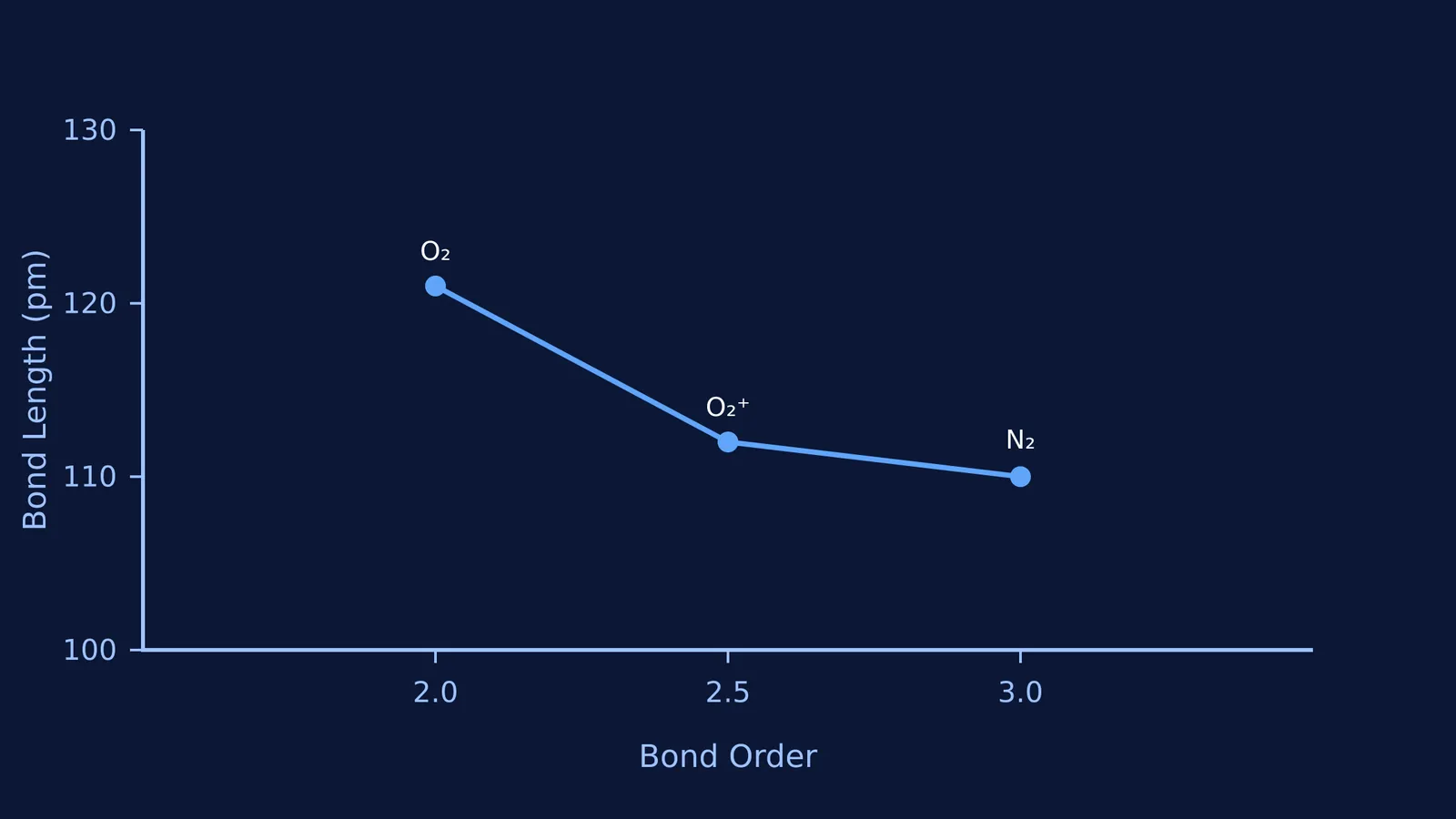
With 8 bonding valence electrons and 2 antibonding valence electrons (from the 2s level), the bond order is (8 − 2) / 2 = 3. This triple bond gives nitrogen a very short bond length of 110 pm (Chem LibreTexts/Chemical_Bonding/Molecular_Orbital_Theory)). Because all its electrons are paired up in the molecular orbitals, N₂ is diamagnetic and repels magnetic fields slightly. With a bond order of 3, N₂ has the shortest bond of the three.
Why is the O₂⁺ bond shorter than the O₂ bond?
Oxygen has one more valence electron per atom than nitrogen. In a neutral O₂ molecule, the 12 valence electrons fill the same bonding orbitals as nitrogen, but the last two electrons are forced into the higher-energy π* antibonding orbitals.
These two antibonding electrons reduce the net bonding effect. The bond order for O₂ is (8 − 4) / 2 = 2. This double bond is longer, measuring 121 pm (Chem LibreTexts/Chemical_Bonding/Molecular_Orbital_Theory)). The two electrons go into separate π* orbitals with parallel spins according to Hund's rule, which explains why O₂ is paramagnetic and is attracted to magnets.
What happens if we remove an electron to make the O₂⁺ cation? We are taking that electron away from an antibonding orbital. Removing a "bond-weakening" electron actually strengthens the overall bond. The bond order increases to (8 − 3) / 2 = 2.5, and the bond length shrinks to 112 pm (Chem LibreTexts/Chemical_Bonding/Molecular_Orbital_Theory)).
So, if you need to arrange these species by bond length from shortest to longest, the correct order is N₂ (110 pm) < O₂⁺ (112 pm) < O₂ (121 pm).
How do you draw molecular orbital energy diagrams?
Drawing these energy levels on paper gets messy, especially when you need to remember the order of σ and π orbitals for different elements. In the Fermi Simulation Lab, you can see how atomic orbitals overlap to form bonding and antibonding molecular orbitals, making the energy diagrams easier to follow.
If you are comparing bonds inside larger molecules, you might need to calculate the average bond order from resonance. You can also predict how polar a bond is by finding the percentage ionic character from dipole moment. Knowing how to use these tools will help you tackle the hardest bonding questions with confidence.


