

On this page
A spray that leaves only a trace in the water can end up concentrated in the animal at the top of the food chain. Here you add DDT to a four-level food chain, predict the concentration at each level, and check your prediction against real measurements.
Why do pesticides build up in top predators?
Three properties come together. The US Environmental Protection Agency describes DDT as "very persistent in the environment" and says it "will accumulate in fatty tissues" (EPA).
It lasts. DDT does not break down quickly, so last season's spray is still around.
It hides in fat. A fat-soluble chemical stays stored in the body instead of being flushed out like water-soluble waste.
Predators eat many prey. Most of the food's energy gets burned up, but the stored DDT stays behind.
So the chemical becomes more concentrated at every step up. That build-up from one level to the next is called biomagnification.
How do you predict DDT at each level of a food chain?
Here is a toy model for paper or a spreadsheet. The rules are assumptions chosen to show the logic, not measurements. We start at the plankton value measured in a 1967 study (Woodwell, Wurster and Isaacson, Science).
Each animal eats 10 kg of food from the level below to build 1 kg of body.
A fraction R of the DDT it eats stays in its body; the rest is excreted.
So each level's concentration is the level below multiplied by 10 × R.
Write your prediction for the top bird before reading on.
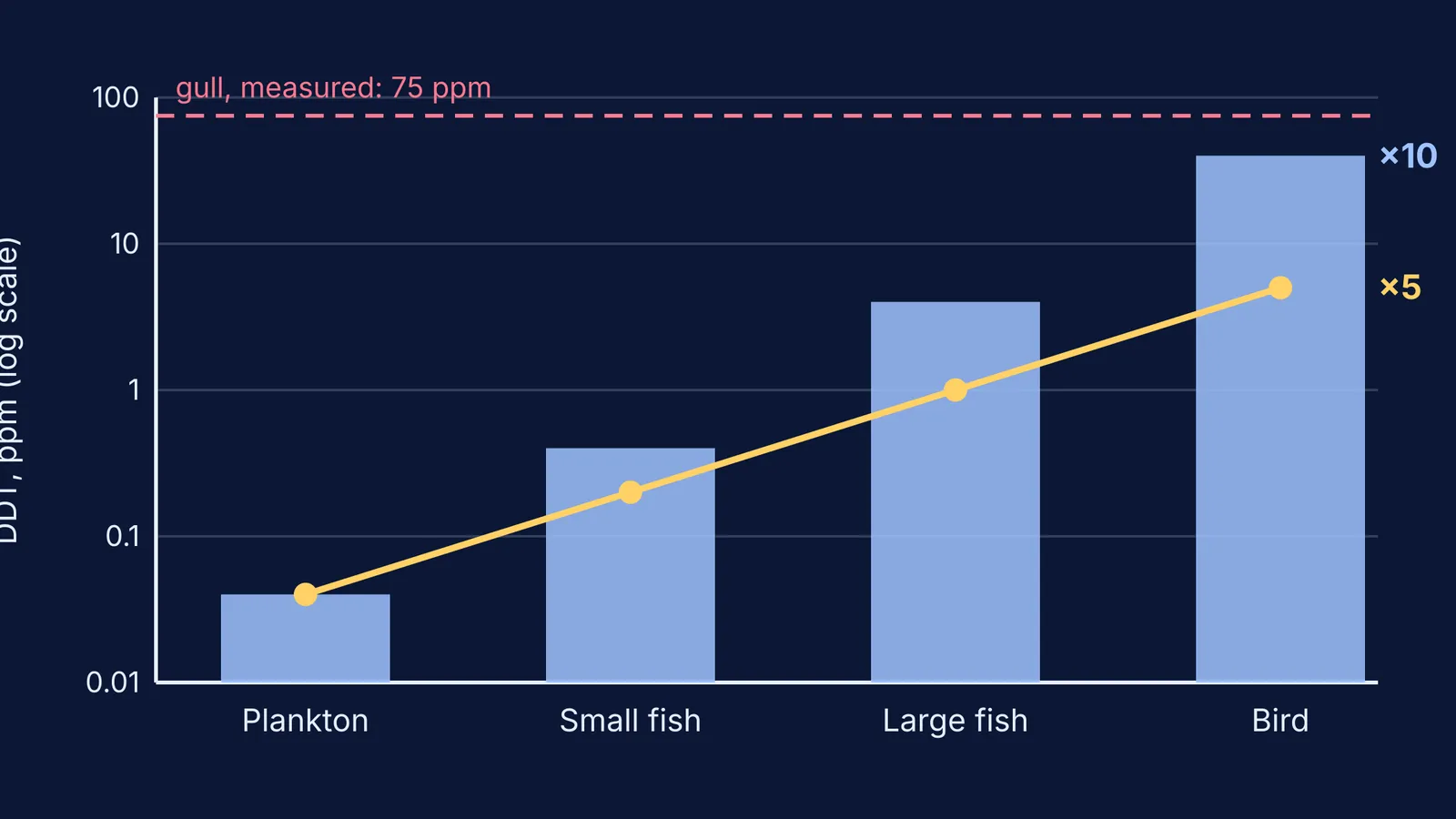
With R = 1 (keeps all of it), the multiplier is 10:
Plankton: 0.04 ppm
Small fish: 0.4 ppm
Large fish: 4 ppm
Fish-eating bird: 40 ppm
With R = 0.5 (keeps half), the multiplier is 5: 0.04, 0.2, 1 and 5 ppm.
Now try R = 0.1. The multiplier becomes 1 and nothing builds up: biomagnification happens only because the chemical stays in the body.
What did the real Long Island measurements show?
George Woodwell, Charles Wurster and Peter Isaacson sampled a salt marsh on Long Island, New York, where DDT residues in the soil averaged more than 13 pounds per acre (Science, 1967).
DDT in that marsh rose from 0.04 parts per million in plankton to 75 parts per million in a ring-billed gull, more than three orders of magnitude (Woodwell et al., 1967).
The authors also found that birds carried 10 to 100 times more DDT than fish. The real gull sits above even the keep-everything prediction of 40 ppm, so real chains may have more links, or birds may eat more for their size than the model assumes. Which assumption would you change first?
Why did DDT harm bald eagles?
The US Fish and Wildlife Service explains that DDT washed into waterways, fish absorbed it, and bald eagles were poisoned when they ate the contaminated fish. The chemical interfered with the birds' ability to produce strong eggshells, so eggs often broke during incubation or failed to hatch (USFWS). Joseph Hickey and Daniel Anderson reported that three birds of prey in steep decline in the United States showed eggshell thinning that began in 1947 and reached 19 percent or more (Science, 1968).
The same USFWS page records only 417 known nesting pairs of bald eagles in 1963. The EPA cancelled DDT in 1972 (EPA). The eagle was removed from the endangered species list on 28 June 2007, and estimates based on 2018-19 data put the lower 48 states at 71,467 breeding pairs (USFWS). How the alarm was first raised is told in our post on Rachel Carson and Silent Spring.
Does biomagnification still matter in India?
Yes. India's Department of Chemicals and Petrochemicals states that DDT is banned for agriculture but still produced in a restricted way for vector control (fighting disease-carrying insects), under a Stockholm Convention exemption (Government of India). For the exam version, read biological magnification explained for Class 10.
How can you test your prediction in a simulation?
Write down your prediction for the top predator before you run anything.
Change one thing at a time: R, food eaten per kg of body, or the number of levels.
Plot on a log scale, so 0.04 and 40 fit on one chart.
Find the setting where nothing builds up, and explain why in one sentence.
Compare your best run with the 75 ppm gull and name the assumption you would change.
The Fermi Simulation Lab has interactive simulations for the ideas that are easier to see than to read. For why a moving model can teach better than a fixed figure, read simulations vs static diagrams.


