

On this page
If you pick a box at random and draw a gold coin, your brain immediately tells you there are only two possible boxes left. Since one has a gold coin remaining and the other has a silver coin, the odds must be equal, right?
Welcome to the Bertrand box paradox, a mathematical puzzle that has tripped up students and professors alike since the 19th century. First published by Joseph Bertrand in his 1889 book *Calcul des Probabilités* (Wikipedia), the puzzle is a perfect example of how our intuition struggles with conditional probability.
Here is how the paradox works, why the real answer is surprising, and an experiment you can run at your desk to prove it.
What is the Bertrand box paradox?
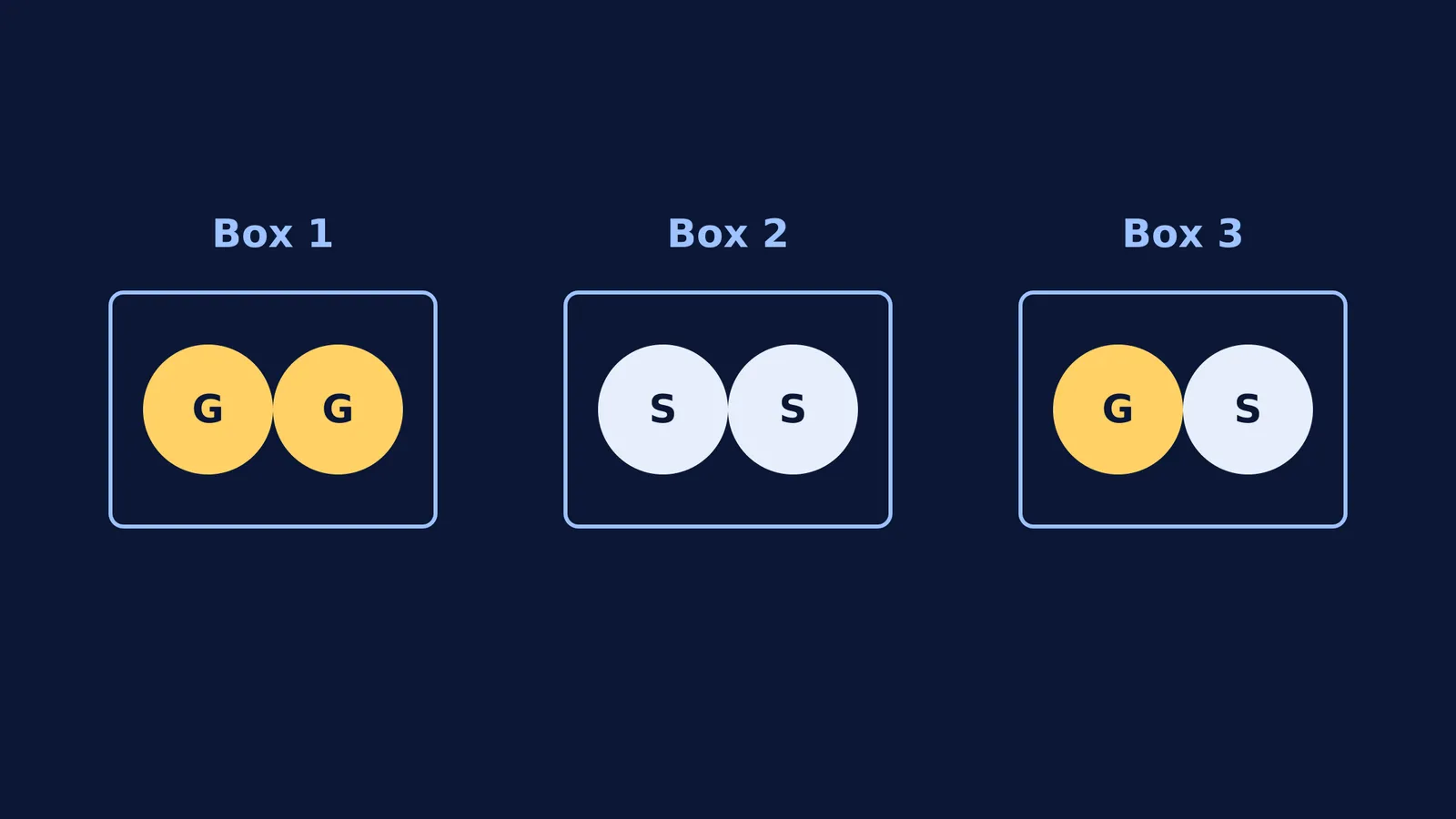
The setup is simple, as described in the original puzzle (Wikipedia). Imagine you have three identical boxes. Inside each box are two coins:
Box 1: Two gold coins (GG)
Box 2: Two silver coins (SS)
Box 3: One gold coin and one silver coin (GS)
You close your eyes, pick one of the three boxes at random, and reach inside to pull out a single coin. You look at it, and it is gold.
Now for the question: what is the probability that the remaining coin in that box is also gold?
Why is the Bertrand box paradox gold coin probability 2/3?
Most people guess 1/2. They reason that since you are holding a gold coin, you cannot have picked Box 2 (which only has silver coins). That leaves Box 1 (GG) and Box 3 (GS). With two boxes left, it feels like a coin flip.
But the actual probability is 2/3 (Wikipedia).
The mistake is counting the remaining *boxes* rather than counting the remaining *coins*. You did not pick a box; you picked a single coin from a pool of coins. In total, there are exactly three gold coins across all the boxes. Let us label them to keep them straight:
Gold Coin A (from Box 1)
Gold Coin B (also from Box 1)
Gold Coin C (from Box 3)
Since you picked a gold coin blindly, you are equally likely to be holding Coin A, Coin B, or Coin C.
Look at what is left in the box for each of those three outcomes:
If you are holding Gold Coin A, the other coin is Gold Coin B.
If you are holding Gold Coin B, the other coin is Gold Coin A.
If you are holding Gold Coin C, the other coin is the silver coin in Box 3.
In two out of the three equally likely scenarios, the other coin in the box is gold. Therefore, the probability is 2/3.
A desk experiment: run trials and count
The best way to overcome a probability paradox is to test it. You can predict the chance the other coin is gold after you pull a gold coin from a random box, then run trials and count the outcomes yourself.
Here is your practical plan:
Gather materials: Take three opaque cups. Find three gold-coloured coins and three silver-coloured coins.
Set up the boxes: Put two gold coins in the first cup, two silver coins in the second, and one of each in the third.
Run a trial: Shuffle the cups. Pick a cup at random and pull out one coin without looking at the other.
Filter the results: If you pull a silver coin, put it back and restart. This is a discarded trial because the paradox specifically asks what happens *given* that the first coin is gold.
Record the successes: If you pull a gold coin, guess what the other coin is, check the cup, and mark a tally on a sheet of paper.
Repeat this process for many valid trials where the first coin is gold. Your tally of the remaining coins will not be equal. Instead, you will see a clear majority of gold outcomes, proving the odds with your own hands. This hands-on approach is much more effective than just reading about with and without replacement: probability problems compared.
How Bayes' theorem explains the trap
When you pull a gold coin, it gives you new information about which box you are likely holding.
Box 1 contains only gold coins, while Box 3 contains a mix. Because Box 1 has more gold coins to offer, you are more likely to have reached into Box 1 than Box 3. This mathematical update of your beliefs based on new evidence is the core of conditional probability and Bayes' theorem: a three-step method.
When students struggle with concepts like this, seeing the problem play out visually makes a huge difference. If you want to test paradoxes without doing manual draws, the Fermi Simulation Lab lets you run millions of simulated trials instantly, allowing you to watch the probability settle exactly on 2/3 in real time.


