

On this page
Balancing an equation is bookkeeping. Every atom that goes into a reaction comes out of it, so you count each element on both sides and adjust until the counts match. The hard part is knowing which numbers you may change.
What does balancing a chemical equation mean?
A balanced chemical equation has equal numbers of atoms of each element on the reactant and product sides, as the law of conservation of matter requires (OpenStax Chemistry 2e). Coefficients are the numbers written immediately to the left of each formula; they give the relative numbers of each substance that react or form.
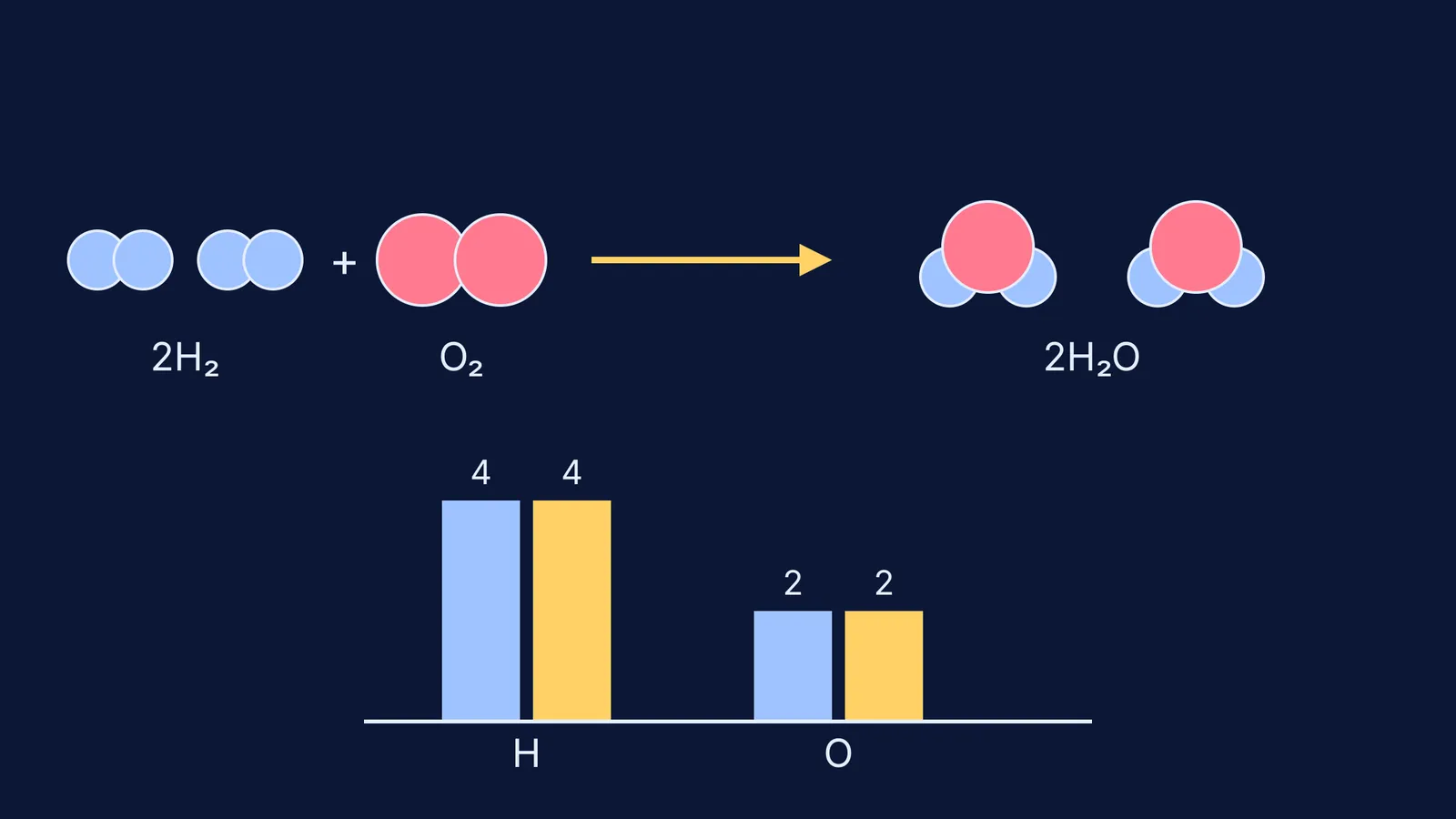
The number of atoms of an element is its coefficient multiplied by its subscript, added across every formula on that side (OpenStax Chemistry 2e). So 2H₂O holds 2 × 2 = 4 hydrogen atoms and 2 oxygen atoms. For where the idea came from, read how Lavoisier showed that mass is conserved in reactions.
Why change coefficients and never subscripts?
Subscripts are part of what the substance is. OpenStax says formula subscripts "cannot be changed without altering the qualitative meaning of the equation" (OpenStax Chemistry 2e). Change H₂O to H₂O₂ and the oxygen count rises, but you have written hydrogen peroxide, a different compound. The equation balances, and it is wrong.
How do you use an atom counter to balance equations?
An atom counter is a running tally of each element on each side, updated every time you change a coefficient. PhET's free Balancing Chemical Equations simulation is an interactive one: you add or remove molecules while bar charts and balance scales show when the equation is in balance, and a game offers three levels of difficulty (ComPADRE listing of the PhET simulation). For the wider evidence on this format, see what PhET research says interactive simulations are good for. An activity built on it by the American Association of Chemistry Teachers lists telling coefficients from subscripts as a learning objective (AACT classroom resource).
On paper:
Draw the counter: one row per element, a Left and a Right column.
Predict the coefficients and write your guess in the margin.
Start with an element that appears in one formula on each side; where you can, leave uncombined elements such as O₂, H₂ or Fe for last.
Change one coefficient, then update every row it affects.
Reduce to the smallest whole numbers and compare with your prediction.
Why predict first? In a Harvard study of classroom physics demonstrations, students who predicted the outcome before seeing it showed significantly greater understanding, while students who only watched did no better than those who never saw it (Crouch, Fagen, Callan and Mazur, American Journal of Physics, 2004). Use the same habit here: commit to a guess, then let the counter show where you went wrong.
Five worked cases: can you predict them first?
Cover each answer and predict. Counts are written Left | Right.
Case 1: water. H₂ + O₂ → H₂O. Counter: H 2 | 2, O 2 | 1. Write 2H₂O (not H₂O₂): H 2 | 4, O 2 | 2. Then 2H₂. Answer: 2H₂ + O₂ → 2H₂O.
Case 2: methane burning. CH₄ + O₂ → CO₂ + H₂O. Carbon is 1 | 1. Hydrogen is 4 | 2, so 2H₂O. Oxygen on the right is now 2 + 2 = 4, so 2O₂. Answer: CH₄ + 2O₂ → CO₂ + 2H₂O, the result OpenStax also works through.
Case 3: iron and steam. Fe + H₂O → Fe₃O₄ + H₂. Oxygen first: 1 | 4, so 4H₂O. Hydrogen is now 8 | 2, so 4H₂. Iron, left till last, is 1 | 3, so 3Fe. Answer: 3Fe + 4H₂O → Fe₃O₄ + 4H₂.
Case 4: aluminium oxide, the odd-even trap. Al + O₂ → Al₂O₃. Oxygen is 2 | 3, and the smallest number both go into is 6, so 3O₂ and 2Al₂O₃. Aluminium is then 1 | 4, so 4Al. Answer: 4Al + 3O₂ → 2Al₂O₃. The tempting wrong move is rewriting the oxide as AlO.
Case 5: lead nitrate and potassium iodide. Pb(NO₃)₂ + KI → PbI₂ + KNO₃. Nitrate survives unchanged, so count NO₃ as one unit: 2 | 1, so 2KNO₃. Potassium is then 1 | 2, so 2KI. Answer: Pb(NO₃)₂ + 2KI → PbI₂ + 2KNO₃, with Pb, N, O, K and I all matching.
When oxidation states change and trial and error stalls, switch to oxidation numbers and half-reactions for redox equations.
What mistakes should you check before an exam?
Changing a subscript, or adding an atom inside a formula.
Forgetting that a subscript outside brackets multiplies everything inside: Pb(NO₃)₂ has 6 oxygen atoms.
Leaving a ratio unreduced: 4H₂ + 2O₂ → 4H₂O balances, but the usual practice is the smallest whole numbers (OpenStax Chemistry 2e).
If pictures help you more than a tally, the Fermi Simulation Lab has interactive simulations for the ideas that are easier to see than to read. If you keep landing on the wrong coefficients, the Fermi Problem Library has a step-by-step solver that explains the reasoning rather than printing an answer.
Tonight, take five unbalanced equations from your textbook: predict each, run the counter, and mark where your guess went wrong.


