

On this page
When learning atomic structure, writing electron configurations often feels like following a rigid timetable. Students memorize *Aufbau* ("building up") and trace diagonal arrows to place electrons into subshells. While this recipe holds for main-group elements, the first transition series brings surprises: iron obeys the (n + l) rule, but copper breaks it. Understanding real configurations requires looking at the electrostatic and exchange forces that govern multi-electron atoms.
How does the Aufbau principle determine electron filling order?
The Aufbau principle states that ground-state atoms fill subshells in order of increasing orbital energy. Under the Bohr-Bury (n + l) rule detailed in OpenStax Chemistry 2e, electrons enter the subshell with the lowest sum of principal quantum number n and azimuthal quantum number l. When two subshells tie, the one with smaller n fills first.
Two quantum rules govern electron placement within subshells:
The Pauli exclusion principle restricts each orbital to at most 2 electrons with opposite spins.
Friedrich Hund's rule of maximum multiplicity requires occupying degenerate orbitals singly with parallel spins before pairing.
This rule explains why potassium (Z = 19) and calcium (Z = 20) fill the 4s subshell (n + l = 4) before the 3d subshell (n + l = 5).
How do you predict the electron configuration of iron?
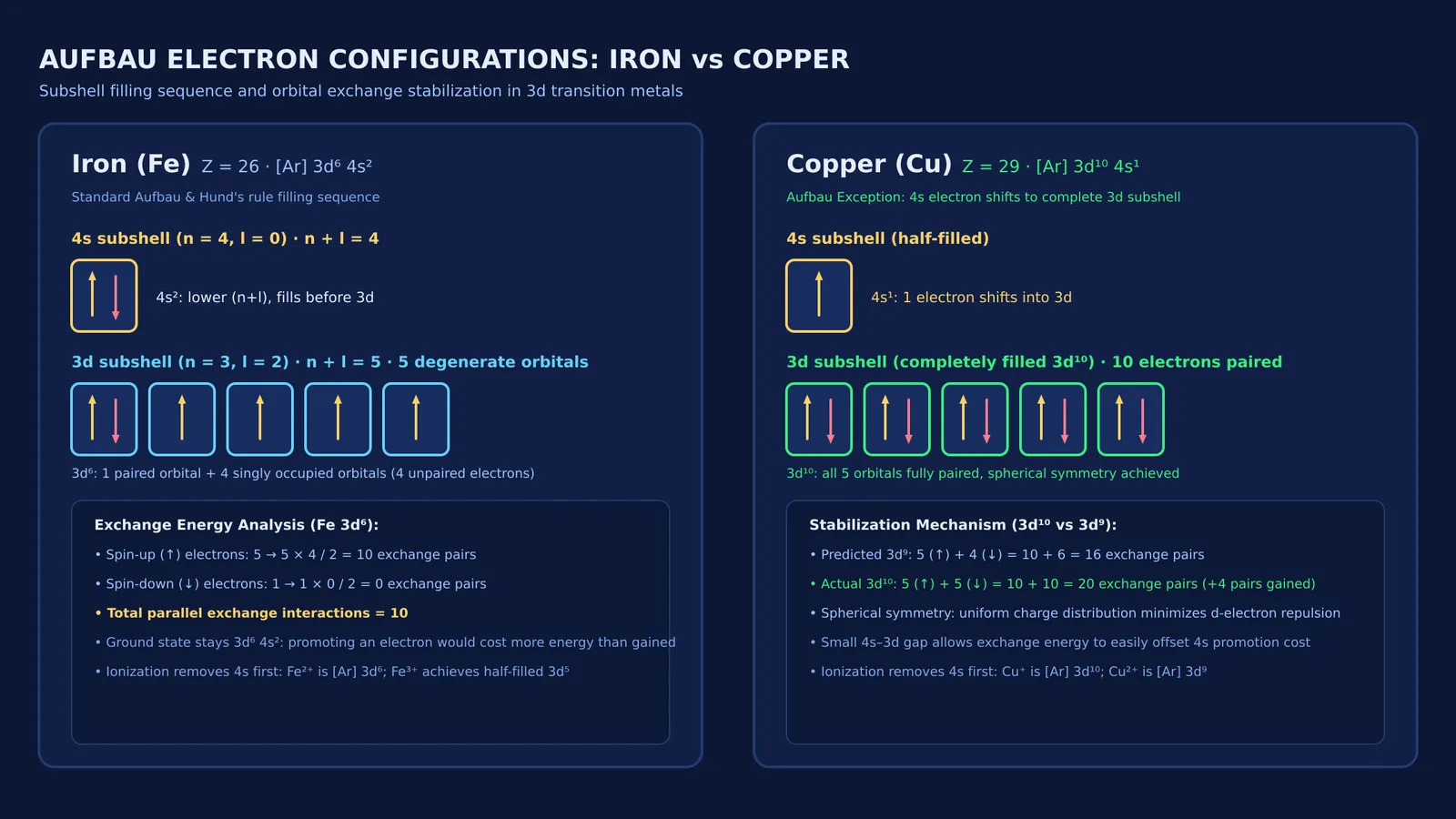
Neutral iron has atomic number Z = 26. According to OpenStax Chemistry 2e, writing its ground state starts from the preceding noble gas core, Argon (Z = 18), with configuration 1s² 2s² 2p⁶ 3s² 3p⁶. The remaining 8 valence electrons distribute across 4s and 3d:
By the (n + l) rule, 2 electrons fill 4s, completing the 4s² pair.
Hund's rule places 5 of the remaining 6 electrons singly into the five 3d orbitals with parallel spins (+1/2).
The 6th electron pairs up in the first 3d orbital, leaving 4 unpaired electrons.
The resulting configuration is [Ar] 3d⁶ 4s². Removing two 4s electrons yields Fe²⁺, while losing a third electron gives the symmetric half-filled 3d⁵ subshell of Fe³⁺, as explored in our guide to electron configurations of transition metal ions.
Why is copper an exception to the Aufbau principle?
For copper (Z = 29), Aufbau predicts [Ar] 3d⁹ 4s². Spectroscopic measurements show the true ground state is [Ar] 3d¹⁰ 4s¹. Shifting one electron from 4s to 3d lowers the total energy through two factors detailed in OpenStax Chemistry 2e and analyzed by Melvyn Melrose and Eric Scerri:
Exchange energy: Parallel-spin electrons within degenerate orbitals exchange positions, releasing stabilizing exchange energy. In 3d⁹, 5 spin-up electrons yield 10 exchange pairs and 4 spin-down electrons yield 6 pairs (16 total). In 3d¹⁰, both spin sets have 5 electrons, giving 10 + 10 = 20 exchange pairs. Gaining 4 exchange interactions stabilizes the atom.
Symmetrical charge distribution: Completely filled subshells possess spherical symmetry, which minimizes electron repulsion.
Because the 4s–3d energy gap is small in the first transition series, exchange stabilization and reduced repulsion easily offset the electron promotion cost.
What happens when you simulate orbital filling one electron at a time?
Textbook charts treat orbitals as fixed energy slots. In reality, orbital energies shift dynamically as nuclear charge grows. W. H. Eugen Schwarz demonstrated that from scandium onward, the 3d subshell contracts and drops below 4s.
Inquiry-based studies by Xiao Li and colleagues show that interactive exercises deepen conceptual understanding by replacing passive memorization with orbital manipulation. Research by Carl Wieman and colleagues similarly confirmed that dynamic simulations help students build intuitive mental models of quantum systems.
Interactive tools make these energetic crossovers visible. The Fermi Simulation Lab provides interactive simulations for ideas that are easier to see than to read, letting you add electrons sequentially and observe why copper flips to 3d¹⁰. To explore broader periodic trends, the Fermi Concept Library maps every concept in physics, chemistry, biology, mathematics and computing, each with its own lesson and its place in the map.
How should you write transition metal configurations without errors?
Standard problem-solving methods in OpenStax Chemistry 2e recommend a structured sequence:
Identify atomic number Z and check whether the atom is neutral or an ion.
Write down the preceding noble gas core.
Apply the (n + l) rule to allocate valence electrons across ns and (n-1)d orbitals.
Check for d⁴ and d⁹ configurations: shift one outer s electron to produce chromium [Ar] 3d⁵ 4s¹ and copper [Ar] 3d¹⁰ 4s¹.
For cations, always remove electrons from the highest principal quantum number first (strip 4s before 3d).
When practicing questions on the chemistry of d- and f-block elements, the Fermi Problem Library offers worked problems with a step-by-step solver that explains the reasoning rather than printing an answer.


