

On this page
Physics connects everyday objects through the simple rule of pressure. Whether you are slicing vegetables in the kitchen or carrying heavy textbooks to school, the same physical laws govern how objects interact with surfaces.
Why do sharp knives cut better?
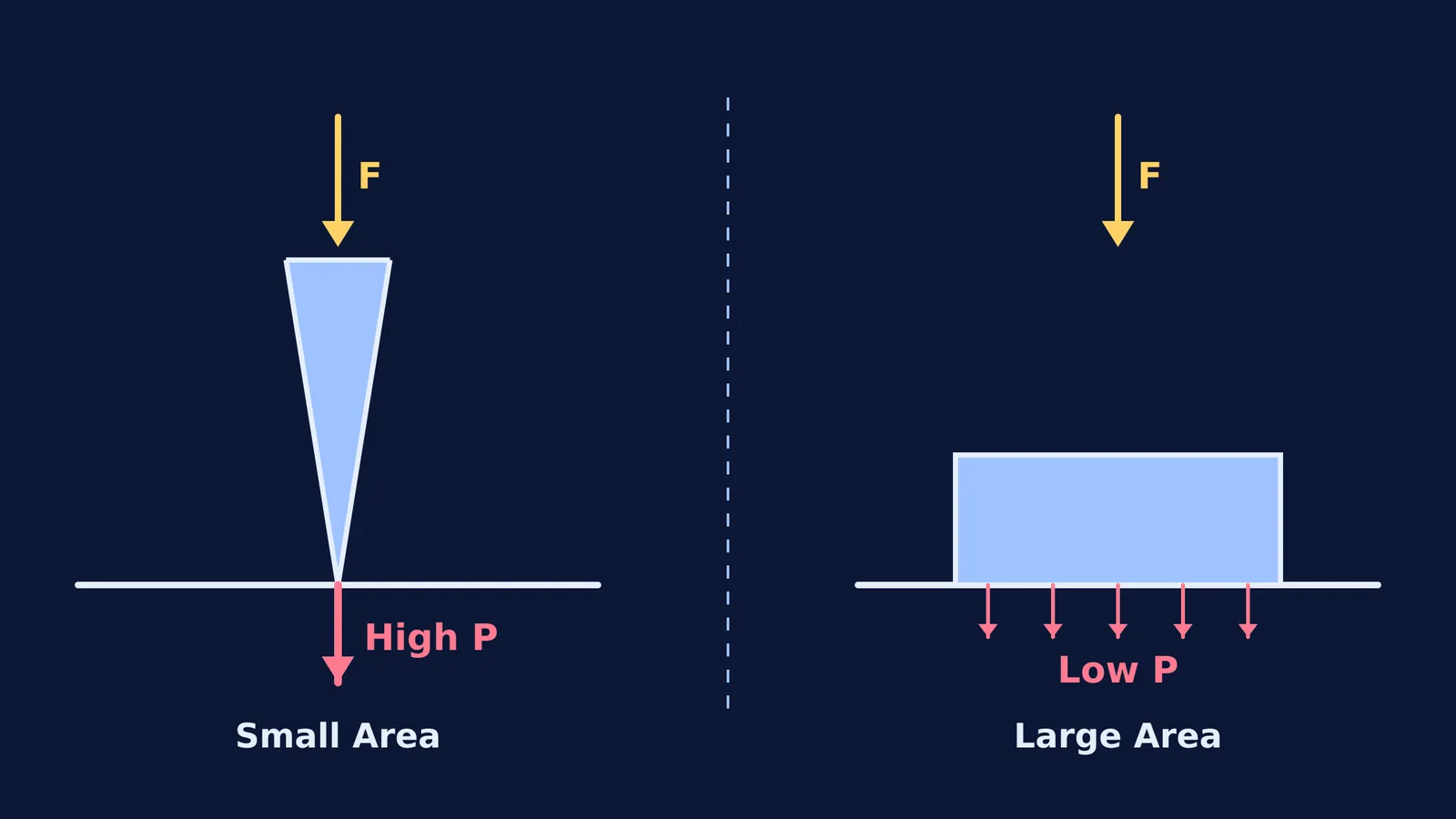
To understand how a knife works, you have to look at the mathematical relationship between force, area, and pressure. Pressure is the force acting on a unit area of a surface. This definition comes directly from the NCERT Class 8 Science curriculum.
When you push down on a tomato, your hand applies a specific amount of force measured in Newtons. A sharp knife has an extremely thin edge, meaning the area of contact with the tomato is tiny—often just a fraction of a square millimetre. Because pressure is calculated by dividing the force by the area, dividing a standard force by a tiny number creates a massive resulting pressure. That high pressure is what overcomes the structural integrity of the vegetable's skin and splits it so easily. A blunt knife, on the other hand, has a thicker edge. The larger area of contact means the pressure drops, and you have to push down much harder to cut.
If you take this scenario to Fermi's AI tutor, it will not simply recite the formula. It works out what you already know by asking you to compare the edge of a butter knife to a chef's knife. By guiding you to realise that the area of contact is the key difference, the tutor ensures you actually understand the mechanics of cutting.
Why do school bags have wide straps?
The exact opposite principle protects you when you carry a heavy load. Your textbooks and supplies have a fixed mass, which means they pull down on your shoulders with a constant force due to gravity.
If a heavy bag had thin string straps, the area of contact with your skin would be incredibly small. Just like the edge of the knife, that small area of contact would turn the weight of the bag into high, painful pressure digging into your shoulders and restricting blood flow.
By designing the bag with wide straps, the manufacturer spreads that identical downward force over a much larger area of contact. Dividing the same force by a larger area results in lower pressure, keeping your shoulders comfortable even on long walks to school.
This concept of distributing force across a surface is the exact same logic you use when calculating the contact force between blocks pushed together on a smooth floor. The wider the contact base, the more dispersed the force becomes, lowering the pressure at any single point.
Why does the area of contact matter so much?
The area of contact is the secret multiplier in the pressure equation. Because it sits in the denominator of the fraction (P = F/A), any change to the area has an inverse effect on the pressure.
If you decrease the area of contact, you proportionally increase the pressure. If you increase the area of contact—such as switching from narrow string straps to wide, padded ones—you proportionally reduce the pressure. This mathematical trick is used everywhere in engineering and nature. It is why camels can walk on loose sand without sinking (broad hooves increase the area of contact) and why nails have pointed tips (a tiny area of contact easily pierces wood).
How can I use AI to learn physics concepts?
When you get stuck on a core idea like force and pressure, using an AI tutor acts as an interactive sounding board. Rather than passively reading a textbook chapter and hoping the equations stick, you actively work through real-world problems.
For example, if you are struggling with the mathematical relationship between the variables, the AI can open the Concept Library to map out exactly how force and area interact. Instead of lecturing you, it holds a line of reasoning across the session. It notices if you confuse force (which stays the same whether the strap is wide or thin) with pressure (which changes based on the strap's width), and decides whether to explain the difference directly or ask you a clarifying question to help you discover the mistake yourself.
What is a good prompt to check my understanding of pressure?
A great way to study is to force yourself to retrieve information and apply it. Here is a step-by-step plan you can use to test your knowledge with an AI tutor:
Open a new chat session and state the topic you want to practice.
Paste the prompt: "I am learning about force and pressure. Give me a scenario involving a heavy object resting on a surface, and ask me questions to help me calculate the pressure. Do not solve it for me; guide me step by step through the math."
Answer the tutor's first question to the best of your ability.
If you get stuck, ask the tutor to draw a diagram showing the force vectors and the area of contact.
By working through the numbers yourself, you build a durable understanding of the physics. Once you master the basics of solids, you will be ready to tackle more complex topics like Pascal's law in hydraulic machines: lifting a car with a small push, where you learn how pressure is transmitted through liquids.


