

On this page
Why does generic AI give too much information for NCERT?
When preparing for the National Eligibility cum Entrance Test (NEET-UG) administered by the National Testing Agency, students often use artificial intelligence to clarify difficult molecular biology chapters. However, general AI models are trained on extensive biomedical literature such as university textbooks by Lehninger, Alberts, and Watson. When asked to explain gene expression, standard models describe complex protein complexes and transcription factor cascades. While scientifically accurate, this surplus detail distracts from Indian entrance examination marking schemes.
According to research in cognitive psychology by Sweller et al. (2019), presenting excessive and uncurated material imposes heavy extraneous cognitive load on learners, hindering long-term schematic retention. The official curriculum published by the NCERT tests specific biological terminology, explicit directionalities, and precise numerical rates. To study effectively with AI, you must instruct the model to separate university-level biochemistry from the exact concepts required by the Class 12 textbook.
What replication details does NCERT expect you to know?
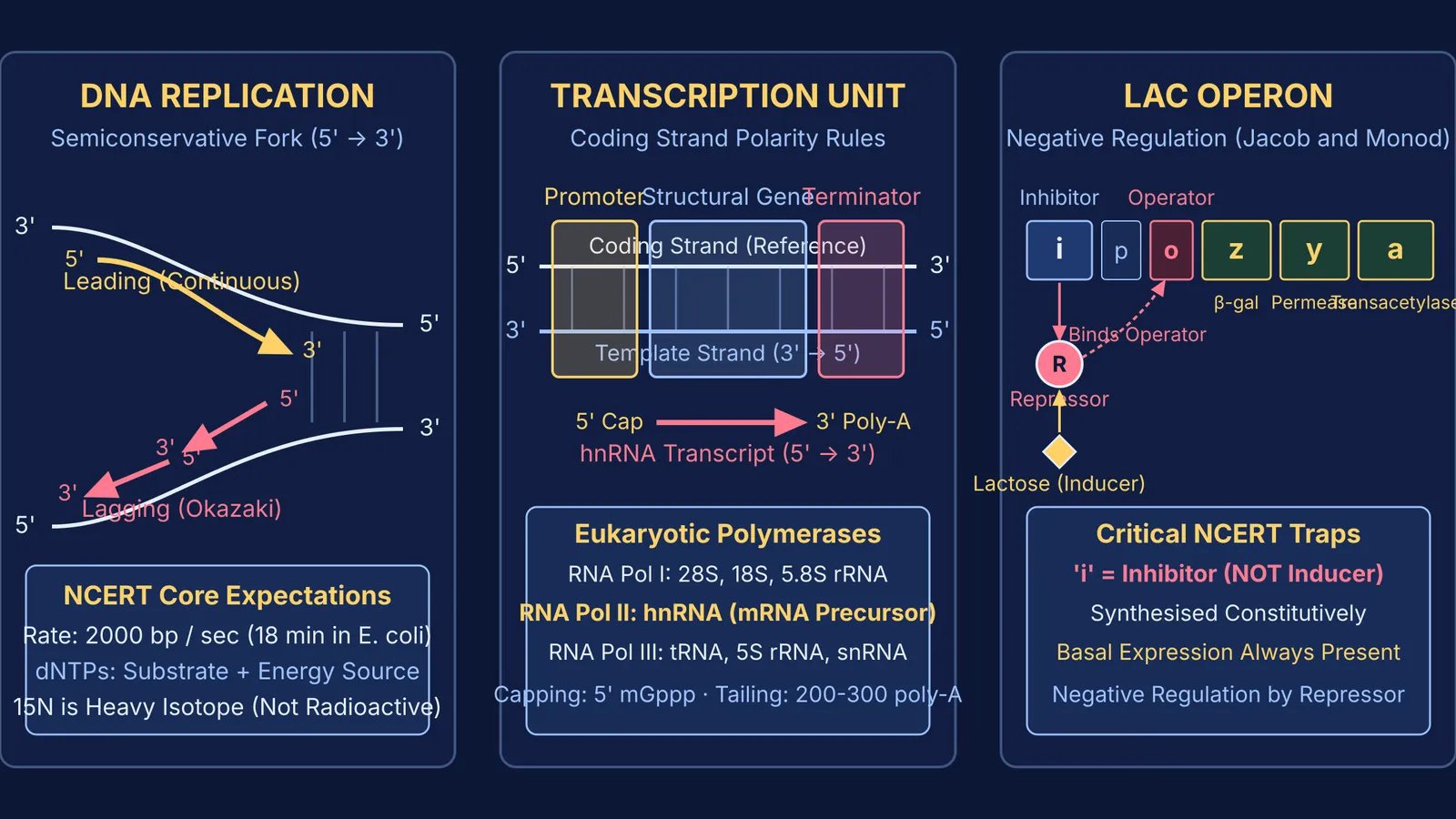
The NCERT textbook focuses on the semiconservative model of DNA replication, supported by two historical experiments. Matthew Meselson and Franklin Stahl demonstrated semiconservative replication in *Escherichia coli* using ammonium chloride containing heavy nitrogen, ¹⁵N (Meselson and Stahl, 1958). NEET regularly tests whether ¹⁵N is radioactive; NCERT clarifies that ¹⁵N is a heavy isotope, not a radioactive one, separated by cesium chloride density gradient centrifugation. In parallel, Herbert Taylor (1958) used radioactive thymidine to prove chromosome replication in *Vicia faba*.
When describing replication machinery, generic chatbots often detail DNA polymerase I, II, and III subunits, topoisomerase, and sliding clamps. In contrast, the NCERT syllabus focuses on the primary enzyme, DNA-dependent DNA polymerase. The textbook highlights its high catalytic speed: *E. coli* contains 4.6 × 10⁶ base pairs and finishes replicating its genome within 18 minutes, operating at an average rate of 2000 base pairs per second. Furthermore, deoxyribonucleoside triphosphates (dNTPs) serve a dual purpose by acting as substrates and providing polymerization energy through high-energy terminal phosphates. Synthesis proceeds exclusively in the 5' → 3' direction, yielding a continuous leading strand and a discontinuous lagging strand of Okazaki fragments in DNA replication, which are joined by DNA ligase.
Which transcription facts are strictly tested in NCERT?
Transcription in NCERT begins with the anatomy of a transcription unit, which consists of a promoter, a structural gene, and a terminator. All spatial references are defined strictly relative to the coding strand (5' → 3'), not the template strand (3' → 5'). For example, the promoter is located upstream towards the 5'-end of the coding strand.
Prokaryotes and eukaryotes handle transcription differently under the NCERT syllabus:
In bacteria, a single DNA-dependent RNA polymerase catalyses initiation with the transient assistance of sigma factor (σ), elongates RNA alone, and terminates upon binding rho factor (ρ). Because bacterial transcripts lack introns and lack a nuclear envelope, transcription and translation can be coupled simultaneously.
In eukaryotes, transcription occurs inside the nucleus across three eukaryotic RNA polymerases. RNA Polymerase I synthesises 28S, 18S, and 5.8S rRNAs. RNA Polymerase II synthesises heterogeneous nuclear RNA (hnRNA), the precursor to messenger RNA. RNA Polymerase III synthesises transfer RNA (tRNA), 5S rRNA, and small nuclear RNAs (snRNAs).
Eukaryotic processing requires capping, tailing, and splicing of eukaryotic RNA. Splicing removes introns and joins exons. Capping adds an unusual nucleotide, methyl guanosine triphosphate, to the 5'-end. Tailing adds 200 to 300 adenylate residues at the 3'-end in a template-independent manner under NCERT specifications.
How does NCERT define the lac operon mechanism?
Elucidated by François Jacob and Jacques Monod (Jacob and Monod, 196180072-7)), the lac operon models polycistronic gene regulation. Students often mistakenly assume the *i* gene stands for 'inducer'; NCERT states that *i* stands for inhibitor, which transcribes the repressor constitutively.
The operon functions through coordinated structural genes and regulatory elements:
The repressor binds to the operator region in the absence of an inducer, physically preventing RNA polymerase from transcribing structural genes.
Lactose or allolactose acts as the inducer, binding the repressor to form an inactive complex that cannot attach to the operator.
The *z* gene codes for beta-galactosidase (hydrolysing lactose into glucose and galactose), the *y* gene codes for permease (increasing cellular permeability to beta-galactosides), and the *a* gene codes for transacetylase.
Regulation by a repressor is classified by NCERT as negative regulation. Students should note that while university texts explore catabolite activator protein (CAP-cAMP) positive control, entrance examinations prioritise the negative repressor mechanism.
How should you prompt an AI tutor for NCERT precision?
To avoid college-level distractions, structure your AI prompts with clear curriculum boundaries. Rather than asking for a generic summary, instruct the model to contrast broad theory with explicit exam criteria:
"Explain DNA replication, transcription, and the lac operon. In part one, list only the core terminology, rates, and mechanisms explicitly stated in Class 12 NCERT Biology. In part two, contrast this with college-level details that NCERT omits. Flag all common examination traps."
When you review the response, check that the AI correctly highlights NCERT's explicit conventions: the dual role of dNTPs, the 18-minute replication duration, the coding strand orientation rule, the three distinct eukaryotic RNA polymerases, and the meaning of the *i* gene.
When you need active guidance, conversational practice reveals what you truly understand. Fermi's AI tutor works out what a student knows and builds a plan for the session, holding a line of reasoning across genetics problems rather than merely reciting textbook text. Students can also explore the Fermi Concept Library, which maps foundational biological concepts to their prerequisites so you can quickly isolate and resolve knowledge gaps.


