

On this page
Every year, hundreds of thousands of students study simple harmonic motion for competitive exams. A recurring hurdle is the phase constant, φ. It often feels like a random number tacked onto the end of a cosine function, but it carries a deeply physical meaning: it tells you exactly where the object was, and which way it was moving, when you started the stopwatch. For many learners, understanding this concept marks the difference between memorising formulas and actually grasping the physics of oscillations.
What does the phase constant mean?
In the standard equation for simple harmonic motion, x(t) = A cos(ωt + φ), you already know the amplitude (A) and the angular frequency (ω). According to OpenStax *University Physics*, the phase shift (or phase constant) adjusts the wave when the initial conditions do not start at the maximum positive displacement.
If a block is pulled to +A and released from rest, φ is zero. But if the block starts at the equilibrium position (x = 0) and is already moving, the standard cosine wave must be shifted to reflect that physical reality. Because there are two possible directions the block could be moving from x = 0, you must check the initial velocity to find the correct angle. Without evaluating both the starting position and the initial velocity, you cannot uniquely determine the phase of the system.
This type of phase shift appears everywhere in physics, from springs to SHM through a tunnel across the Earth: period and speed at centre, and even in the difference between Displacement and pressure waves in sound: the 90° phase shift.
How to ask the AI to explain the phase constant?
When you encounter a confusing phase constant problem, you can ask a tutor to walk you through it. Fermi's AI tutor can work out what you already know and build a plan for the session, rather than just printing the final number.
Try pasting this prompt to set up a guided exercise:
"I have a block on a spring in simple harmonic motion. At t = 0, it is at the equilibrium position (x = 0) and it is moving in the negative direction. Can you explain step-by-step how to find the phase constant φ for the equation x(t) = A cos(ωt + φ)? Do not just give me the answer; ask me leading questions so I can solve it myself."
The tutor will prompt you to set t = 0, leading you to 0 = A cos(φ). From there, it will ask you to think about which angles give a cosine of zero, and then use the negative velocity to choose between them. By answering these guiding questions, you build a much stronger intuition for the mathematics than you would by simply reading a textbook solution.
How do you verify the phase constant with a sketch?
Once the AI guides you to an answer—in this case, φ = π/2—you should always check it against a physical sketch. Drawing the motion forces you to translate the algebra back into the real world.
If you want to see this in action dynamically, the Fermi Simulation Lab has interactive simulations for ideas easier to see than read. To verify it on paper, follow this sequence:
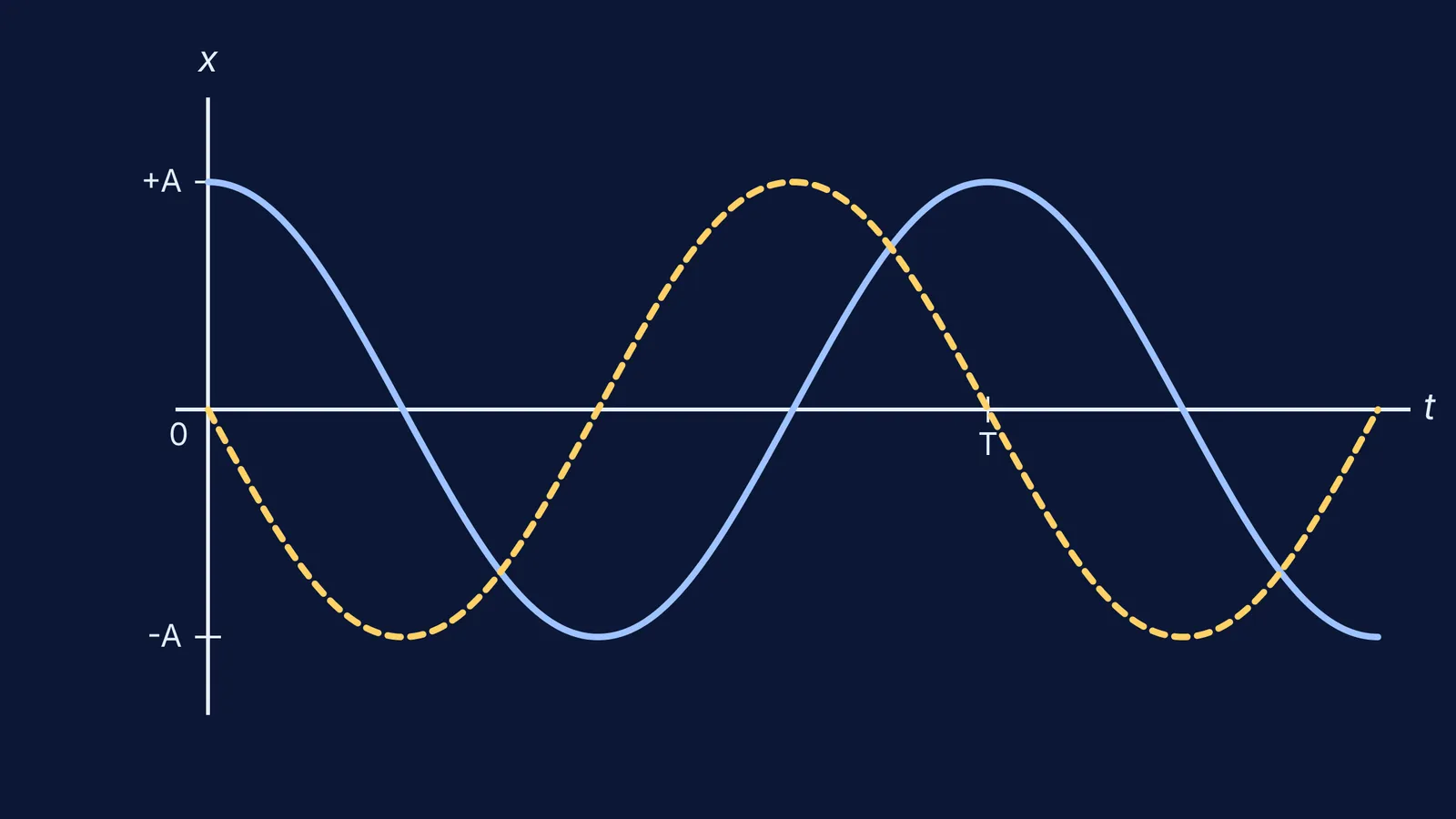
Plug in the constant: Write out your final equation. With φ = π/2, you get x(t) = A cos(ωt + π/2).
Use trigonometry: Apply the identity cos(θ + π/2) = -sin(θ). Your equation simplifies to x(t) = -A sin(ωt).
Draw the curve: A standard sine wave starts at zero and goes up. A negative sine wave starts at zero and goes down.
Check the physics: Look at your graph at t = 0. The line starts at x = 0 and immediately dips into the negative region. This matches your original physical setup perfectly: starting at equilibrium and moving in the negative direction.
If your calculated phase constant had been -π/2, the equation would become A cos(ωt - π/2) = A sin(ωt), which moves in the positive direction—a clear signal that the sign was wrong. By sketching the result, you catch algebraic mistakes before they cost you marks. This habit of visualizing equations will serve you well in all areas of physics, from wave mechanics to alternating current circuits.


