

On this page
When preparing for exams, you will often encounter pairs of concepts that look almost identical. It is easy to memorise the definitions separately, but under the pressure of a test, the lines blur. If you have ever stared at a multiple-choice question and wondered whether to use molarity or molality, you have experienced this overlap.
Why do we confuse similar concepts?
Human memory is associative. When two ideas share most of their traits, they overlap in your mind. This is why students routinely mix up mass and weight in physics, or mitosis and meiosis in biology.
Cognitive science offers a solution: look at the differences directly. A 2004 study of 9th-grade students learning statistics found that those who learned by contrasting cases performed significantly better on transfer tasks than those who simply practised standard formulas (Schwartz & Martin, 2004). By struggling to find the specific differences between similar examples, the students created a mental framework that made the underlying rules obvious. They stopped looking at the surface and started noticing the structure.
You can use this method for any subject, whether you are untangling apomixis and polyembryony in biology or deciding between removable and jump discontinuities in mathematics.
How do you ask AI to contrast concepts?
Instead of asking an AI to define a single term, ask it to contrast a pair.
Most learning tools answer questions. Fermi's AI tutor teaches — it holds a line of reasoning across a whole session, notices where a student is stuck, and decides whether to explain, ask, or show. You can bring your confusing pairs to it, and it will work out what you already know and build a plan for the session.
To get the best result, give the AI a clear instruction. Try this script:
"I keep confusing [Concept A] and [Concept B]. Pull them apart for me. Show me the exact point where they differ, and give me a one-line test to tell them apart in an exam."
What is a one-line test?
A one-line test is a single, practical question that instantly separates two ideas. It cuts through the textbook jargon and forces you to focus on the single variable that matters.
Here are three examples of how pulling apart confusing pairs creates a clear test.
Mass versus weight
Mass is the amount of matter in an object. It is a scalar quantity, measured in kilograms using a balance. Weight is the gravitational force acting on that mass. It is a vector quantity, calculated as mass times gravity, and measured in newtons using a spring scale.
The one-line test: If you take the object to the Moon, which one changes?
The answer: Weight changes because the local gravity changes. Mass stays exactly the same.
Molarity versus molality
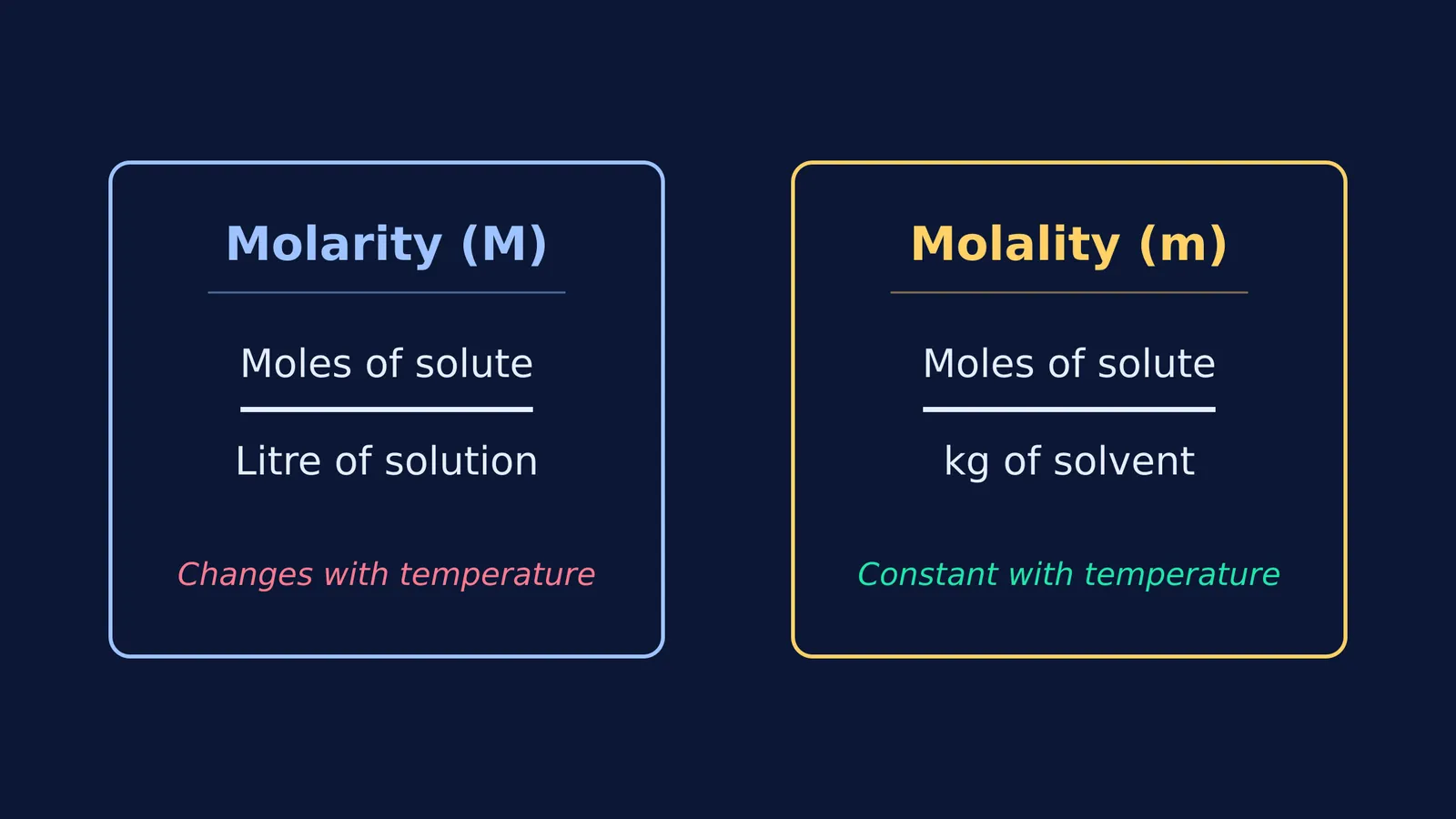
In chemistry, both of these terms measure concentration, but they do so using different physical properties. Molarity (M) is the moles of solute divided by the volume of the entire solution in litres. Molality (m) is the moles of solute divided by the mass of the solvent alone in kilograms.
The one-line test: If you heat the flask, which concentration changes?
The answer: Molarity changes. Liquids expand when they are heated, which increases the volume and therefore decreases the molarity. Molality remains constant because the mass of the solvent does not change with temperature.
Mitosis versus meiosis
In biology, both processes are forms of cell division, but their goals are entirely different. Mitosis produces two identical diploid cells. It is used for everyday growth and tissue repair. Meiosis produces four genetically different haploid cells (gametes). It is used strictly for reproduction.
The one-line test: Which process cuts the chromosome number in half?
The answer: Meiosis cuts the chromosome number in half so that when two gametes fuse, the normal number is restored.
How do you study with contrasting pairs?
Do not just read the differences and assume you will remember them. The real value comes from active recall.
Keep a running list of the pairs that trip you up during mock tests.
Ask your AI tutor to contrast them and generate a one-line test.
Write down the one-line test on a flashcard, with the answer on the back.
The next time you face a difficult question involving those concepts, apply the test first before looking at the options.
When you learn to notice the exact pivot point between two ideas, you stop relying on rote memory. You begin to see the underlying logic of the subject, and that is what actually builds confidence for exam day.


