

On this page
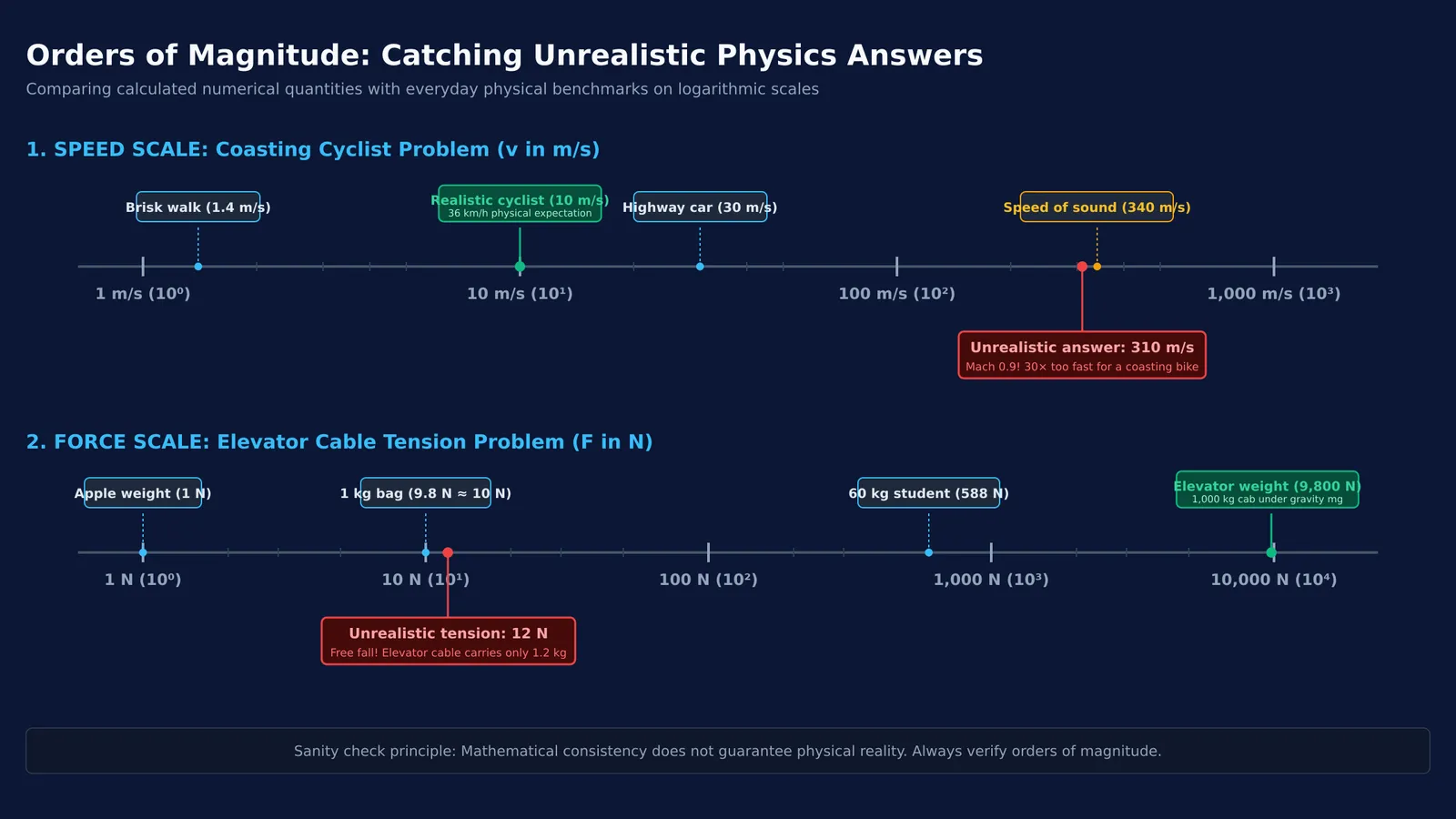
You finish a kinematics problem for a cyclist coasting down a ramp and write down 310 m/s. The algebra was neat and the calculator showed no errors. Yet 310 m/s is Mach 0.9—nearly the speed of sound in air.
When solving physics numericals, students easily lose touch with physical reality. Checking whether a computed number makes sense catches misplaced powers of ten, missing square roots, and unit blunders before an exam ends. With structured prompting, an AI tutor acts as a real-time reality filter, translating abstract SI units into familiar everyday objects.
Why do students miss unrealistic physics answers?
In an August 2025 study in *Physical Review Physics Education Research*, researchers Abolaji R. Akinyemi, Michael E. Loverude, and John R. Thompson examined how 580 introductory physics students evaluate expressions across mechanics, collisions, and electrostatics (Akinyemi et al., 2025). They classified student checking into three categories: consulting external sources, checking through computation, and comparing to the physical world.
The authors found that most students do not evaluate solutions using expert strategies. Instead, students overwhelmingly fall into a computational frame: they re-read algebra or punch numbers into a calculator again. They verify arithmetic, but rarely ask whether the quantity itself makes physical sense.
This mirrors findings by Alan Van Heuvelen in the *American Journal of Physics*, where only 10% to 20% of introductory students spontaneously constructed qualitative representations or diagrams to make sense of physical processes (Van Heuvelen, 1991). Without reference points, answers like a 5-second drop for a pen falling off a desk go unnoticed.
While platforms like Fermi's AI tutor write on a board, draw the figure, and hold a line of reasoning across a session to keep physical meaning front and centre, you can also prompt conversational AI to build your own reality filter.
How can an AI tutor provide an everyday sanity check?
Solving physics problems drains working memory. As Andrew J. Mason and Chandralekha Singh demonstrated in the *American Journal of Physics*, students rarely engage in spontaneous reflection without explicit scaffolding (Mason & Singh, 2010).
Asking an AI chatbot "Is this answer right?" usually triggers a full re-derivation that can confuse you with alternate coordinates. Instead, ask for a physical sanity check by translating your value into an everyday analogue:
"I calculated a tension of 12 N in the cable supporting a 1,000 kg elevator cab. What does 12 N feel like in daily life, and is this realistic?"
The AI will point out that 12 N is roughly the weight of a 1.2 kg bag of flour. Because gravity pulls on a 1,000 kg elevator with 9,800 N, a cable tension of 12 N means the elevator is in free fall with a downward acceleration of 9.79 m/s². That immediately flags an order-of-magnitude error—like dropping a factor of 10³ when converting tonnes to kilograms.
A quick dimensional analysis check confirms your formula units match before testing magnitude.
Which prompts give the best real-life comparisons?
To receive sharp diagnostic comparisons rather than generic praise, use prompts that anchor the AI's response to physical scale:
Speed check: "I calculated a final speed of [e.g. 45 m/s] for a [e.g. cyclist coasting down a 5-metre hill]. What everyday vehicle or animal moves at this speed, and is this realistic without an engine?"
Force check: "My calculated normal force on a [e.g. 60 kg student sitting on a stool] is [e.g. 6,000 N]. Compare this force to familiar weights so I can judge whether the scale makes sense."
Time check: "I found that a [e.g. steel ball dropped from 1.5 metres] takes [e.g. 3.2 seconds] to land. Compare this duration to events like a heartbeat or eye blink."
When solving complex problems, checking intermediate stages in the Fermi Problem Library—which offers worked problems with a step-by-step solver that explains the reasoning rather than printing an answer—isolates where an exponent slipped. Studying how physicists estimate and check answers and using prompts that make you think will help you spot these slips independently.
How do you build an intuitive mental benchmark library?
Using an AI tutor for sanity checks builds your intuition for timed exams. Anchor your thinking to these core benchmarks:
Speed: 1.4 m/s is a brisk walk; 10 m/s (36 km/h) is an Olympic sprint or city traffic; 30 m/s (108 km/h) is highway speed; 340 m/s is the speed of sound.
Force: 1 N is the downward weight of an apple (100 g); 10 N is a 1 kg bag of salt; 600 N is the weight of a student; 12,000 N is a passenger car.
Time and Power: 0.1 s is an eye blink; 1 s is a resting heartbeat; 100 W is resting human metabolic power; 2,000 W is an electric kettle.
For setups where scale is hard to picture on paper, opening the Fermi Simulation Lab provides interactive simulations for the ideas that are easier to see than to read, showing how motion adjusts dynamically.
A five-second reality check is often all it takes to catch a decimal slip and protect your score.


