

On this page
Asking a chatbot for everyday examples of inertia or pressure connects a textbook definition to your kitchen or your bus ride. The catch: some examples will be wrong, and they sound as confident as the right ones. Treat each one as a claim to test, not a fact to copy.
Why do AI examples of physics concepts go wrong?
A chatbot learns from human writing, and human writing about physics is full of common-sense ideas that are not quite right. Ibrahim Halloun and David Hestenes catalogued many of these beliefs about motion that conflict with Newton's laws in their 1985 paper Common sense concepts about motion.
Chatbots pick up some of the same habits. Gerd Kortemeyer tested ChatGPT on a real calculus-based physics course and concluded it would narrowly pass the course while exhibiting many of the preconceptions and errors of a beginning learner. Colin West later found GPT-4's answers came close to expert level on the Force Concept Inventory, a standard test of Newtonian mechanics concepts, but with a few very notable exceptions and limitations.
The idea that air over a wing must speed up to meet the air underneath at the back edge is widely repeated, and NASA's Glenn Research Center says plainly that the lift predicted by the "Equal Transit" theory is much less than the observed lift. If a chatbot offers it as an example of pressure, it is repeating a myth. We have a longer guide on spotting when AI gets physics wrong.
How do you ask AI for real-life examples of physics concepts?
Ask for examples you can check. A prompt like this works well:
"Give me five everyday examples of inertia that a Class 9 student in India could see at home or on the way to school. For each one, say which object resists a change in motion, what force acts, and a safe way I could test it at home."
An example that comes with a test is one you can prove wrong. For more prompt patterns, see our guide to prompts that make ChatGPT teach physics.
How do you test an AI example at home?
Use predict, test, explain. Research by Catherine Crouch, Eric Mazur and colleagues found that students who only watched a classroom demonstration understood it no better than students who never saw it, while students who predicted the outcome first showed significantly greater understanding. The prediction is what does the work.
Predict. Before you try anything, write one line: what will happen, and why, using the concept.
Test. Do it safely at home if you can. If you cannot, reason it through on paper with a force diagram.
Explain. Compare the result with your prediction and the AI's claim. Mark the example right, half-right or wrong.
Worked example: inertia
Here is the kind of list a chatbot might give, with verdicts.
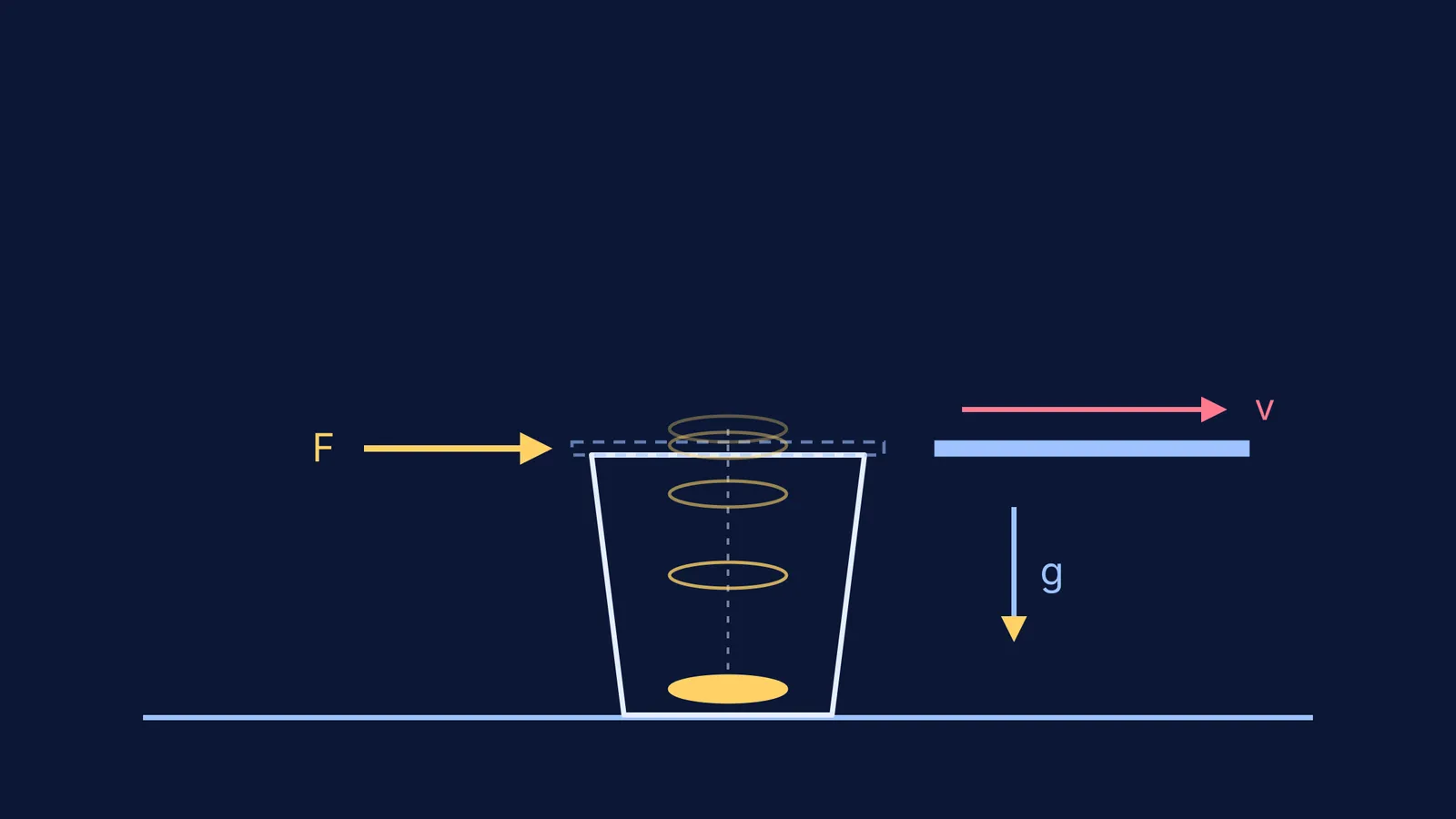
A coin on a card over a tumbler drops in when you flick the card away. Test it. It works: the card is pulled out too fast for friction to drag the coin sideways much, so the coin stays put and falls straight down. Right.
Passengers lurch forward when a bus brakes suddenly. Reason it: your body keeps moving forward while the bus slows. Right.
A ball keeps rolling because the force of your kick stays inside it. Wrong. No force is needed to keep it moving; it slows because friction and air push against it.
Worked example: pressure
A sharp knife cuts better than a blunt one. Same force on a smaller area means more pressure. Right.
You suck juice up a straw. Half-right. You lower the pressure in your mouth, and the atmosphere, about 101 325 Pa at standard pressure, pushes the juice up. Test it: put a straw in water, close the top with your finger and lift it. The water stays in because the air below pushes up harder than the air above.
A plane flies because air over the longer top surface must catch up. Wrong, as NASA's page above explains.
If pressure itself feels shaky, our Class 8 guide to force and pressure covers the basics.
What should you do when an AI example is wrong?
A wrong example is useful. Ask the chatbot, "Example 3 contradicts Newton's first law. What is wrong with it?" Check its answer against your NCERT textbook or your teacher, then write the correction in your own words.
If a wrong example shows a gap in the concept itself, the Fermi Concept Library has a lesson for every concept in physics, chemistry, biology, mathematics and computing. For ideas that are easier to see than to read, the Fermi Simulation Lab has interactive simulations you can try. And Fermi's AI tutor decides whether to explain, ask or show, and checks your understanding as it goes.
Tonight, pick one concept from this week's chapter, ask for five examples, and test them all before you sleep.


