

On this page
You have just solved a problem and the answer matches the key. Before you turn the page, ask an AI for two other ways to solve the same problem, compare them, and decide which one you will use when that kind of question appears in JEE Main or your board paper.
Why ask for another method once you have the answer?
In a study published in the Journal of Educational Psychology, Bethany Rittle-Johnson and Jon Star had seventh-graders study worked examples of equation solving, either two methods on the same page or the same methods one after another.
The study involved 70 seventh-grade students at a school in Tennessee, according to a Harvard Graduate School of Education summary. The comparison group made greater gains in solving equations and in flexibility with different methods, though the two groups did not differ in conceptual knowledge. "Both groups saw the same strategies, but the student who saw them side by side remembered how to use them, and then used them more later on," Star said in the school's summary.
A follow-up study with 162 seventh- and eighth-graders found that comparing different methods for the same problem best supported conceptual knowledge and flexibility, more than comparing different problem types or similar problems solved the same way (Rittle-Johnson and Star, 2009).
An AI chatbot gives you that second and third method in seconds. Your job is to do the comparing.
How do you ask AI for another method to solve the same problem?
Solve the problem yourself first, on paper. Then paste the question and your working, and use a prompt like this:
"Here is my solution. Show me two different methods for the same problem. Do not repeat my method."
"For each method, number the steps and tell me what extra quantity it gives me, if any."
"Which method would you use in a timed MCQ, and which would you write in a board answer? Explain why in two lines."
Then redo each new method yourself with a timer running, and note the steps and seconds each one took.
If you want a tutor that teaches rather than just answers, Fermi's AI tutor holds a line of reasoning across a session and decides whether to explain, ask or show, so you can bring your own solution and work through other routes together.
Worked example: one incline, three methods
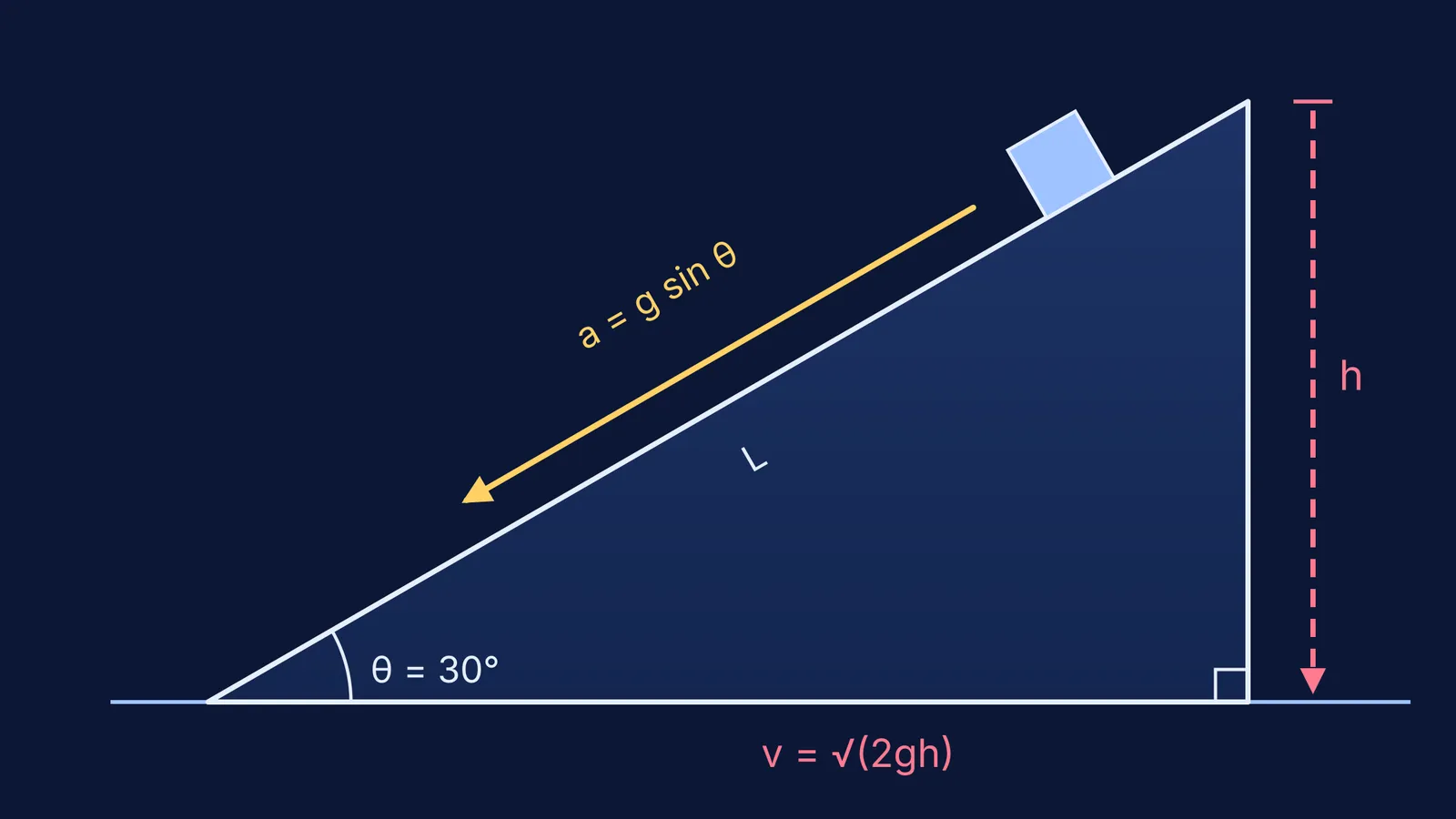
A block slides from rest down a smooth incline of height 5 m at 30°. Find its speed at the bottom. Take g = 10 m/s².
Newton and kinematics: acceleration a = g sin 30° = 5 m/s². Slope length L = h / sin 30° = 10 m. Then v² = 2aL = 100, so v = 10 m/s. Four lines.
Energy conservation: mgh = ½mv², so v = √(2gh) = √100 = 10 m/s. Two lines.
Work-energy theorem: work by gravity = (mg sin 30°) × L = mgh = ½mv², so v = 10 m/s. Three lines.
All three agree, which is itself a check. Energy is shortest and ignores the angle. Only the Newton method gives you the acceleration, so if the next part asks for the time taken, it is the one you need: t = v / a = 2 s.
Which method should you use in JEE and which in boards?
Decide once per question type, and write it down:
JEE MCQ or numerical answer: pick the method with the fewest steps you can do reliably. Only the final answer is checked.
JEE question with several parts on one setup: pick the method that gives you the extra quantity the later parts will need.
Board answer: pick the method you can show clearly, with the principle named. CBSE's March 2015 Class 10 mathematics marking scheme, for example, tells examiners: "Alternative methods are accepted. Proportional marks are to be awarded."
Board question that names a method ("using the matrix method"): use that method, even if another is faster.
Any exam: keep the second method as your check when you have time left.
For how to study the worked solutions themselves, our guide to the self-explanation effect for worked examples pairs well with this habit.
What should you check before trusting the AI's method?
Chatbots can produce a method that looks neat and is wrong. Before adding any method to your notes, confirm it reaches the same answer as yours, check units at every step, and test it on a second problem of the same type. Our article on why AI chatbots get maths wrong has a five-step check.
When you are stuck, ask for a hint before a full method; see what tutoring research says about hints and answers.
When a method keeps going wrong, the Fermi Problem Library has worked problems with a step-by-step solver that explains the reasoning rather than printing an answer. Pick tonight's last solved problem and try the two-method prompt on it.


