

On this page
Most calculus students learn early on that the integral of xⁿ is xⁿ⁺¹/(n+1). But if you plug n = −1 into that rule, it fails because it requires dividing by zero. Instead, the area under the curve y = 1/x requires an entirely different function: the natural logarithm, ln(x).
But why does a geometric area have anything to do with logarithms, a tool originally invented to speed up arithmetic? When the area under 1/x is ln x visualised, you can see how geometry naturally turns multiplication into addition.
What does the area under 1/x look like?
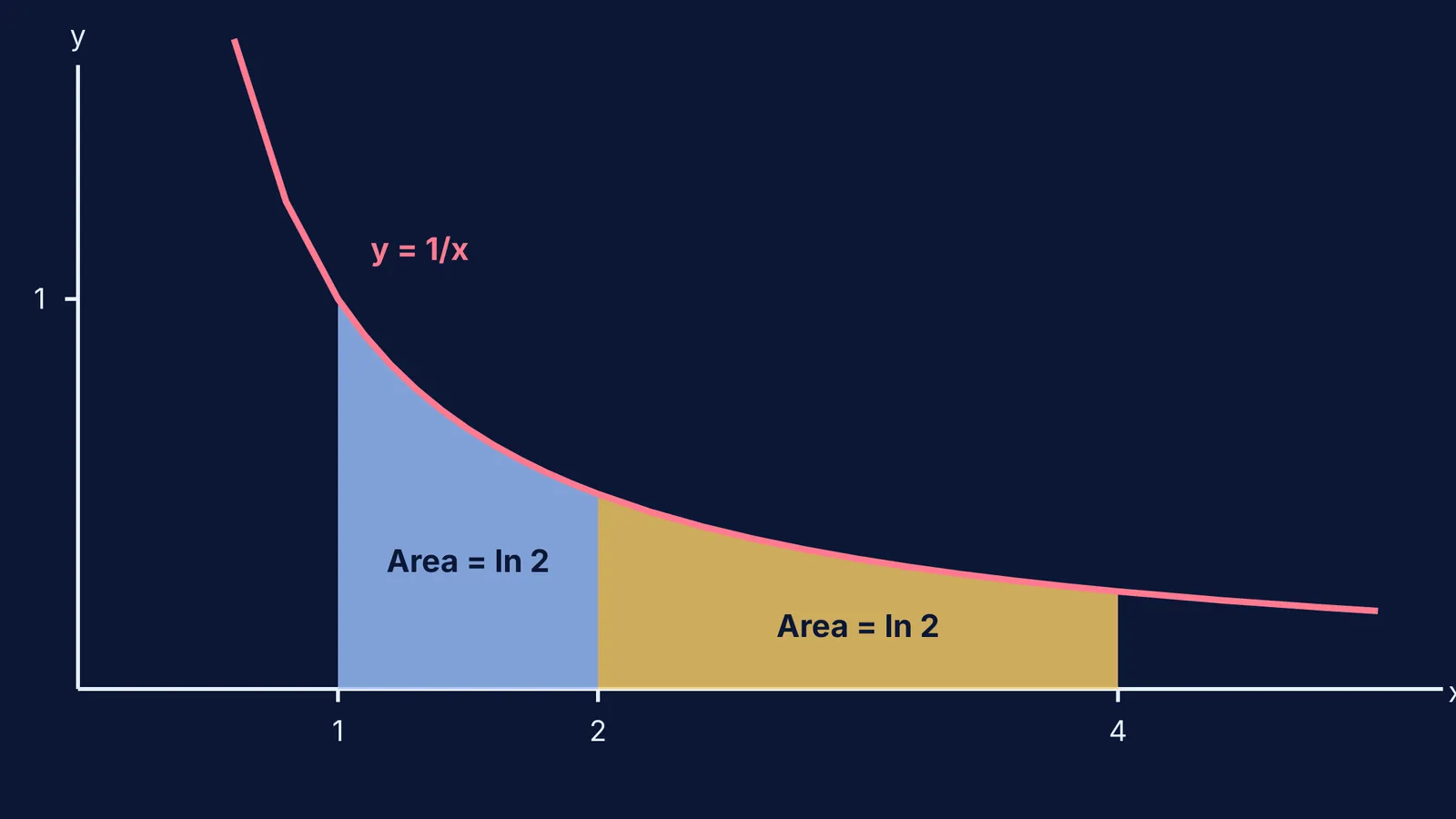
If you draw the curve y = 1/x on a graph and pick a starting point of x = 1, you can shade the area under the curve up to x = 2. Let's call that area A.
Now, predict what happens if you measure the area of the next chunk, from x = 2 to x = 4. Because the curve drops lower as x increases, the height is much shorter. However, the base is exactly twice as wide. When you calculate or measure this new region, you find it is exactly equal to A.
The area from 1 to 2 is exactly the same as the area from 2 to 4.
This is the geometric secret of the hyperbola. Whenever you multiply the boundaries of the interval by a constant factor, the area under the curve stays the same. If you measure the area from 3 to 6, or from 10 to 20, it will always equal A. If you find it hard to picture how these curves and areas stretch, the Fermi Simulation Lab lets you drag the boundaries under the hyperbola and watch the exact areas match up in real time.
Why does the area under a hyperbola equal the natural logarithm?
This unique scaling property means that areas under 1/x turn multiplication into addition.
If the area from 1 to 2 is A, and the area from 2 to 4 is also A, then the total continuous area from 1 to 4 is simply A + A = 2A. The interval on the horizontal axis doubled, but the area merely added to itself.
This mirrors the defining rule of logarithms: log(x × y) = log(x) + log(y).
Because ln(2) plus ln(2) equals ln(4), measuring the area under this specific curve is visually the same mathematical operation as taking a logarithm. The area from 1 to x behaves exactly like ln(x). When dealing with more complex regions, like integrating over n periods, visualising the area is often the fastest way to understand the underlying algebra.
Who discovered the connection between hyperbolas and logarithms?
The link between geometry and logs predates the formal invention of calculus. In his 1647 work *Opus Geometricum*, the Flemish Jesuit mathematician Grégoire de Saint-Vincent proved that the area under a rectangular hyperbola remains constant over intervals with equal ratios.
Two years later, in 1649, his former student Alphonse Antonio de Sarasa realised that this geometric progression of areas was functionally identical to the logarithms that had been championed by earlier mathematicians (read about Henry Briggs and how base-10 logarithms were first computed). This insight led to the creation of the term "hyperbolic logarithm", which we now call the natural logarithm.
Calculus was later formalised in works like the one by Guillaume de l'Hôpital, the 0/0 rule and the first calculus textbook, but the foundational geometry was already securely laid.
A practical framework for logarithmic integrals
When you are solving physics or chemistry problems, you will constantly encounter the integral of 1/x. If you get stuck evaluating definite integrals that result in logarithmic terms, the Fermi Problem Library has worked problems with a step-by-step solver that explains the reasoning rather than printing an answer.
Here is a simple checklist for handling integrals that yield logarithms:
Check for the derivative: If you have an integral in the form ∫(f'(x)/f(x)) dx, the answer will be ln|f(x)| + C.
Remember the absolute value: Always put the argument of the logarithm in absolute value bars. The area under 1/x is only defined for positive x in this context, so ln(−2) is undefined in real numbers.
Use log rules to simplify: Once you evaluate the bounds, use the subtraction rule ln(b) − ln(a) = ln(b/a) to combine your answers into a single, clean term.


