

On this page
Area between two curves is a standard Class 12 integration topic, and easy to lose marks on. The algebra is rarely the problem. The marks go when you guess which curve is on top, or miss that the curves swap places partway through. Here is a short routine, two worked examples, and a way to practise by predicting the shaded region before you integrate.
How do you know which curve is on top?
The rule comes from the textbook definition. In OpenStax Calculus Volume 1, section 6.1, if f(x) ≥ g(x) on [a, b], the area between them is the integral from a to b of [f(x) − g(x)] dx. When the curves cross, the same section gives the area as the integral of |f(x) − g(x)|, and says you break the interval up and evaluate several integrals depending on which function is greater.
In practice, that becomes four steps:
Set the two equations equal and solve. The solutions are the intersection points, and they cut the x-axis into intervals.
Pick one easy test point inside each interval, often 0 or a half.
Put it into both functions. The bigger value marks the top curve for the whole interval, since continuous curves only swap order where they meet.
Integrate (top − bottom) on each interval and add the pieces. Every piece should be positive.
Why does my area come out as zero or negative?
Because a plain definite integral is signed: wherever the curve you subtract is on top, the piece counts as negative. Here is a classic example that catches many students.
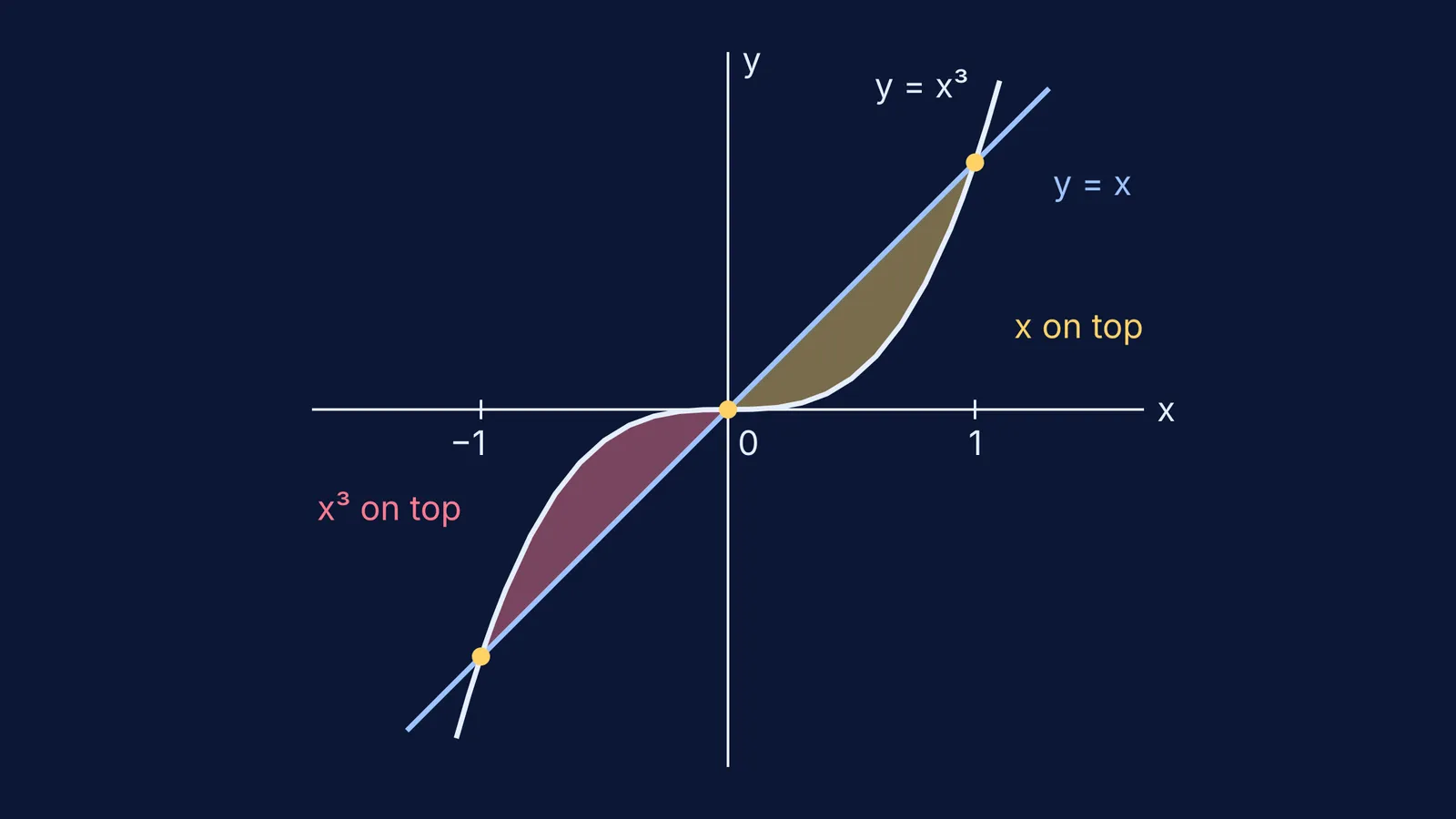
Find the area enclosed by y = x and y = x³.
Intersections: x³ = x gives x(x − 1)(x + 1) = 0, so x = −1, 0, 1.
Test x = −0.5: the line gives −0.5 and the cubic gives −0.125, so the cubic is on top on [−1, 0].
Test x = 0.5: the line gives 0.5 and the cubic gives 0.125, so the line is on top on [0, 1].
One integral of (x − x³) from −1 to 1 gives exactly 0: the two mirror-image regions cancel. Use two integrals:
On [−1, 0]: the integral of (x³ − x) is [x⁴/4 − x²/2] from −1 to 0, which is 0 − (1/4 − 1/2) = 1/4.
On [0, 1]: the integral of (x − x³) is [x²/2 − x⁴/4] from 0 to 1, which is 1/2 − 1/4 = 1/4.
The enclosed area is 1/4 + 1/4 = 1/2 square units.
A second worked example: y = x² and y = x + 2
Intersections: x² = x + 2 gives x² − x − 2 = 0, so (x − 2)(x + 1) = 0 and x = −1 or 2.
Test x = 0: the line gives 2, the parabola gives 0. The line is on top.
Integrate (x + 2 − x²) from −1 to 2. The antiderivative is x²/2 + 2x − x³/3.
At x = 2 it is 2 + 4 − 8/3 = 10/3. At x = −1 it is 1/2 − 2 + 1/3 = −7/6.
Area = 10/3 + 7/6 = 27/6 = 9/2 square units.
Writing (x² − x − 2) instead gives −9/2: the sign tells you the order was flipped.
When a boundary is like x = y², cut sideways: integrate in y and ask which curve is on the right, as in our guide to finding area with horizontal strips. Splitting where the sign changes is also the key to definite integrals with modulus and floor functions.
Does predicting before you look actually help?
One well-known study suggests that guessing first changes what you learn from a demonstration. In the American Journal of Physics, Crouch, Fagen, Callan and Mazur (2004) found that students who passively watched classroom demonstrations understood the underlying concepts no better than students who did not see them at all. Students who predicted the outcome before seeing it showed significantly greater understanding.
That study used physics demonstrations, but the habit carries over to graphs. Before you shade anything, write down three predictions:
The x-values where the curves meet.
The top curve in each interval.
A rough size for the area, guessed from the grid.
Then draw or shade the region, compare, and only then set up the integrals.
Some ideas are easier to see than to read, and the Fermi Simulation Lab has interactive simulations built for them. Whatever picture you use, let it check your predictions, not replace them. If a whole problem still goes wrong, the Fermi Problem Library has a step-by-step solver that explains the reasoning rather than printing an answer.
Measuring a curved region by filling it with simpler shapes is older than calculus; read about Eudoxus and the method of exhaustion. For your next practice set, pick one question where the curves cross twice and say the top curve out loud for each interval before you start.


