

On this page
When you are stuck on a physics or maths numerical, the quickest way forward seems to be opening a solution PDF. You look at the steps, understand the logic, and write it down. It feels like you have learned the concept. But when a similar problem appears in an exam, your mind goes blank.
Why does this happen, and can an AI tutor fix it? The difference between looking up an answer key and working with a tutor comes down to who is doing the thinking.
Why do solution PDFs feel helpful but fail in exams?
Solution PDFs give you a finished answer. They are excellent for verifying your work after you have solved a problem. However, when you use them *while* practicing, they do the thinking for you.
Cognitive scientists refer to this as "cognitive offloading." Reading a correct, elegantly written solution is a passive process. Because you are not generating the steps yourself, your brain bypasses the most critical part of learning: the struggle to connect what you already know to what you need to find out.
This creates an illusion of competence. The solution makes logical sense when you read it, so you assume you could produce it. In reality, you have only practiced reading, not problem-solving.
What does this look like in a real physics problem?
Consider a standard problem from Class 11 physics: finding the maximum height of a projectile. If you are unsure how to start and open a solution PDF, you will immediately see the equation for the vertical motion, followed by the substituted values and the final answer.
You copy the steps, and it feels logical. However, the PDF has done the crucial work of identifying the right equation and deciding to resolve the initial velocity into its vertical component.
If you approach the same problem with an AI tutor, the interaction changes. When you say you are stuck, a good tutor will not hand you the formula. Instead, it might ask: "At the maximum height, what is the vertical component of the projectile's velocity?"
This forces you to pause and realise that the vertical velocity must be zero at the peak. Once you establish that, the tutor might prompt you to choose an equation of motion that links initial velocity, final velocity, acceleration and displacement. You are still doing the thinking. The tutor is merely providing the scaffolding to keep you moving forward. This active participation builds the strong neural pathways you need to recall the method during a high-pressure exam.
Why is struggling before seeing the answer important?
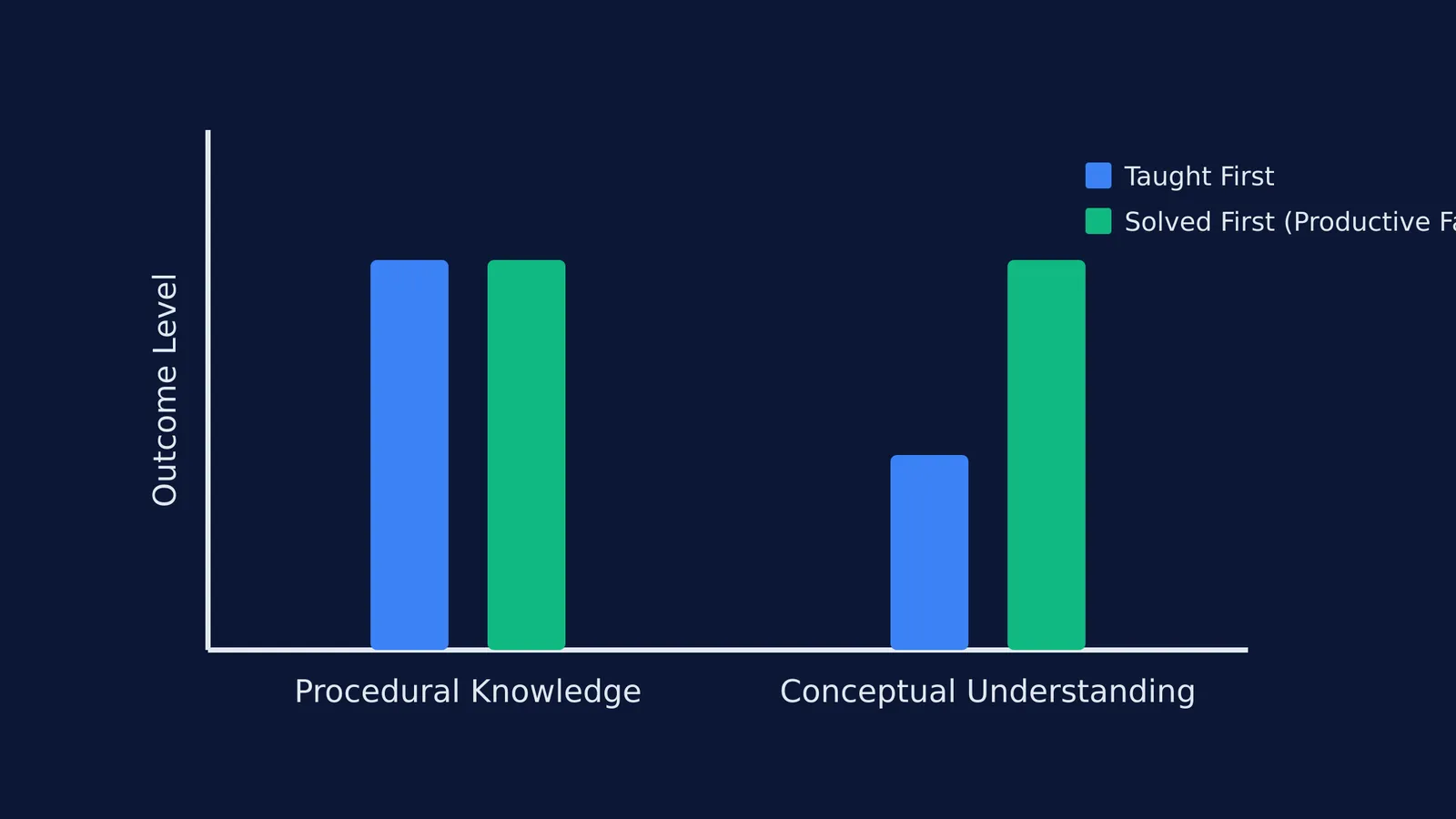
Research shows that getting the answer right away might actually limit your understanding. A 2014 study by researcher Manu Kapur on "productive failure" in mathematics tested exactly this. Kapur found that students who tried to solve problems before being taught the correct procedure gained significantly greater conceptual understanding and ability to transfer their skills to new problems, compared to those who were given the method first.
When you look at a solution PDF too early, you rob yourself of this productive failure. You need to attempt the problem, even if you do it incorrectly, to build the mental hooks that will catch the correct explanation when you finally see it. If the procedure is just handed to you, it rarely sticks.
Are AI tutors better than solution PDFs for practice?
While a solution PDF gives you the final destination, an AI tutor can guide your journey. This is the difference between being handed a map and having a guide walk beside you.
When you make a mistake, a solution PDF just shows you a different set of steps. An AI tutor, however, can respond to your specific attempt. If you use Fermi's AI tutor, it holds a line of reasoning across a session and notices exactly where you are stuck. It works out what you know and builds a plan for the session, stepping in with a conceptual hint rather than just giving away the final answer.
This approach forces you to do the work. The system provides just enough scaffolding to get you to the next line of working. If you need step-by-step guidance, the Fermi Problem Library has worked problems with a step-by-step solver that explains the reasoning rather than printing an answer.
How should you use AI tutors and solution PDFs?
Both solution PDFs and AI tutors have a place in your study routine, provided you use them actively. To get the most out of your study sessions, follow this framework:
Try it first: Never look up help until you have spent at least five minutes writing down your given variables, the formulas you know, and your first attempt.
Use AI for hints: If you are stuck, ask an AI tutor for a hint, not the answer. Can AI tutors teach better than chatbots that give answers? explores how scaffolding helps you more than a plain text response.
The 'close the screen' rule: Whether you read a hint from an AI or study a step in a solution PDF, close the screen before you write it down. If you cannot hold the logic in your head for five seconds, you have not understood it.
Use PDFs to verify: Keep your solution PDFs closed until you have a final answer. Then, use them to check your accuracy, sign conventions, and presentation format.
Understanding the balance between worked examples and solving from scratch is key. The goal of practice is not to finish the worksheet quickly, but to train your brain to think. By letting an AI tutor guide your attempt instead of letting a PDF skip the struggle, you prepare yourself for the exam hall where the only thinking is your own.


