

On this page
In biology, calculating how genetic material divides during cell division often trips students up. The trick is to separate the number of chromosomes from the amount of DNA.
If you are studying university biology, getting these numbers right is essential. It is not just about memorising facts; understanding the physical changes inside the cell allows you to solve complex genetics problems with confidence.
What are chromosome number and DNA content?
To track the changes accurately, you need to follow two separate measures throughout the cell cycle:
Chromosome number (n): This represents ploidy, or the number of complete sets of chromosomes in a cell. You can find this number by counting the centromeres. Whether a chromosome consists of one chromatid or two sister chromatids, it still counts as a single chromosome as long as they share one centromere.
DNA content (C): This is the amount of DNA in a haploid nucleus. You can find this by counting the individual DNA molecules, or chromatids. If a chromosome has replicated into two sister chromatids, its DNA content has doubled even though the chromosome number remains the same.
A typical human somatic cell in its normal state is diploid, meaning it has a chromosome number of 2n (46 chromosomes) and a DNA content of 2C.
Ask AI: Chromosome number and DNA content each stage meiosis?
If you ask an AI tutor or check a textbook to track these values through a cell division cycle, you will see a clear and logical pattern. According to a biology text on meiosis, the process involves one round of DNA replication followed by two distinct rounds of division (LibreTexts, 2021/02%3A_Chromosomes_Mitosis_and_Meiosis/2.03%3A_Meiosis)). This changes the ploidy and DNA content at specific, predictable stages.
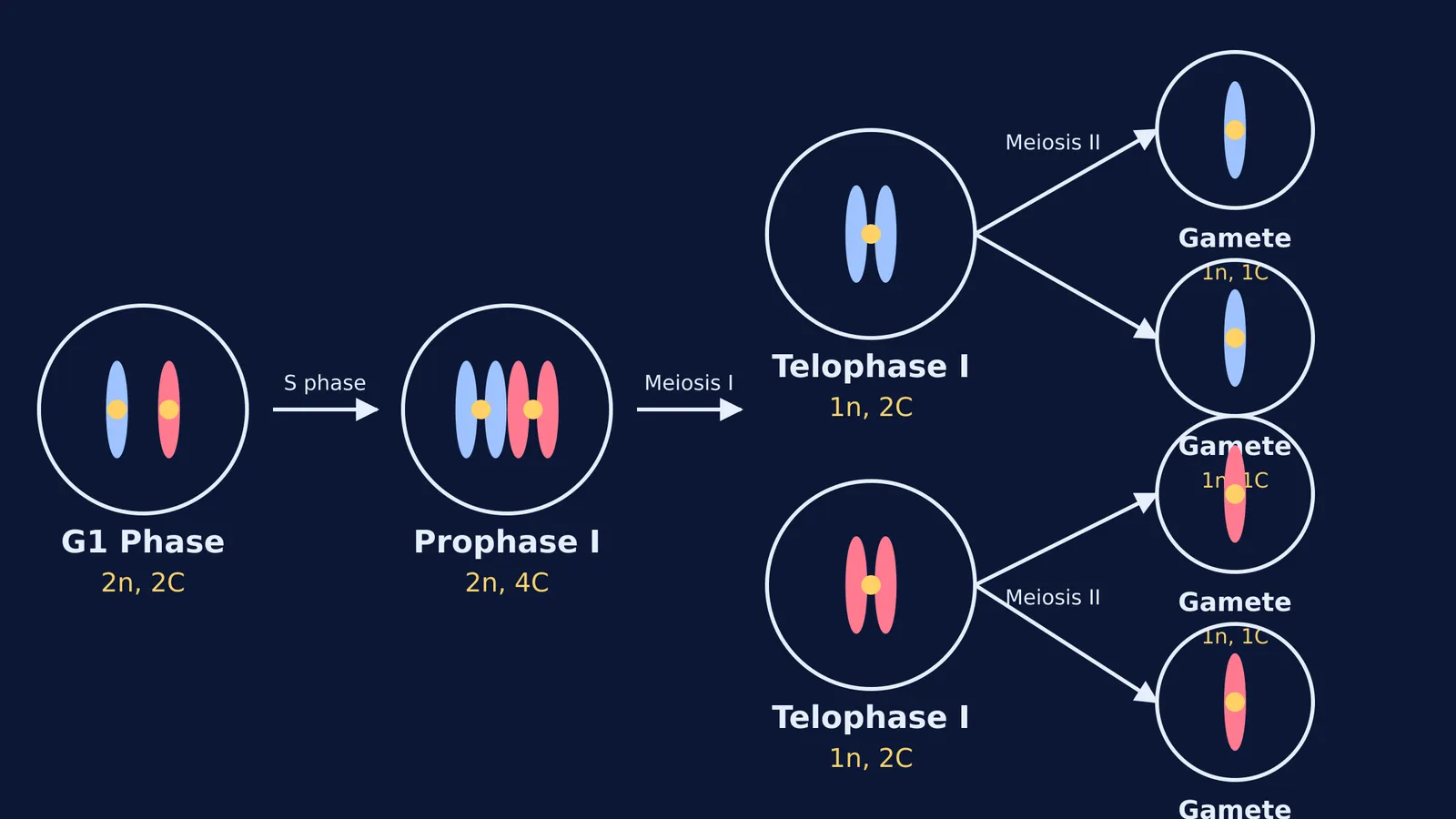
Here is what happens to a diploid cell starting at 2n, 2C:
G1 Phase: The cell is growing and preparing for replication. It starts at 2n, 2C.
S Phase: The DNA replicates to prepare for division, but the centromeres do not split. Because the centromeres hold the newly formed sister chromatids together, the chromosome number stays 2n, but the DNA content doubles to 4C.
Prophase I and Metaphase I: The cell is still at 2n, 4C as homologous chromosomes pair up to form bivalents. These pairs align along the centre of the cell.
Telophase I (after Meiosis I): The cell divides into two. Homologous chromosomes separate into the two new cells. This reductional division drops the values to 1n, 2C per cell. Each chromosome still consists of two sister chromatids.
Telophase II (after Meiosis II): Sister chromatids finally separate. This equational division leaves four haploid gametes, each at 1n, 1C.
To see how these specific stages fit into the broader picture of cell division, read our guide on cell cycle, mitosis and meiosis: stages and chromosome counts.
Does Anaphase I or II reduce the chromosome number?
A common stumbling block when learning this topic is confusing Anaphase I with Anaphase II.
In Anaphase I, entire homologous chromosomes are pulled to opposite poles of the dividing cell. The cell itself is still 2n until it physically divides during cytokinesis, at which point the resulting cells become 1n. Because the number of chromosome sets is halved, this is called a reductional division.
In Anaphase II, the sister chromatids are finally pulled apart. This is an equational division; the number of chromosomes per cell remains unchanged, but the chromatids separate to opposite poles before the cell divides into 1n gametes. The DNA content is halved from 2C to 1C, but the cells remain haploid.
If you are working through a practice problem and make a mistake on these steps, Fermi's AI tutor will catch the slip. The platform is designed to guide you through university-level courses. Because the tutor teaches rather than simply answers, it notices where a student is stuck and might ask you to draw the cell and count the centromeres out loud, helping you correct your own reasoning. If you start a session confused about meiosis, Fermi works out what you already know, builds a plan for the session, and teaches through it.
How can you check the n and C rules?
When working through genetics problems on your own, keep these essential checks in mind to avoid common errors:
Does the phase happen before or after the S phase? If it is after the S phase but before the first division, the DNA content is doubled (4C).
Has the first meiotic division finished? If yes, the homologous chromosomes have separated and the cell is haploid (1n).
Are you looking at a single chromosome's structure? Knowing the chromosome types by centromere position can help you visualise what gets pulled apart when the spindle fibres attach.
Has fertilisation occurred? When two 1n, 1C gametes fuse together, the resulting zygote returns to the standard 2n, 2C state, ready to begin the cycle anew.


