

On this page
Gametogenesis — the biological process of making sperm and eggs — runs on two completely different internal clocks. While male gamete production is a relatively fast, continuous cycle, female gamete production involves decades-long pauses. When you map these processes against the rhythmic fluctuations of the human menstrual cycle, the resulting timelines are full of critical hormone spikes and ploidy changes.
If you are studying reproductive biology, drawing these cycles out as parallel timelines is a proven way to master the facts. Instead of staring at a blank page, you can ask for help from Fermi's AI tutor. It is an AI-powered STEM learning platform that teaches rather than just answering questions. It can work out what you already know and build a plan for the session, guiding you through the exact days, hormones, and cell divisions that define human reproduction.
How many days does spermatogenesis take?
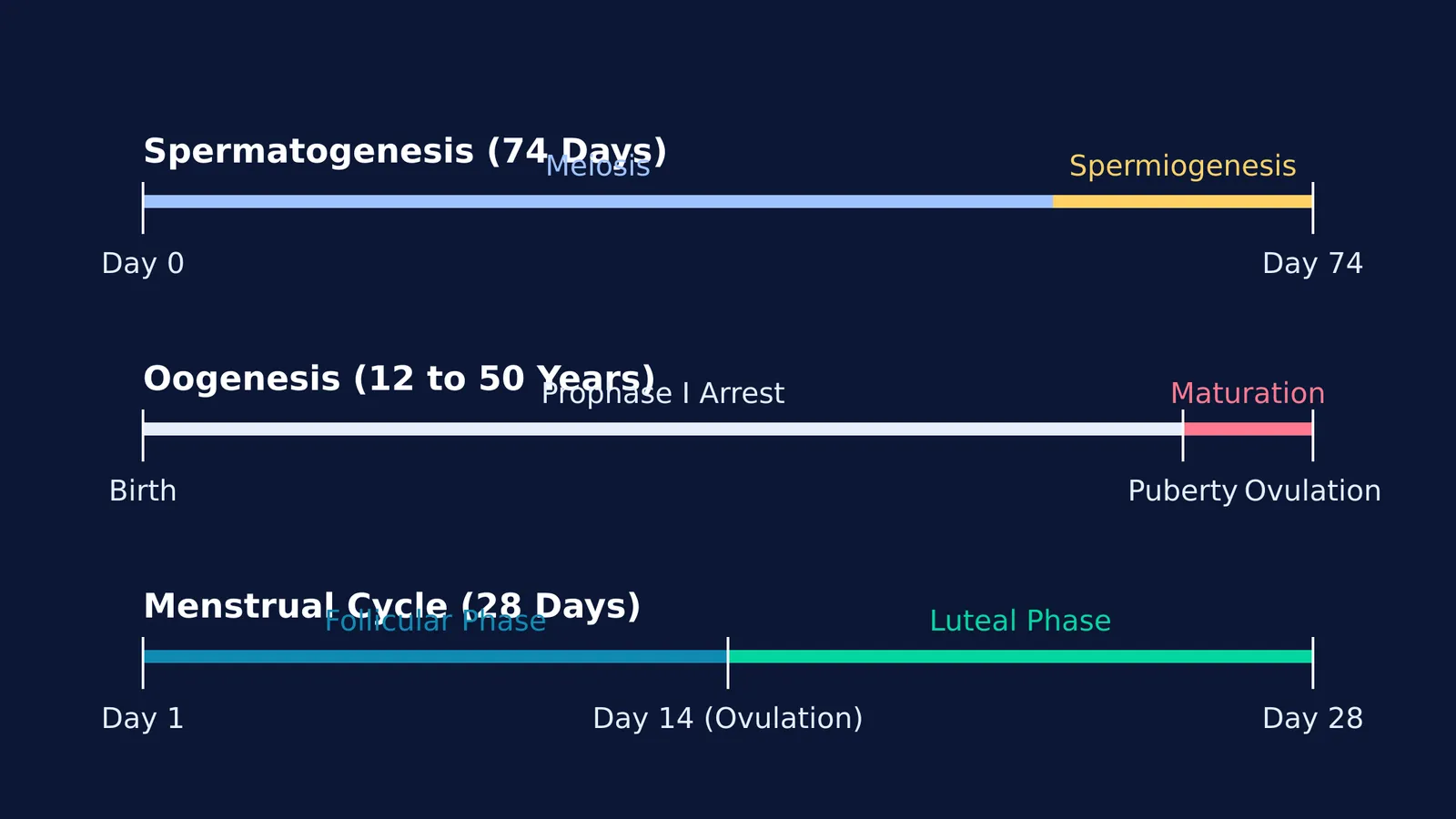
Spermatogenesis is the process of producing mature sperm cells in the testes. According to studies measuring cell development with tritium-labelled biopsies, human spermatogenesis takes approximately 74 days from start to finish (Spermatogenesis). While some modern DNA clock measurements suggest slight variations, the 74-day figure remains the standard textbook timeline.
Unlike oogenesis, the process begins at puberty and runs continuously throughout a healthy male's life. It starts when a diploid stem cell, the spermatogonium (2n), undergoes mitosis. The resulting primary spermatocytes then enter meiosis. Meiosis I produces two haploid secondary spermatocytes (n), and Meiosis II yields four haploid spermatids (n). In the final phase, called spermiogenesis, these round spermatids shed their excess cytoplasm and grow tails to become mature spermatozoa.
After completing this 74-day journey in the seminiferous tubules, the sperm are not yet ready for fertilisation. Including transport and maturation through the highly coiled epididymis, the entire process takes approximately three months.
If you ask the AI tutor to trace this out, it can help you map the exact hormonal triggers. You will see how gonadotropin-releasing hormone (GnRH) prompts the anterior pituitary to release luteinising hormone (LH) and follicle-stimulating hormone (FSH). These hormones then drive testosterone production and initiate sperm maturation on a constant, rolling schedule.
How many days does oogenesis take?
Oogenesis, the creation of an egg cell (ovum), operates on a timeline that is punctuated by massive delays. It begins before a female is even born and can take anywhere from 12 to 50 years to complete, depending on when a specific egg is ovulated (Oogenesis).
During foetal development, millions of oogonia divide and become primary oocytes. These cells begin meiosis but abruptly arrest in prophase I. They remain in this suspended state (the dictyate stage) throughout childhood. It is only at puberty that the biological clock restarts.
Once activated, the active phase of folliculogenesis—the maturation of the follicle surrounding the egg—takes several months to complete. The final, critical stretch of this maturation corresponds to the first half of a single menstrual cycle. Crucially, while meiosis I finishes just before ovulation, meiosis II is only completed if fertilisation actually occurs.
You can read more about what happens immediately after this final division in From fertilisation to implantation: the first week of pregnancy.
Can AI make a timeline of the menstrual cycle days?
Yes. The menstrual cycle averages 28 days in length, though healthy, normal cycles can range from 21 to 35 days (Menstrual cycle). This cycle perfectly overlaps with the final preovulatory weeks of oogenesis.
The Fermi Concept Library contains detailed lessons on these biological rhythms. You can use it to map the concurrent changes happening in the ovaries (the ovarian cycle) and the uterus (the uterine cycle) over those 28 days:
Days 1–5 (Menstrual Phase): The cycle begins with menstruation, which lasts for 2 to 6 days as the thickened uterine lining is shed if no pregnancy has occurred.
Days 1–13 (Follicular Phase): Driven by rising levels of FSH, a dominant follicle matures in the ovary. Simultaneously, estrogen secreted by the growing follicle prompts the uterine lining to proliferate and thicken.
Day 14 (Ovulation): A sharp, sudden surge in LH causes the mature Graafian follicle to rupture, releasing the egg into the fallopian tube.
Days 15–28 (Luteal Phase): The remnants of the ruptured follicle transform into the corpus luteum, which secretes progesterone. This hormone prepares the endometrium for potential implantation. If fertilisation does not happen, the corpus luteum breaks down, progesterone levels drop, and the cycle resets on day 28.
Understanding how these chemical signals coordinate is complex. You can review How hormones act: membrane receptors vs intracellular receptors to understand cellular signalling, or explore Hormonal feedback loops: how the body keeps hormone levels steady to see how estrogen and progesterone keep the 28-day cycle running.
By laying out spermatogenesis (74 days), the menstrual cycle (28 days) and the active phases of oogenesis side by side, the intricate biology of human reproduction becomes a clear, logical sequence.


