

On this page
Most practice asks you to produce an answer. Exams also ask something quieter: can you tell when your own answer is wrong? You can train that second skill on purpose. Ask an AI chatbot to write a full worked solution with one mistake planted in it, find the mistake yourself, and only then check the key.
What is spot-the-error practice?
Researchers call these erroneous examples: step-by-step problem solutions with one or more errors for students to find and fix, as defined by McLaren, Adams and Mayer in the International Journal of Artificial Intelligence in Education.
In their study, 390 middle-school students learned decimals either by finding, explaining and fixing errors or by solving the same problems and explaining their solutions (McLaren et al., 2015). The two groups did not differ on the immediate test, but on a delayed test a week later the error-finding group did significantly better. The problem-solving group reported liking their version more: liking a method and learning from it are different things.
The evidence has limits. A 2025 systematic review of 40 studies found that erroneous examples can help, but the benefit depends on how errors are explained, how prompts are designed and what the learner already knows (Dieterich, Rumann and Rodemer, Educational Psychology Review). The same review warns that prompts to find, explain and correct errors may tip into overload when the material is complex, so start with chapters you have already studied.
How do you get an AI to plant one mistake?
Copy this prompt and paste in a problem from your textbook or a past paper:
"Write a complete worked solution to the problem below. Number every step. Put exactly one error in it: a wrong formula, a sign slip, a unit mistake or an arithmetic slip. Carry the error through to the final answer, as a student would. Do not mark it, hint at it or mention that there is an error. Do not show the answer key until I type KEY. Problem: [paste here]"
Three rules make it work:
Use a problem whose answer your textbook confirms, in case the AI gets its own key wrong.
Start with formula and sign errors in topics you are weak on.
Write your verdict (step, what is wrong, corrected answer) before you type KEY.
Can you find the error in this projectile solution?
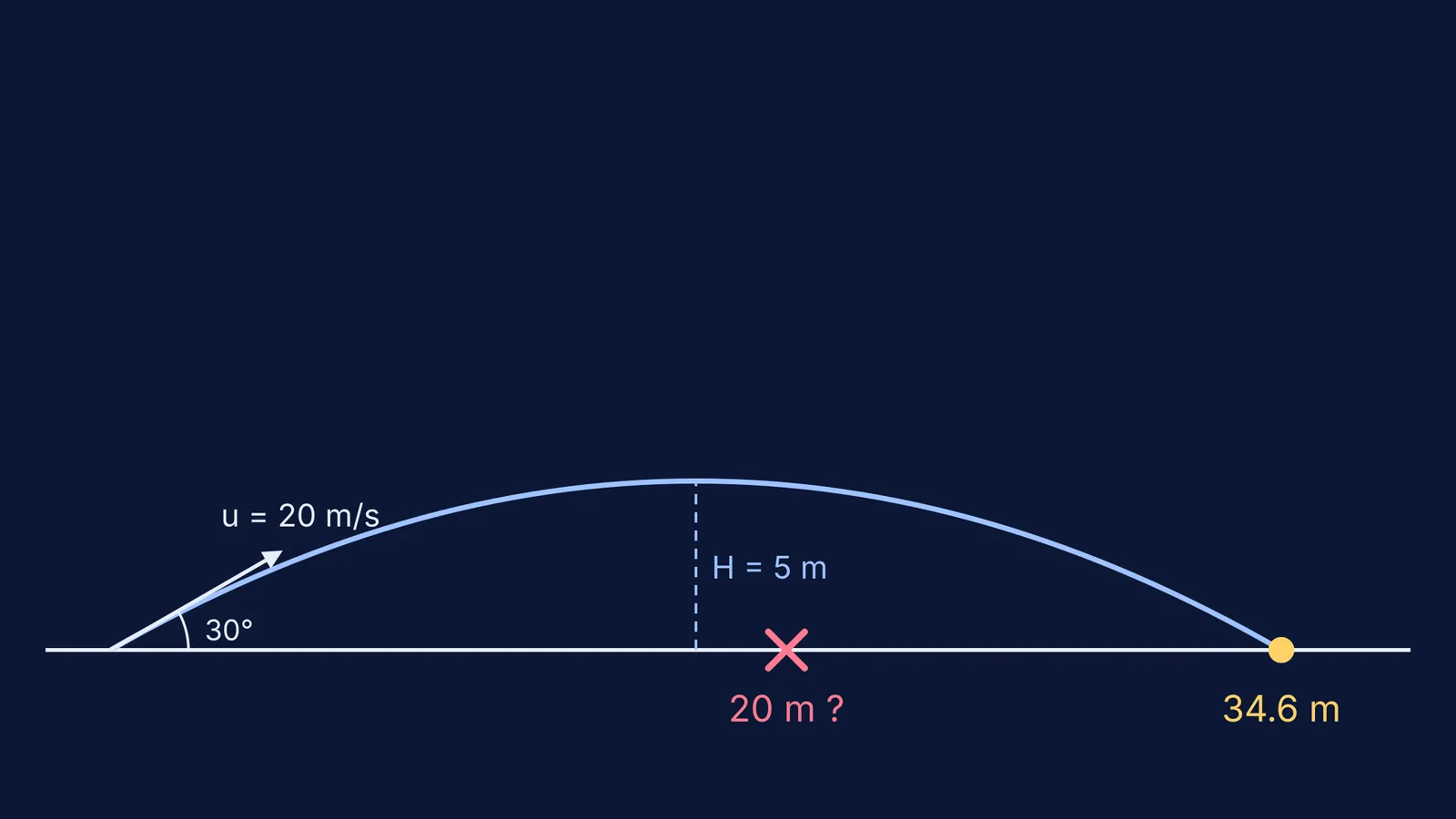
Try this one now. A ball is thrown from level ground at 20 m/s at 30° above the horizontal. Take g = 10 m/s². Find the time of flight, the maximum height and the range.
Horizontal velocity: ux = 20 cos 30° = 17.3 m/s.
Vertical velocity: uy = 20 sin 30° = 10 m/s.
Time of flight: T = 2uy/g = 2 × 10/10 = 2 s.
Maximum height: H = uy²/2g = 100/20 = 5 m.
Range: R = u² sin θ/g = 400 × 0.5/10 = 20 m.
Stop here and find it before reading on.
A dimensional analysis check would not catch this, because sine has no units. What catches it is a second, independent route: range equals horizontal speed times time of flight. That cross-check is the habit you are building.
What should you check when hunting for the error?
Go through every step with the same short list:
Formula: is it the right equation, with the right angle or term?
Signs: does each direction have the sign the setup demands?
Units: do both sides match, with values converted before use?
Arithmetic: redo each calculation, not just the last one.
Second route: can you reach the answer another way, or test a limiting case such as θ = 90°?
If your answer and the AI's key disagree, do not assume the AI is right. Read why AI chatbots get maths wrong and how to check them, then settle it from your textbook.
When the error you missed was a wrong method rather than a slip, compare it against a solution that shows its reasoning. The Fermi Problem Library has worked problems with a step-by-step solver that explains the reasoning rather than printing an answer, so you can see where the method should have gone.
How does this help in exams?
In an exam, nobody tells you there is an error. So once planted errors feel easy, change the prompt to "include zero or one errors". Now you must decide whether the solution is right at all, the judgement you make when you check your answers in the last 10 minutes of an exam.
A simple weekly plan:
Monday and Wednesday: two spot-the-error solutions each, from the chapter you finished last week.
Friday: three "zero or one errors" solutions from mixed chapters.
Sunday: list the error types you missed, and ask for more of those next week.
If you would rather have someone walk through a topic with you before you start hunting for errors, Fermi's AI tutor can work out what you already know and build a plan for the session.


