

On this page
You read a physics question three times and still cannot say what it wants. The sentence, not the formula, is the problem. The fix takes two minutes: let an AI chatbot untangle the wording, but not the solving.
Why does the wording of a physics question block you?
Often the difficulty is language, not physics. In a study in Cognitive Psychology, Cummins, Kintsch, Reusser and Weimer (1988)90011-4) found that children's "errors" on word problems were often correct solutions to miscomprehended problems, and that problems with abstract or ambiguous language were miscomprehended more often.
Physics questions add their own code words. "Released from" a moving object means the body starts with that object's velocity. "Smooth" means no friction. "Light string" means its mass is ignored. Miss one of these and you solve a different problem perfectly.
George Pólya put the first step plainly in How to Solve It: "You have to understand the problem. What is the unknown? What are the data? What is the condition?" Asking AI to rephrase is a way of answering those three questions when you are stuck.
How do you ask AI to rephrase a question without solving it?
Say clearly that you do not want the answer. Copy this, then paste the full question below it, word for word:
"Restate this physics question in plain words. Do not solve it and do not give any formula or answer."
"List what is given, with values and units, then what is asked, then any assumptions the question states."
"Do not add any number or assumption that is not in the text. If a word could mean two things, flag it instead of choosing."
If the question has a figure, the AI only knows what you tell it about the figure; our guide to asking AI about a photographed problem covers how to get that part right.
A worked example: the stone and the rising balloon
Here is a typical Class 11 question:
"A balloon is ascending vertically with a uniform velocity of 5 m/s. When it is at a height of 30 m above the ground, a stone is released from it. Taking g = 10 m/s², find the time taken by the stone to reach the ground."
A good restatement looks like this:
Given: the balloon moves straight up at a steady 5 m/s.
Given: the stone is let go when the balloon is 30 m above the ground.
Given: g = 10 m/s², and no air resistance is mentioned.
Flagged: "released from" a moving balloon means the stone starts with the balloon's velocity, 5 m/s upward, not from rest.
Asked: the time from release until the stone hits the ground.
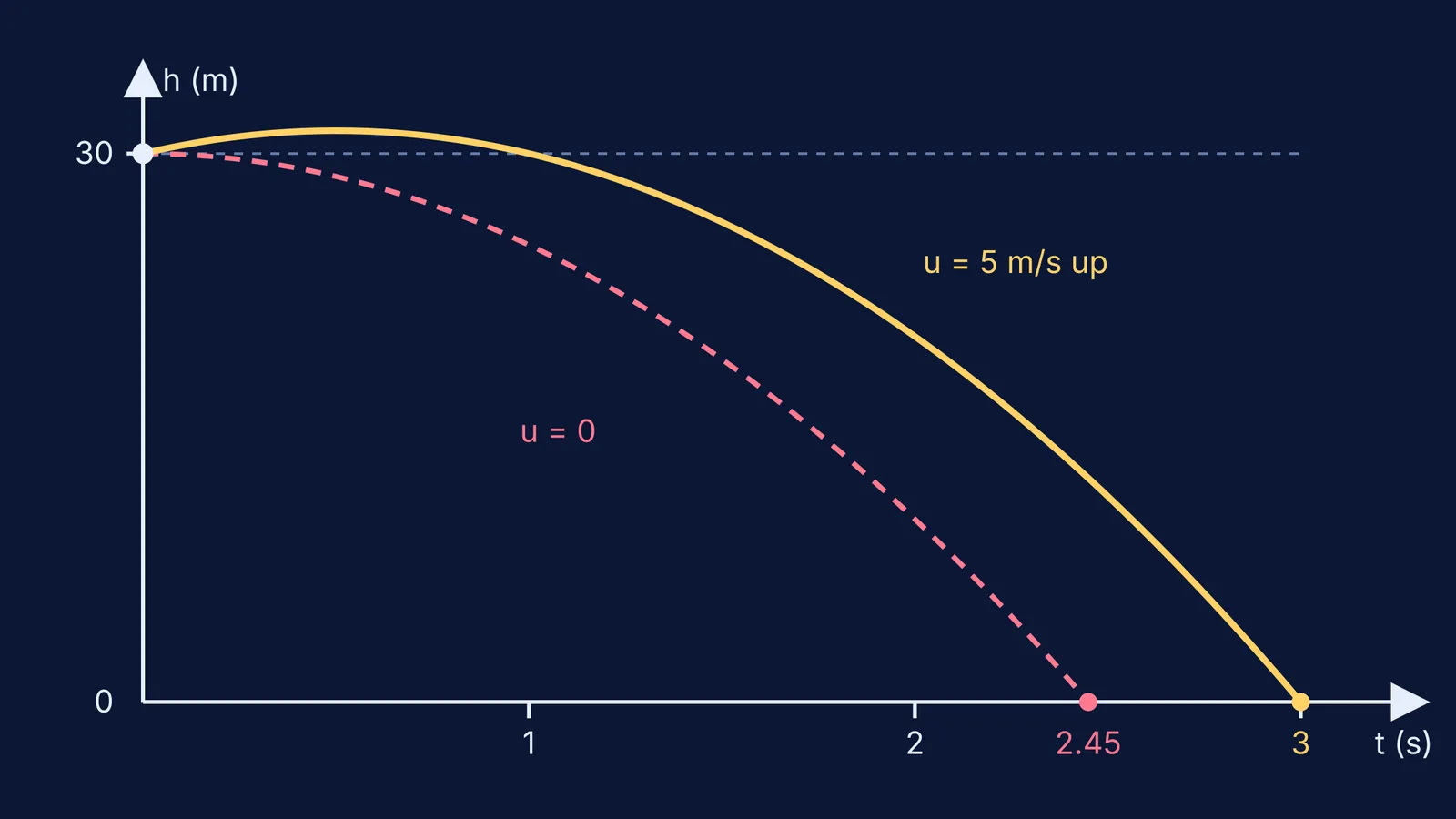
Suppose the AI had written "a stone is dropped from 30 m". Simpler, and wrong: it lost the starting velocity. Solve that version and you get about 2.45 s. Solve the real one and the stone first rises, then falls, landing at 3 s. The hero graph above shows both.
How do you check the AI did not add or drop anything?
AI models are sensitive to small changes in wording. Shi and colleagues (ICML 2023) found that large language models' accuracy on maths word problems dropped sharply when irrelevant information was added to the problem. In Apple's GSM-Symbolic study, adding one seemingly relevant but unneeded clause caused performance drops of up to 65% across the models tested. A rephrasing can slip in the same way, so check it against the original:
Numbers: every value in the question appears in the list, and every value in the list appears in the question.
Units: cm stayed cm, km/h was not quietly turned into m/s.
Direction and state words: up, down, horizontal, at rest, released, smooth, light, uniform are all still there.
The question asked: time stayed time; "distance" did not become "displacement".
Nothing new: no extra assumption such as g = 9.8 m/s² or "assume it starts from rest".
If a line fails, quote the phrase and ask the AI to fix only that item. For checking a full solution later, see how to check an AI's physics solution, and for more prompts of this kind, ChatGPT prompts for physics that make you think.
What if the question still makes no sense after rephrasing?
Then the gap is probably a concept, not the wording. If "released from a moving balloon" still feels strange, you need the idea of relative motion, not a cleaner sentence. Fermi's AI tutor notices where you are stuck and decides whether to explain, ask or show, drawing the figure as it goes. When you are ready to try the solving, the Fermi Problem Library has worked problems with a step-by-step solver that explains the reasoning rather than printing an answer.
Next time a question stops you: three-line prompt, five checks, then your pen.


